Well that was interesting.
I'd read before that the N95 rating meant that it only filtered 95% of particles.
I confirmed that, so no, that N95 filter shown, nor any N95 particle filter, does not provide "complete and total filtration".
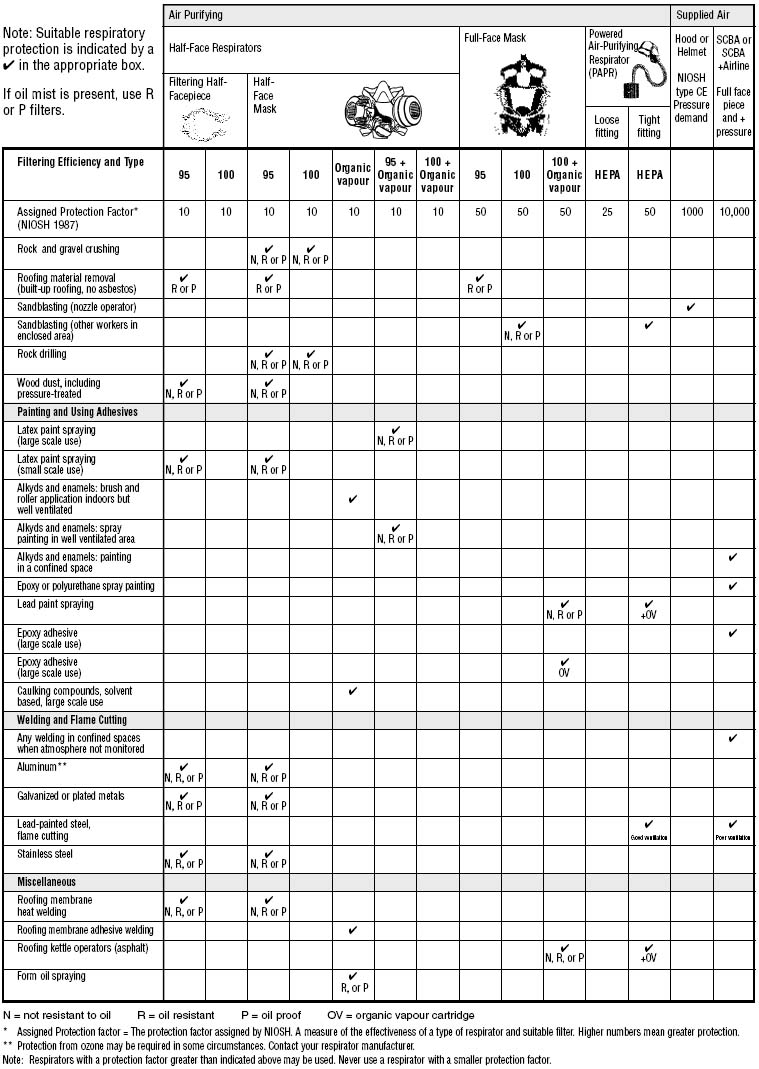
Respirators are rated “N” if they are not resistant to oil, “R” if somewhat resistant to oil, and “P” if strongly resistant (oil proof).
In the type N, there's N95, N99, or N100, filtering in turn 95%, 99% and 100% (99.97%).
The link provided goes to a model 9211, which now sports a different appearance than the embedded photo. It appears to be the best of the half-face Respirator Masks that I've ever seen, with many features of fit and airflow that should make it a good choice for playa use. Worth checking out if you have issues with playa dust.
A doctor on-playa once told me that the surgical masks she saw so many people wearing were useless against the bulk of playa dust. What I found out explains why.
I found these sources. There's a lot there.
http://www.cdc.gov/niosh/npptl/topics/r ... are.html#e
http://blogs.cdc.gov/niosh-science-blog/2009/10/n95/
The parts I found interesting, include:
On surgical masks:
Surgical masks are not designed for use as particulate respirators and do not provide as much respiratory protection as an N95 respirator. Surgical masks provide barrier protection against droplets including large respiratory particles. Most surgical masks do not effectively filter small particles from the air and do not prevent leakage around the edge of the mask when the user inhales.
Collection efficiency of surgical mask filters can range from less than 10% to nearly 90% for different manufacturers’ masks when measured using the test parameters for NIOSH certification.
The FDA, in part, accepts the NIOSH filter efficiency and breathing resistance test results as exceeding the usual surgical mask requirements.
on NIOSH-Approved Particulate Filtering Facepiece Respirators:
Whether the goal is to prevent the outward escape of user-generated aerosols or the inward transport of hazardous airborne particles, there are two important aspects of performance. First, the filter must be able to capture the full range of hazardous particles, typically within a wide range of sizes (<1 to >100 µm) over a range of airflow (approximately 10 to 100 L/min). Second, leakage must be prevented at the boundary of the facepiece and the face.
the most important aspect of a NIOSH-certified respirator’s performance will be how well it fits to the face and minimizes the degree of leakage around the facepiece. This must be measured for each individual and their selected respirator.
It is more difficult to fit a half-facepiece respirator (one that covers the mouth and nose only) than a full-facepiece respirator (one that also covers the eyes).
all particulate filters used in NIOSH-certified respirators, including N95s, are designed and engineered to provide very high levels of particle collection efficiencies
perhaps the most misunderstood aspect of filter performance and bears repeating. Filters do NOT act as sieves. One of the best tests of a filter’s performance involves measuring particle collection at its most penetrating particle size, which ensures better performance for larger and smaller particles. Further, the filter’s collection efficiency is a function of the size of the particles, and is not dependent on whether they are bioaerosols or inert particles.
Given the particle size distribution of Black Rock Playa soils:
Particle Size, Weight Percent
Clay < 3 um, 65.3%
Silt 3 to 15 um, 21.2%
Silt 15 to 62.5 um, 10.4%
Sand > 62.5 um, 3.1%
It appears that any NOISH rated particle filter should be filtering the dust from the playa, with N95, N99 and N100 being good, better and best.
But your performance will likely depend on the comfort level of the model of facepiece you choose, with particular effectiveness dependent on how well it fits you.
p.s.
I still think the
Playa-Tested©)'( thick cotton bandana and the shemagh are good choices.








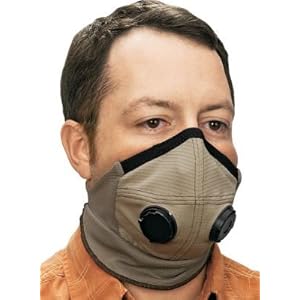
 Not sure if I'm allowed to post the link to these, but if you search for "ATV Tek Pro Series Rider Dust Mask" they are easy enough to find. I did the XL, user feedback was that the mediums are too small for most ppl.