

I read the link you posted. It said nothing about hybrid cars.
And yes, my Prius gets 50 MPG when I actually drive it consciously (there are 4 levels of the gas pedal - regen, neutral, electric, gas). Normally, I get about 46-48 when I'm rushing around & drive it like a 'regular' car. There are plenty of folks who get far better than 50 though. I just don't obsess over it as much as they do. Although I am looking into putting a damper in the grille, which holds more heat in during the winter. This will lessen the amount of time the engine needs to heat up to optimal temp.
Global Cooling
-
neon tetra

- Posts: 408
- Joined: Tue Sep 21, 2010 5:49 pm
-
dr.placebo

- Posts: 980
- Joined: Mon Sep 13, 2004 3:03 pm
- Burning Since: 1999
- Camp Name: Cleu Camp
- Location: Volcano, HI
- Contact:
The problem with using "natural variability" as an explanation for the warming since 1975 is that we have not seen any natural trend that has been driving the warming in that time. The natural influences we do see have a small cooling effect on average during that time.
We do see human influences, though. We do measure CO2 levels rising, and it is traceable to human use of fossil fuels and deforestation. We do see other effects, some warming and some cooling, that are due to human activities. And the scientific opinion is heavily that the balance is towards warming from mostly human causes. The scientists are not ignoring the oceans, they know that the oceans are the major heat sinks.
Saying that it has to be natural because it has always been natural ignores the possibility, even the likelihood, that this time it is different. Humans are finally numerous enough, finally using enough fossil fuel, and finally cutting down enough trees fast enough to make a difference.
The notion that there is no evidence is ignoring the massive amount of data that has resulted from climate studies. I 'm quite willing to say that less than 100% of the data are solid, but for me it all follows the normal pattern for scientific credibility: multiple methods yielding multiple results from competing groups.
We do see human influences, though. We do measure CO2 levels rising, and it is traceable to human use of fossil fuels and deforestation. We do see other effects, some warming and some cooling, that are due to human activities. And the scientific opinion is heavily that the balance is towards warming from mostly human causes. The scientists are not ignoring the oceans, they know that the oceans are the major heat sinks.
Saying that it has to be natural because it has always been natural ignores the possibility, even the likelihood, that this time it is different. Humans are finally numerous enough, finally using enough fossil fuel, and finally cutting down enough trees fast enough to make a difference.
The notion that there is no evidence is ignoring the massive amount of data that has resulted from climate studies. I 'm quite willing to say that less than 100% of the data are solid, but for me it all follows the normal pattern for scientific credibility: multiple methods yielding multiple results from competing groups.
-
ygmir

- Posts: 30403
- Joined: Thu Sep 20, 2007 8:36 pm
- Burning Since: 2007
- Camp Name: qqqq
- Location: nevada county
one of the questions for me, is:
will it matter?
unless, any warming, or cooling, that occurs, goes far out of "norms" for those sorts of things, will the earths natural balancing mechanisms just kick in and begin moderating the effects?
In other words, if this "man made" warming spikes at or near any other historical warming trend, it would seem the other factors, that regulate temps, will be able to overcome it, anyway.
Unless, of course, those mechanisms, are somehow interfered with.
will it matter?
unless, any warming, or cooling, that occurs, goes far out of "norms" for those sorts of things, will the earths natural balancing mechanisms just kick in and begin moderating the effects?
In other words, if this "man made" warming spikes at or near any other historical warming trend, it would seem the other factors, that regulate temps, will be able to overcome it, anyway.
Unless, of course, those mechanisms, are somehow interfered with.
YGMIR
Unabashed Nordic
Pagan
Unabashed Nordic
Pagan
-
geekster

- Posts: 4865
- Joined: Wed Sep 08, 2004 2:53 pm
- Location: Hospice For The Terminally Breathing
- Contact:
PDO. There was a cooling trend from the 1940's to 1975. From 1975 to about 2005 we had a warming trend. Actually, it has been flat, no trend since about 2000. We should see another 30 yea-ish cooling trend as we saw from about 1940 to about 1975. The PDO operates on a 60 year cycle (roughly, it can go 5 or so years either way in any given cycle) and plays a huge role in global climate. The pacific is a pretty large portion of the Earth's surface and things that happen there tend to influence large land areas, too.dr.placebo wrote:The problem with using "natural variability" as an explanation for the warming since 1975 is that we have not seen any natural trend that has been driving the warming in that time. The natural influences we do see have a small cooling effect on average during that time.
The cooling trend in North America, for example, since 1998 is about -0.9F per decade.
True. But there is actually no indication except from computer models that this rise will have any impact on temperatures. When CO2 was rising the fastest in relative terms, from the 1940's to the mid 1970's, global temperatures were cooling. There is no demonstrated link between human CO2 emissions and temperature change so far. Observational data have not matched the model forecasts and, in fact, different models give different results.We do see human influences, though. We do measure CO2 levels rising, and it is traceable to human use of fossil fuels and deforestation.
Of course. Land use changes can very drastically change local conditions but to what extent that has any bearing on global climate has not yet been demonstrated. There is a lot of playing with numbers going on and projecting of changes in one area as being changes of wider scope. The recent debunking of the Steig et al paper is one example where changes on the West Antarctic peninsula were "smeared" across the entire continent by using changes in one area to "adjust" temperatures in another. This makes things appear different than they really are.We do see other effects, some warming and some cooling, that are due to human activities.
According to Georgia Tech, 50% of the "global temperature change" has been due to local land use changes, not due to any change in CO2 emissions. Cutting a forest to plant a field raises the local temperature. Irrigating a desert raises the local temperature (reduces daytime temperature but increases nighttime temps). And no, that is not from Dr. Curry, that is from City and Regional Planning Professor Brian Stone.
Also, be careful of other manipulations of data. For example, lets say I have an area that was rural. Now I have two cities in that area. Because of the urban heat island effect, temperatures local to those two urban areas will be higher. Now someone taking an "average" over the entire region will report that the global average temperature has increased when actually there has been no change in global climate and instead there has been very localized changes in specific areas but when added to the global average do, in fact, cause that average to increase. But the rural areas outside of the urban areas may actually have no different climate than they had before. The "global climate" was not changed.
It is like having a room full of people. You replace two of them with people who are much taller, take an average of the population, and report that the average height of the people in the room increased. While that is true, only two of the actually changed, the change wasn't global in scope across the entire population.
And the scientific opinion is heavily that the balance is towards warming from mostly human causes.
uhm, much less heavily than it was, say two years ago. There are now 1000 scientists who have signed up against the IPCC findings. In fact, many of the assumptions of CO2 impact itself are now coming under question and there is a growing consensus that the impact of CO2 on temperature change has been greatly exaggerated. One of the more recent discussions (within the past week) is here:
http://judithcurry.com/2010/12/11/co2-n ... nsitivity/
Of course they are. I don't understand what you are saying in that sentence because everyone knows that the majority of the heat in the climate system is in the oceans, not the atmosphere and ARGO is showing a slow decline in ocean temperatures at depth since 2004.The scientists are not ignoring the oceans, they know that the oceans are the major heat sinks.
That is what you read, not what I meant. Maybe I wasn't clear. The point is that temperatures can naturally trend by a degree or more per decade. If you see a trend of rising temperatures (or falling temperatures) of a degree per decade, it is not outside the normal natural changes. Also, the warming seen since 1975 correlates exactly to the change from PDO cool to PDO warm, exactly the same transition that has resulted in exactly the same rate of temperature change over the same length of time in the past. 1998 peak temperatures did not exceed 1933 temperatures. 2010 temperatures during the large el nino event did not exceed those of 1998. Overall, the trend is still cooling. Yes, we have long cycles of warming and cooling, but the trend over the past 2000 years has been relentless cooling. The Roman Warm Period was warmer than the Medieval Warm Period. The Medieval Warm Period was warmer than the Modern Warm Period. The Little Ice Age was colder than the Dark Ages Cool Period. But superimposed in those are regular 60-year cycles of warming and cooling driven, apparently, by the Pacific Decadal Oscillation. The Atlantic also has its own cycle but it is a smaller body of water and has less impact. Also, the tropical Atlantic is closed off by the Isthmus of Panama which shortens the equatorial transit of the water because it hits land and then turns North and transits out of the equatorial region and gives up its heat.Saying that it has to be natural because it has always been natural ignores the possibility, even the likelihood, that this time it is different.
That is a religious statement, not one based on fact. That is a statement of faith. First you assume net deforestation of the planet. That is not happening. Yes, there are some areas that are being deforested at a rapid rate but overall, the number of trees on the planet is increasing. How many trees existed in the 17th century in what is now Grand Island, Nebraska? How many trees exist there now? Same with Phoenix? In the early 19th century, nearly the entire Santa Cruz mountain region was completely clear cut to rebuild San Francisco after the great Earthquake. Those forests have recovered. At around the same time nearly the entire upper Midwest was completely clear cut, those forests have recovered. Same with the forests in the Eastern US. If you get up above the tree canopy in suburban Fairfax County, Virginia the place is a virtual forest. 100 years ago, that area was plowed fields.Humans are finally numerous enough, finally using enough fossil fuel, and finally cutting down enough trees fast enough to make a difference.
And again, there is still no evidence that the CO2 emissions from fossil fuel burning has actually influenced climate at all. That is also a religious statement based on "belief" and not on any actual facts. There is absolutely no evidence that we have experienced anything at all out of the ordinary or of greater trend or magnitude than naturally occurs. There is growing consensus that we might not be capable of injecting enough CO2 into the atmosphere to make a difference. For one thing, the more you put in, the faster it comes out!
Also, across geological time, just before the start of the industrial area, the Earth's CO2 was at an all time low for the planet. Never before had Earth had such a small amount of CO2 in the atmosphere. All of the coal, oil, shale, slate, limestone, marble, etc. is CO2 taken from the air. That process is relentless and never stops. Earth's CO2 levels were over 5x today's levels when most modern plant and animal species evolved and were 100x higher for some of them (species like Araucarias, for example).
When you show me the evidence, I will believe it, but to date there isn't any. Yes, climate has warmed since 1976. I also expect it to cool for the next 30 years. And this cooling might actually be a doozy because we have three things all lined up at the same time: 1. Pacific Decadal Oscillation has switched negative. 2: Atlantic Oscillation has switched negative at the same time. 3: An extremely weak solar cycle which has in the past resulted in climactic cooling (the most recent example being the Dalton Minimum). I expect global temperatures to drop at least 2C over the next 30 years and possibly 3C while CO2 continues its (mostly) linear increase.The notion that there is no evidence is ignoring the massive amount of data that has resulted from climate studies.
And finally, if CO2 were *really* all that dire of an emergency, we have ways right this very minute to generate all the electricity the world needs without burning a spec of fossil fuel and without changing lifestyle one iota. The fact that we have not undergone a massive nuclear electrification program (like China is, for example) is testament to the fact that it just isn't that big of an "emergency". In fact, the recent revelation that this has pretty much been nothing more than a "hook" to get people to buy into "global redistribution of wealth" by imposing CO2 limits on certain countries and intentionally not imposing those limits on other countries in order to shift industrial development to those areas is further evidence that it is basically a game.
http://thegwpf.org/ipcc-news/1877-ipcc- ... ealth.html
Do you realize the costs involved in all of this and how little difference it makes? Did you read what I posted above? You could eliminate *the entire UK* from the planet and the difference would take 12 months to make up. So reducing CO2 emissions by the UK by some 1 or 2 or 10% is going to cost billions and not make any measurable difference whatsoever. It doesn't change anything. It is a waste of money. If you want to change something, engage in a massive nuclear electrification program and recycle the spent fuel. We could do it right now if it was really about CO2, but it isn't.
Pabst Blue Ribbon - The beer that made Gerlach famous.
-
geekster
- Posts: 4865
- Joined: Wed Sep 08, 2004 2:53 pm
- Location: Hospice For The Terminally Breathing
- Contact:
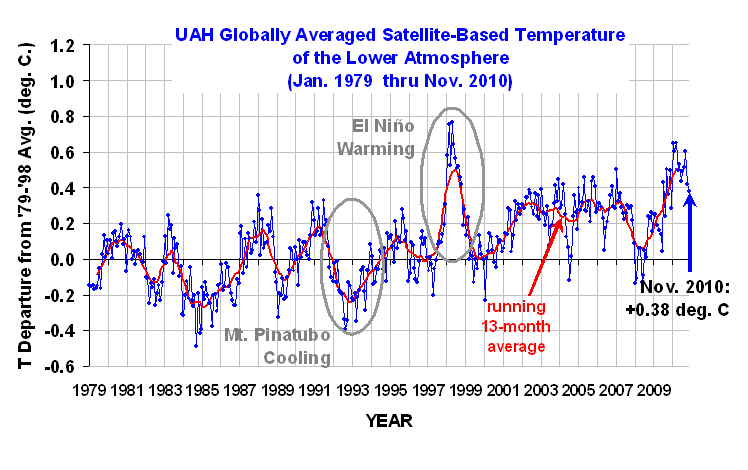
Temperatures were generally flat in trend from 1979 until the huge el nino event of 1998. Temperature then made a step up and has been flat with another large el nino this year but not as strong as the 1998 event. Notice the very strong la nina event in 2008. We will see more of those and are in one right now:

Note the steady down trend in Nino34 surface temperatures since 1979. Now look at the Northern Hemisphere:

Notice the trend reversal in 2005.
But lets look more closely. Here is the North Pacific:

We see a pretty steady down trend in temperatures since 2005. But the North Atlantic looks quite different ... sort of ...

There is a clear down trend starting in 2004 but this year's el nino event was quite visible in the North Atlantic and North Atlantic temperatures got even higher than 1998 but are currently rapidly falling again though there is a significant heat anomaly in the far North Atlantic that has yet to work its way out but will over the coming couple of years. The Gulf of Mexico and the Gulf Stream are currently cooler than normal and over time this will have its impact on the North Atlantic over the coming months/years.
Pabst Blue Ribbon - The beer that made Gerlach famous.
-
geekster
- Posts: 4865
- Joined: Wed Sep 08, 2004 2:53 pm
- Location: Hospice For The Terminally Breathing
- Contact:
One other strong indication that CO2 is not having its modeled impact is temperatures at the South pole. During winter, the air is very dry and there are few clouds, and as there is no sunshine for half the year, CO2 has its greatest greenhouse impact at that point and at that time. As there is the lowest impact of H2O greenhouse insulation, an increase in atmospheric CO2 would be expected to be seen most strongly in winter low temperatures at the poles.
The temperature trend at the South pole is down. It has been getting colder, not warmer, in the winter at the South Pole station (and Antarctic ice cover is at record highs). There has been significant "warming" on the West Antarctic peninsula but this is attributed to a change in predominate wind direction bringing winds in off the Southern Ocean rather than from inland has they had been before when the "normal values" were set.
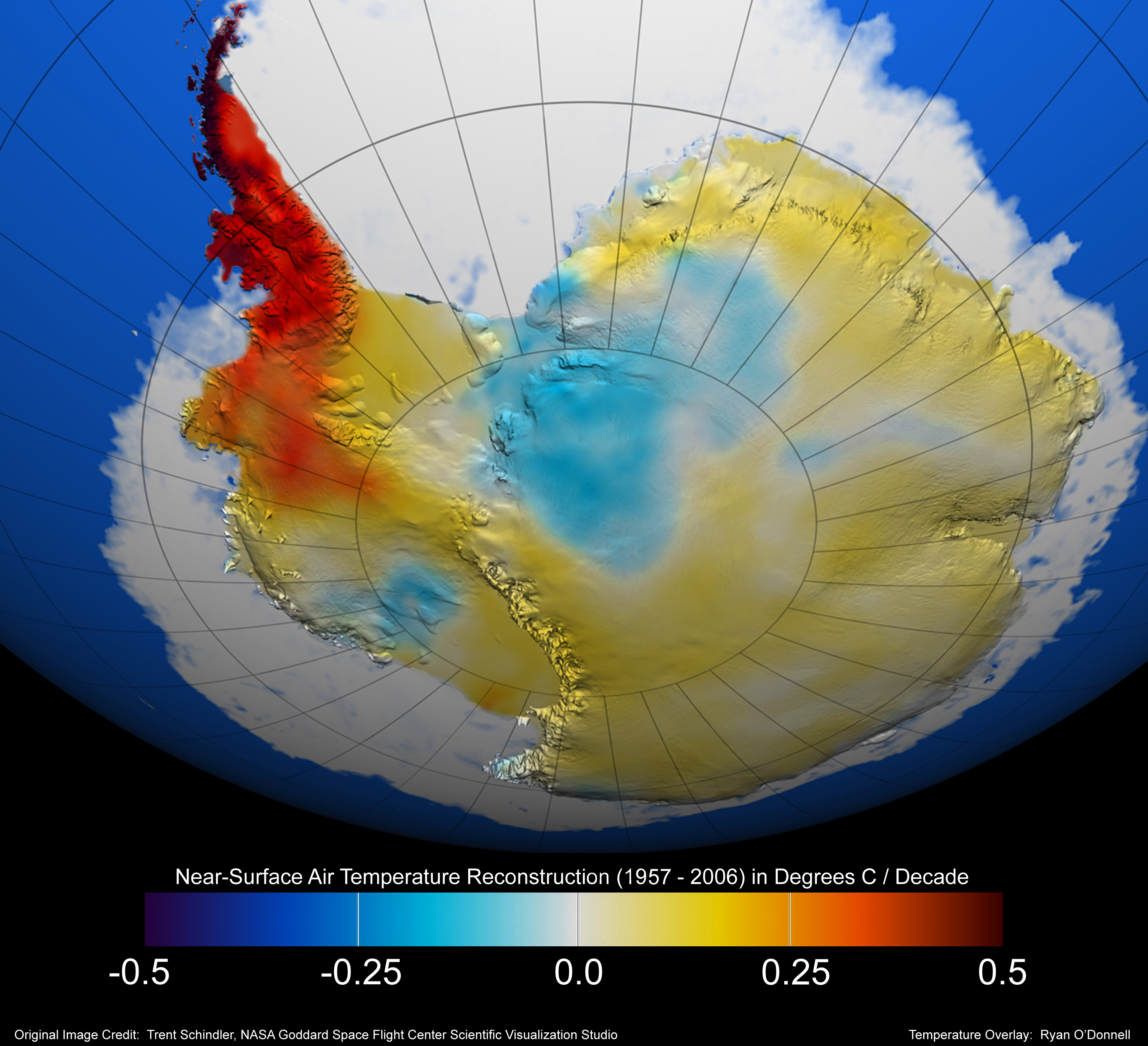
So again, we have temperature change explained by a natural variation in long term weather patterns and no indication that CO2 is having any impact on temperatures anywhere on the planet.
[youtube][/youtube]
The temperature trend at the South pole is down. It has been getting colder, not warmer, in the winter at the South Pole station (and Antarctic ice cover is at record highs). There has been significant "warming" on the West Antarctic peninsula but this is attributed to a change in predominate wind direction bringing winds in off the Southern Ocean rather than from inland has they had been before when the "normal values" were set.
So again, we have temperature change explained by a natural variation in long term weather patterns and no indication that CO2 is having any impact on temperatures anywhere on the planet.
[youtube][/youtube]
Pabst Blue Ribbon - The beer that made Gerlach famous.
-
geekster
- Posts: 4865
- Joined: Wed Sep 08, 2004 2:53 pm
- Location: Hospice For The Terminally Breathing
- Contact:
Continental US temperatures 1998 to today. Most recent 12-month period (October previous year - November current year).

Trend is -0.9F/decade or about -9F/century. If it keeps up at that rate, we will be in another ice age in only a few decades, but it won't.

1930 to 1980. Temperature trend -0.2F/decade

CO2 increase. Note the spike in 1998 during el nino. Warming ocean outgases CO2. Abyssal ocean probably still outgasing CO2 as it warms from the LIA. Granted, we do add a lot of CO2 from fossil fuel, not saying we don't, but Earth adds a lot, too.
Trend is -0.9F/decade or about -9F/century. If it keeps up at that rate, we will be in another ice age in only a few decades, but it won't.
1930 to 1980. Temperature trend -0.2F/decade
CO2 increase. Note the spike in 1998 during el nino. Warming ocean outgases CO2. Abyssal ocean probably still outgasing CO2 as it warms from the LIA. Granted, we do add a lot of CO2 from fossil fuel, not saying we don't, but Earth adds a lot, too.
Pabst Blue Ribbon - The beer that made Gerlach famous.
-
geekster
- Posts: 4865
- Joined: Wed Sep 08, 2004 2:53 pm
- Location: Hospice For The Terminally Breathing
- Contact:

So basically, no observable trends over Antarctica as a whole but significant local trends that overall tend to cancel each other out.
But note that even 20 degrees of warming would not result in any significant ice melt as the South Pole station sits on top of 10,000 feet of ice and does not generally reach within 20 degrees of the melting point of ice. It did once, though, when the high temperature reached an all time record on December 27, 1978 of −13.6 °C but the record low was five years later in 1983 of -128.6F
So no evidence of any warming let alone any greenhouse warming.
Pabst Blue Ribbon - The beer that made Gerlach famous.
-
can't sit still
- Posts: 4645
- Joined: Tue Aug 23, 2005 4:21 pm
- Location: SoCal
This is just getting TOO FUNNY for words. Every time that they have a global warming conference, the conference locale tuns colder than hell. They decided not to risk a northern locale this year after all the previous freezes. Cancun looked safe.
http://wattsupwiththat.com/2010/12/09/g ... in-cancun/
Cancun had a record low that was 14 degrees below the mean. I've driven there several times and it was never chilly. Like the article says "God has a sense of humor"
Geekster, after reading your "Coup de Grace, remind me not to get on the wrong side of a debate with you.
http://wattsupwiththat.com/2010/12/09/g ... in-cancun/
Cancun had a record low that was 14 degrees below the mean. I've driven there several times and it was never chilly. Like the article says "God has a sense of humor"
Geekster, after reading your "Coup de Grace, remind me not to get on the wrong side of a debate with you.
I don't post things because I believe that they are the absolute truth. I post them because I believe that they should be considered.
-
geekster
- Posts: 4865
- Joined: Wed Sep 08, 2004 2:53 pm
- Location: Hospice For The Terminally Breathing
- Contact:
More priceless news:
http://www.worldclimatereport.com/index ... g-revival/About 15 to 20 years ago, folks began to notice problems in amphibian communities around the world. At first, physical deformities were being noticed and then large population declines were being documented.
The finger was initially pointed at the coal industry, with an idea that perhaps mercury was leading to the deformities. But this didn’t pan out. Next, farm practices came under fire, as excess fertilizer running off into farm ponds became the leading suspect. But that theory didn’t hold water either. Then, attention turned to the ozone hole, with the idea that increased ultraviolet radiation was killing the frogs. No luck there either.
Then came the Eureka moment—aha, it must be global warming!
This played to widespread audiences, received beaucoup media attention and, of course, found its way into Al Gore’s An Inconvenient Truth.
But, alas, this theory, too, wilted under the harsh glare of science, as new research has now pretty definitively linked an infection of the chytrid fungus to declines, and even local extinctions, of frog and toad species around the world.
Perhaps the biggest irony in all of this, is that while researchers fell all over themselves to link anthropogenic environmental impacts to the frog declines, turns out that as they traipsed through the woods and rainforests to study the frogs, the researchers themselves quite possibly helped spread the chytrid fungus to locations and populations where it had previously been absent.
Now a bit good—although hardly unexpected—news is coming out of the frog research studies. Some frog populations in various parts of the world are not only recovering, but also showing signs of increased resistance—gained through adaptation and/or evolution—to the chytrid fungus.
Thus opens a new chapter in the ongoing Disappearing Frog saga, and one that likely foretells of a hoppy ending.
Pabst Blue Ribbon - The beer that made Gerlach famous.

Most issues with fluorescents have to do with lighting distribution, not the source.
You might be sensitive to color balance and accuracy too.
Cool white and warm white are horrendously poor sources.
Full spectrum is now reasonable to cheap.
I like the philips colortone 7500K for standard 40 watt tubes.
I find I see better with better color.
There are more choices in the newer tube formats.
PLS should b particularly high quality with the right tube.
Daylight disposables are a sometimes cheap starter approach.
Walmart has led the way with a $7 pair of cheap ge daytlights in 26 watts at 6500K.
H depot has a pair that came out at $5, then raised to $6, in a 5000K.
I prefer the ge, but the other is decent.
Better units are worth the money, but the cheap ones are useful.
Panasonic makes an excellent bulb.
I prefer to bounce them off a white ceiling and walls.
LEDs are still poor in color accuracy compared to fluorescents, and wildly inefficient by comparison, with the exception of use in optics and certain special uses such as low wattage and extreme cold.
Cost isn't even close either.
You might be sensitive to color balance and accuracy too.
Cool white and warm white are horrendously poor sources.
Full spectrum is now reasonable to cheap.
I like the philips colortone 7500K for standard 40 watt tubes.
I find I see better with better color.
There are more choices in the newer tube formats.
PLS should b particularly high quality with the right tube.
Daylight disposables are a sometimes cheap starter approach.
Walmart has led the way with a $7 pair of cheap ge daytlights in 26 watts at 6500K.
H depot has a pair that came out at $5, then raised to $6, in a 5000K.
I prefer the ge, but the other is decent.
Better units are worth the money, but the cheap ones are useful.
Panasonic makes an excellent bulb.
I prefer to bounce them off a white ceiling and walls.
LEDs are still poor in color accuracy compared to fluorescents, and wildly inefficient by comparison, with the exception of use in optics and certain special uses such as low wattage and extreme cold.
Cost isn't even close either.
There are conversion kits for standard 40 watt fixtures that convert to an electronic ballast and a newer style narrow tube, even in high output.
HO and VHO work in severe cold quite easily.
Many warehouses are lit with nothing else but these tubes now, replacing HID like metal halide.
The newer light sources like plasma are still too costly, in spite of a long life.
Many 12 VDC and 24 VDC fixtures and disposables are available.
Some are still usa made, like U-lite-it.
HO and VHO work in severe cold quite easily.
Many warehouses are lit with nothing else but these tubes now, replacing HID like metal halide.
The newer light sources like plasma are still too costly, in spite of a long life.
Many 12 VDC and 24 VDC fixtures and disposables are available.
Some are still usa made, like U-lite-it.
-
can't sit still
- Posts: 4645
- Joined: Tue Aug 23, 2005 4:21 pm
- Location: SoCal
geekster, you can check frogs off the list but, bats and bees are now a huge problem. I suppose that the 'white-nose" problem will eventually work it's way out but, it's not a certainty. The bee problem is just getting worse.
Industry claims that the bat problem will necessitate a HUGE increase in pesticide. That certainly won't help the bees.
Keeping an overall perspective, one must remember that the "Homo" line diverged from the other apes about 3 million years ago. Neanderthal made it through all this time right up to the last 35,000 years. There were a few other Homo lines,,, maybe even a hobbit. ALL the homo lines died out except for ours. Maybe we need to be a bit more careful.
Industry claims that the bat problem will necessitate a HUGE increase in pesticide. That certainly won't help the bees.
Keeping an overall perspective, one must remember that the "Homo" line diverged from the other apes about 3 million years ago. Neanderthal made it through all this time right up to the last 35,000 years. There were a few other Homo lines,,, maybe even a hobbit. ALL the homo lines died out except for ours. Maybe we need to be a bit more careful.
I don't post things because I believe that they are the absolute truth. I post them because I believe that they should be considered.
Have you considered using a block heater to preheat the engine and oil?neon tetra wrote:I read the link you posted. It said nothing about hybrid cars.
And yes, my Prius gets 50 MPG when I actually drive it consciously (there are 4 levels of the gas pedal - regen, neutral, electric, gas). Normally, I get about 46-48 when I'm rushing around & drive it like a 'regular' car. There are plenty of folks who get far better than 50 though. I just don't obsess over it as much as they do. Although I am looking into putting a damper in the grille, which holds more heat in during the winter. This will lessen the amount of time the engine needs to heat up to optimal temp.
It definitely extends engine life.
Shortening the warm up cycle would save petrol.
-
dr.placebo
- Posts: 980
- Joined: Mon Sep 13, 2004 3:03 pm
- Burning Since: 1999
- Camp Name: Cleu Camp
- Location: Volcano, HI
- Contact:
Geekster, when one looks at the temperature data, especially in graphical form, one notices that there is a lot of noise on the short time scale (1-10 years). So much so that it is often true that the confidence level (p-value) does not give much confidence. So saying that there is a significant warming or cooling trend over the past 10 years is pretty much not true. There may be a trend, but at least for the currently available global temperature data it is not significant in the normal statistical sense.
Since my last post about trends, which used the GISS LOTI global land/sea data, I have added the HADCrut3v data set, also for global land/sea data. Although the HADCrut3v data excludes most of the Arctic, when one looks at the past 20-40 years the trends are quite similar and have good p-values (less than 0.001). I ran the trends for the HADCrut3v data, and I get:
1970-2009, linear trend = 0.0162 deg C / year, p-value < 0.0001
1975-2010, linear trend = 0.0171 deg C / year, p-value < 0.0001
1980-2009, linear trend = 0.0161 deg C / year, p-value < 0.0001
1985-2009, linear trend = 0.0178 deg C / year, p-value < 0.0001
1990-2009, linear trend = 0.0167 deg C / year, p-value = 0.0003
1995-2010, linear trend = 0.0114 deg C / year, p-value = 0.0338
2000-2009, linear trend = 0.0031 deg C / year, p-value = 0.6834
The HADCrut3v trends are slightly lower than the GISS data, but not so much that they really disagree. In fact the trend from 1980 is 0.0161 for HADCrut3v, 0.0163 for RSS, and 0.0165 for GISS. The trends start getting unreliable after 1995, and the p-values after 2000 indicate no trend at all. My point is simple: short-term trends are unreliable given the noise in the climate data.
The UAH satellite data are sometimes in dispute (compared to the RSS data, for example), but let's accept them as roughly accurate for now. You seem to imply that the warming seen for the post 1998 is due to the 1998 El Nino, which was unusually large, but not obviously larger than the 1983 event (see the graph).

My point is this: ENSO spikes don't always line up with temperature, and the spikes tend to cancel out.
As for Antarctica, I found the source of the graphs. For any interested, see:
http://noconsensus.wordpress.com/2010/1 ... iscussion/
I looked at the graphs from the paper. It appears to me that they show warming over the Antarctic continent, and the cited trend confirms it. Not uniformly, to be sure, but warming nonetheless.
The cooling trend at the South Pole is not disproof of the CO2 effect. Show me a published paper that discusses the cooling trend at the South Pole as evidence against the effects of CO2. There are wind circulation effects and ozone depletion effects to consider.
Here's another way to look at the Antarctic trends. They start by cooling, but in recent years (roughly since 1980) they are warming. It looks a lot like a delayed version of the global temperature trends (just speculation, though). See this link for the data (and exploration tool):
http://igloo.atmos.uiuc.edu/ANTARCTIC/TRENDS/
However, it's only a piece of the puzzle. Antarctica cannot be used to disprove AGW based on temperature trends alone, even if it is warming less quickly than the global average. We know that there are other regions that have cooled slightly, even as other regions have warmed. It's called "global warming" for a reason. Citing US temperature trends is also beside the point.
1940-1970: http://www.skepticalscience.com/global- ... ediate.htm
CO2: http://www.skepticalscience.com/empiric ... effect.htm
human CO2: http://www.skepticalscience.com/human-c ... ediate.htm
models: http://www.skepticalscience.com/climate ... ediate.htm
Since my last post about trends, which used the GISS LOTI global land/sea data, I have added the HADCrut3v data set, also for global land/sea data. Although the HADCrut3v data excludes most of the Arctic, when one looks at the past 20-40 years the trends are quite similar and have good p-values (less than 0.001). I ran the trends for the HADCrut3v data, and I get:
1970-2009, linear trend = 0.0162 deg C / year, p-value < 0.0001
1975-2010, linear trend = 0.0171 deg C / year, p-value < 0.0001
1980-2009, linear trend = 0.0161 deg C / year, p-value < 0.0001
1985-2009, linear trend = 0.0178 deg C / year, p-value < 0.0001
1990-2009, linear trend = 0.0167 deg C / year, p-value = 0.0003
1995-2010, linear trend = 0.0114 deg C / year, p-value = 0.0338
2000-2009, linear trend = 0.0031 deg C / year, p-value = 0.6834
The HADCrut3v trends are slightly lower than the GISS data, but not so much that they really disagree. In fact the trend from 1980 is 0.0161 for HADCrut3v, 0.0163 for RSS, and 0.0165 for GISS. The trends start getting unreliable after 1995, and the p-values after 2000 indicate no trend at all. My point is simple: short-term trends are unreliable given the noise in the climate data.
The UAH satellite data are sometimes in dispute (compared to the RSS data, for example), but let's accept them as roughly accurate for now. You seem to imply that the warming seen for the post 1998 is due to the 1998 El Nino, which was unusually large, but not obviously larger than the 1983 event (see the graph).
My point is this: ENSO spikes don't always line up with temperature, and the spikes tend to cancel out.
As for Antarctica, I found the source of the graphs. For any interested, see:
http://noconsensus.wordpress.com/2010/1 ... iscussion/
I looked at the graphs from the paper. It appears to me that they show warming over the Antarctic continent, and the cited trend confirms it. Not uniformly, to be sure, but warming nonetheless.
The cooling trend at the South Pole is not disproof of the CO2 effect. Show me a published paper that discusses the cooling trend at the South Pole as evidence against the effects of CO2. There are wind circulation effects and ozone depletion effects to consider.
Here's another way to look at the Antarctic trends. They start by cooling, but in recent years (roughly since 1980) they are warming. It looks a lot like a delayed version of the global temperature trends (just speculation, though). See this link for the data (and exploration tool):
http://igloo.atmos.uiuc.edu/ANTARCTIC/TRENDS/
However, it's only a piece of the puzzle. Antarctica cannot be used to disprove AGW based on temperature trends alone, even if it is warming less quickly than the global average. We know that there are other regions that have cooled slightly, even as other regions have warmed. It's called "global warming" for a reason. Citing US temperature trends is also beside the point.
The above paragraph has so much wrong in so little space that I am impressed. To shorten my response I'll use links:But there is actually no indication except from computer models that this rise will have any impact on temperatures. When CO2 was rising the fastest in relative terms, from the 1940's to the mid 1970's, global temperatures were cooling. There is no demonstrated link between human CO2 emissions and temperature change so far. Observational data have not matched the model forecasts and, in fact, different models give different results.
1940-1970: http://www.skepticalscience.com/global- ... ediate.htm
CO2: http://www.skepticalscience.com/empiric ... effect.htm
human CO2: http://www.skepticalscience.com/human-c ... ediate.htm
models: http://www.skepticalscience.com/climate ... ediate.htm
-
neon tetra
- Posts: 408
- Joined: Tue Sep 21, 2010 5:49 pm
Yea, they make those specifically for the Prius too. They're good for people with more of a consistent schedule, as you can set it on a timer.gyre wrote: Have you considered using a block heater to preheat the engine and oil?
It definitely extends engine life.
Shortening the warm up cycle would save petrol.
It doesn't really work out for me though b/c I have much more of a sporadic schedule.
[img]http://i30.photobucket.com/albums/c336/earthfragments2/bug.gif[/img]
-
Roberto Dobbisano

- Posts: 2973
- Joined: Thu Jul 09, 2009 5:54 pm
- Location: Dobbidossola, Italy.
Lets see, Cranky Critter, Eco-Uppity & Smarmy Righteousn
And yes, my Prius gets 50 MPG
Ed?
Ed Begley Jr.??
is that you?

"10 principles? you cant HANDLE the 10 principles..."
Some people run them all the time.
May only be cost effective in mild weather or in a garage though.
You see it on more expensive engines normally.
An oil pan heater can heat the oil rapidly, though it won't be the same as heating the block, minimizing expansion.
Even synthetic oil benefits from correct temperatures.
Using all options could do quick pre-heating on short notice.
I've seen different wattage options for block heaters and more than one is possible.
A coolant pre-heater is also available.
Not very effective in very cold areas though.
But it could be used in combination with a block and oil heater.
Thermostats are available on some of these, and rheostats could also be used to moderate them.
May only be cost effective in mild weather or in a garage though.
You see it on more expensive engines normally.
An oil pan heater can heat the oil rapidly, though it won't be the same as heating the block, minimizing expansion.
Even synthetic oil benefits from correct temperatures.
Using all options could do quick pre-heating on short notice.
I've seen different wattage options for block heaters and more than one is possible.
A coolant pre-heater is also available.
Not very effective in very cold areas though.
But it could be used in combination with a block and oil heater.
Thermostats are available on some of these, and rheostats could also be used to moderate them.
-
neon tetra
- Posts: 408
- Joined: Tue Sep 21, 2010 5:49 pm
The Prius does pump the coolant into a "thermos" after you shut it off, which helps. I also have a pretty big hill that I drive up when I leave the house, which warms it up pretty quickly. And then coming home, I always regenerate a bar or 2 on the battery going down the hill.
[img]http://i30.photobucket.com/albums/c336/earthfragments2/bug.gif[/img]
The thermos is an interesting touch.
Most cars can also benefit from a more tightly regulated coolant system.
I know someone that found 10% more power with the oil set to 260.
Evans cooling fluid can allow some more aggressive running approaches, especially with diesels.
There are some sophisticated systems to keep the heat up in diesel pickups.
Geared and clutched cooling fans with computerized thermostats.
I think the only reason more cars don't use controlled grilles is liability.
I've had great results blocking off the radiator in cold weather.
Most cars can also benefit from a more tightly regulated coolant system.
I know someone that found 10% more power with the oil set to 260.
Evans cooling fluid can allow some more aggressive running approaches, especially with diesels.
There are some sophisticated systems to keep the heat up in diesel pickups.
Geared and clutched cooling fans with computerized thermostats.
I think the only reason more cars don't use controlled grilles is liability.
I've had great results blocking off the radiator in cold weather.
-
can't sit still
- Posts: 4645
- Joined: Tue Aug 23, 2005 4:21 pm
- Location: SoCal
Global warming is a tough sell. It seems to have been rebranded "climate change". Also,we have the dire threat of "desertification".
"Desertification and land degradation is "the greatest environmental challenge of our time" and "a threat to global wellbeing"
"Conflicts and food price crises all stem from the degradation of land, he added."
"Gnacadja, a former environment minister in Benin, said combating desertification and soil degradation requires better land management, better equipment and new technology "
Strange, I would have though birth control would be of utmost importance.
http://www.guardian.co.uk/environment/2 ... ate-change
"Desertification and land degradation is "the greatest environmental challenge of our time" and "a threat to global wellbeing"
"Conflicts and food price crises all stem from the degradation of land, he added."
"Gnacadja, a former environment minister in Benin, said combating desertification and soil degradation requires better land management, better equipment and new technology "
Strange, I would have though birth control would be of utmost importance.
http://www.guardian.co.uk/environment/2 ... ate-change
I don't post things because I believe that they are the absolute truth. I post them because I believe that they should be considered.
-
dr.placebo
- Posts: 980
- Joined: Mon Sep 13, 2004 3:03 pm
- Burning Since: 1999
- Camp Name: Cleu Camp
- Location: Volcano, HI
- Contact:
Unless we have a global catastrophe, and I'm not one to hope for it, the population growth is likely to peak at a pretty high level. UN estimates range from about 8 to 10 billion in 2050, depending on which scenario is chosen. Other estimates are more gloomy, citing the upcoming energy peaks (oil, coal, gas) as limiting the ability of the world to feed itself.
As is obvious from previous posts, I think that we are in trouble from global warming. But I also think that peak energy problems will show up first, and cause significant problems in not that many decades.
One might think that the first energy peak to show up, peak oil, would limit our carbon usage. It might not. In WW2 Germany was able to shift a lot of liquid fuel production from oil to coal. They did so at immense cost, but the same kind of shift could be chosen by much of the world in a not too different kind of crisis. Only this time the cost increase of oil would not be due to war, but to the exhaustion of cheap oil.
Feel free to substitute "shale oil" into this scenario. It also would result in large carbon emissions at high prices. And it would be difficult to drive up the production rate fast enough. I'm guessing that the most likely scenario is a mad scramble for fossil based oil alternatives using multiple technologies. The rush has already started in Canada, so I don't need to invent much.
From a carbon perspective the major benefit of peak fossil fuel production is that solar and wind power become competitive without having a carbon tax or cap-and-trade. So even if we don't have the political will to do something right now the same effect will still occur at a (sadly) delayed time, with delayed but increased consequences.
Nuclear is a dark horse option. I'm guessing that we can't bring enough online soon enough to maintain energy levels. And it does not produce hydrocarbon fuel, which we are still wedded to.
Grumble. I'm not in an optimistic mood this evening.
As is obvious from previous posts, I think that we are in trouble from global warming. But I also think that peak energy problems will show up first, and cause significant problems in not that many decades.
One might think that the first energy peak to show up, peak oil, would limit our carbon usage. It might not. In WW2 Germany was able to shift a lot of liquid fuel production from oil to coal. They did so at immense cost, but the same kind of shift could be chosen by much of the world in a not too different kind of crisis. Only this time the cost increase of oil would not be due to war, but to the exhaustion of cheap oil.
Feel free to substitute "shale oil" into this scenario. It also would result in large carbon emissions at high prices. And it would be difficult to drive up the production rate fast enough. I'm guessing that the most likely scenario is a mad scramble for fossil based oil alternatives using multiple technologies. The rush has already started in Canada, so I don't need to invent much.
From a carbon perspective the major benefit of peak fossil fuel production is that solar and wind power become competitive without having a carbon tax or cap-and-trade. So even if we don't have the political will to do something right now the same effect will still occur at a (sadly) delayed time, with delayed but increased consequences.
Nuclear is a dark horse option. I'm guessing that we can't bring enough online soon enough to maintain energy levels. And it does not produce hydrocarbon fuel, which we are still wedded to.
Grumble. I'm not in an optimistic mood this evening.
-
can't sit still
- Posts: 4645
- Joined: Tue Aug 23, 2005 4:21 pm
- Location: SoCal
Here's a guy who is doing well at predicting the weather. He does NOT look at the earth. He looks at the sun;
http://www.smh.com.au/environment/weath ... 1945a.html
http://www.smh.com.au/environment/weath ... 1945a.html
I don't post things because I believe that they are the absolute truth. I post them because I believe that they should be considered.
-
geekster
- Posts: 4865
- Joined: Wed Sep 08, 2004 2:53 pm
- Location: Hospice For The Terminally Breathing
- Contact:
New Zealand finally admits ... no global warming:
http://www.scoop.co.nz/stories/SC1012/S ... icated.htm
[quote]“NIWA makes the huge admission that New Zealand has experienced hardly any warming during the last half-century. For all their talk about warming, for all their rushed invention of the “Eleven-Station Seriesâ€
http://www.scoop.co.nz/stories/SC1012/S ... icated.htm
[quote]“NIWA makes the huge admission that New Zealand has experienced hardly any warming during the last half-century. For all their talk about warming, for all their rushed invention of the “Eleven-Station Seriesâ€
Pabst Blue Ribbon - The beer that made Gerlach famous.
-
geekster
- Posts: 4865
- Joined: Wed Sep 08, 2004 2:53 pm
- Location: Hospice For The Terminally Breathing
- Contact:
Well, first, so far there is no connection been proved that CO2 has had any measurable impact on global temperatures so all the arm waiving about "carbon" is just that, arm waiving.Nuclear is a dark horse option. I'm guessing that we can't bring enough online soon enough to maintain energy levels
Secondly, China has hundreds of nuclear plants planned or under construction. When you say "we" I am assuming you mean on a global scale, not the US. US CO2 emissions aren't rising. We could do nothing and not add to the "problem" ... if there is a "problem". The increase in global CO2 is coming mainly from China, India, and Brazil and there isn't squat we can do in the US about that.
If CO2 were really the issue, we would have already been building megawatts of nuclear instead of hundreds of kilowatts of wind and solar. But CO2 isn't really the issue. It is used as "bait".
Pabst Blue Ribbon - The beer that made Gerlach famous.
-
Ugly Dougly

- Posts: 17612
- Joined: Wed Sep 10, 2003 9:31 am
- Burning Since: 1996
- Location: เชียงใหม่
Re: Lets see, Cranky Critter, Eco-Uppity & Smarmy Righte
Mine is blue, too!Roberto Dobbisano wrote:And yes, my Prius gets 50 MPG
Ed?
Ed Begley Jr.??
is that you?
-
Ugly Dougly
- Posts: 17612
- Joined: Wed Sep 10, 2003 9:31 am
- Burning Since: 1996
- Location: เชียงใหม่
Okay, some substantial contribution:
http://blogs.kqed.org/climatewatch/2010 ... han-hopes/
http://blogs.kqed.org/climatewatch/2010 ... han-hopes/
Good news for cities, towns and farms across the state that rely on the State Water Project: Today California's Department of Water Resources doubled its projected 2011 deliveries of water from its initial 25% estimate to 50% of amounts requested.
Fifty percent doesn't sound like much but compared to last year, when the initial projection for 2010 was a record-breaking low of five percent, this year is off to a pretty soggy start. These allocations tend to climb throughout the season, so the 25 million Californians who rely on this water could actually see much higher numbers as the winter progresses. 2010 ended up with a 50% allocation despite its conservative early estimates.
Statewide, remote sensing indicates the mountain snowpack is 122% of normal for this date. As of Wednesday, the northern Sierra had already received nearly half its "normal" precipitation for the entire water year, which runs from October 1 to September 30, according to DWR.
And it looks like more of the same for the near future. Meteorologists are predicting up to 15 feet of new snow for parts of the Northern Sierra by the middle of next week.
-
can't sit still
- Posts: 4645
- Joined: Tue Aug 23, 2005 4:21 pm
- Location: SoCal