

This has the feel of an idea that will likely get scrapped as I can think of only a few ways to make it work and all of them are vulnerable to dust... but I'm hopeful that someone has done something similar.
I have a trike with 4" wide rims and I want to put strip lights around the inside of the rims. I think it will look pretty killer with the wide rims and the really bright strips on all three wheels. Most strip lights require 12v, which means I'd need to somehow mount a decent sized 12v battery pack on the wheel itself to power the lights, which is not exactly ideal. So something I've thought of before but never actually tried is to make a rotary wiper electrical connection between the wheel and the frame, so I can just have a central battery and a single switch that sends power to all three wheels.
Has anyone done this? I can't think of a way to fabricate such a thing that isn't going to be really time intensive and likely to get destroyed by the dust. There are a number of manufacturers for rotary slip ring connectors like this but the ones I've found are pricey and I haven't found one with a large through bore that would work with this application (The center bore of the ring has to be large enough for the trike hub to connect to the frame).
Halp!
Slip Ring connectors for wheel lighting.
-
melodiousdirge

- Posts: 688
- Joined: Wed Mar 16, 2011 11:29 pm
- Burning Since: 2011
- Location: Central Coast, CA
Slip Ring connectors for wheel lighting.
Beware teh snarkasm
-
melodiousdirge
- Posts: 688
- Joined: Wed Mar 16, 2011 11:29 pm
- Burning Since: 2011
- Location: Central Coast, CA
Re: Slip Ring connectors for wheel lighting.
Something like this:
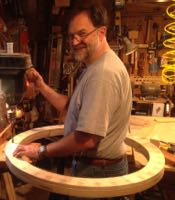
Only I don't want to spend the amount of time this guy clearly has on his device
Only I don't want to spend the amount of time this guy clearly has on his device
Beware teh snarkasm
-
Joeln

- Posts: 767
- Joined: Thu Feb 20, 2014 12:55 pm
- Burning Since: 2014
- Camp Name: On our own
- Location: Fort Collins, CO
Re: Slip Ring connectors for wheel lighting.
Here are 2 Nimh battery packs I made and the RGB LED strip.
This is the rig I am going to put on my bicycle wheel.
The smaller pack is 1200 mAH and runs the 15 foot strip for 3+ hours.
I expect much better run time since I'm putting just over 1/3 that length on the wheel.
I figure it should be easy enough to attach the battery securely near the hub.
This is the rig I am going to put on my bicycle wheel.
The smaller pack is 1200 mAH and runs the 15 foot strip for 3+ hours.
I expect much better run time since I'm putting just over 1/3 that length on the wheel.
I figure it should be easy enough to attach the battery securely near the hub.
You do not have the required permissions to view the files attached to this post.
Collapse first and avoid the rush

Re: Slip Ring connectors for wheel lighting.
Years ago, I made such slip rings and "brushes" myself, on a 1" shaft, for use in Christmas parades. I used hardware store components -- copper pipe fittings for the slip rings, and plastic pipe fittings for insulators. Similar for the followers -- copper tubing for the contact, and plastic tubing the rest of the way to the pivot. These were not perpendicular brushes like in el motors, but hinged levers applied with tension springs. Crude and effective. I ran this with 110 VAC from a small generator.
Would it work in the Dust? Worst case, you wipe it off with a rag once in a while. But my guess is that these large simple parts would not be affected by Dust. You might want a tad more tension on the followers than otherwise.
Would it work in the Dust? Worst case, you wipe it off with a rag once in a while. But my guess is that these large simple parts would not be affected by Dust. You might want a tad more tension on the followers than otherwise.
-
Papa Bear
- Posts: 531
- Joined: Tue Sep 02, 2003 9:36 pm
- Burning Since: 2003
- Camp Name: Astral Headwash. Not the Placer.
- Location: Berthoud, Colorado
- Contact:
Re: Slip Ring connectors for wheel lighting.
They do make slip rings with a wide enough bore, but they get pricey really quick. The one we're using for the top of the Dragonfly Mating Ritual has a 5" internal diameter, and ran us around $600 (I think, that's the last quote I heard). Then again, we needed one that would handle a lot more power than yours would.

Re: Slip Ring connectors for wheel lighting.
You could just use one slip ring (a spring pressing against washer, squeezing two washers together, etc) if enough current can pass through the wheel bearings and axle to act as the grounded half of the connection.
I've considered this problem quite often and have never built what I consider to be the ideal solution: a pair of resonant coils to pass current inductively and then rectify and regulate it on the isolated side.
Edit: Actually I just went ahead and measured the resistance from a bare spot on my frame, to the bare metal out on the rim end of a spoke. Only 1.6 ohms! That had to go through the frame, through the bolted connection to the axle, through the pair of ball bearings, and then out through the spokes to the rim. I would say it's totally feasible to use just one slip contact to pass 12V+ to your wheel, and set up your bike with the frame grounded.
Edit Edit: Turns out my multimeter battery or probes are going bad, and when shorted together they show 1.5 ohms. So that's actually only 0.1 ohms from the frame of the bike out to the rim.
Edit edit edit: And if you do want to machine a pair of isolated rings, here is a pretty neat little dual carbon brush holder from a generator:
I've considered this problem quite often and have never built what I consider to be the ideal solution: a pair of resonant coils to pass current inductively and then rectify and regulate it on the isolated side.
Edit: Actually I just went ahead and measured the resistance from a bare spot on my frame, to the bare metal out on the rim end of a spoke. Only 1.6 ohms! That had to go through the frame, through the bolted connection to the axle, through the pair of ball bearings, and then out through the spokes to the rim. I would say it's totally feasible to use just one slip contact to pass 12V+ to your wheel, and set up your bike with the frame grounded.
Edit Edit: Turns out my multimeter battery or probes are going bad, and when shorted together they show 1.5 ohms. So that's actually only 0.1 ohms from the frame of the bike out to the rim.
Edit edit edit: And if you do want to machine a pair of isolated rings, here is a pretty neat little dual carbon brush holder from a generator:
-
Papa Bear
- Posts: 531
- Joined: Tue Sep 02, 2003 9:36 pm
- Burning Since: 2003
- Camp Name: Astral Headwash. Not the Placer.
- Location: Berthoud, Colorado
- Contact:
Re: Slip Ring connectors for wheel lighting.
One thing to keep in mind is that a slip ring is fine for power, but even a really good one is problematic in terms of shipping any kind of data (such as for control sequences on the lights) - lots of noise in that kind of mechanical connection.
If you want some kind of pattern, it's probably simplest to drive it in a preset pattern from control boards on each wheel (possibly with a wheel-mounted switch or selector if you want to change them). There are chips out there that will let you set up a peer-to-peer network (xBee, for example), but that's another layer of complication.
Honestly, if it were me, I'd just mount a battery pack on each wheel and find a way to make them easily swapped/recharged. But I'm really curious to see what your final solution looks like.
If you want some kind of pattern, it's probably simplest to drive it in a preset pattern from control boards on each wheel (possibly with a wheel-mounted switch or selector if you want to change them). There are chips out there that will let you set up a peer-to-peer network (xBee, for example), but that's another layer of complication.
Honestly, if it were me, I'd just mount a battery pack on each wheel and find a way to make them easily swapped/recharged. But I'm really curious to see what your final solution looks like.
-
melodiousdirge
- Posts: 688
- Joined: Wed Mar 16, 2011 11:29 pm
- Burning Since: 2011
- Location: Central Coast, CA
Re: Slip Ring connectors for wheel lighting.
Haha, good ideas and lots of edits. I actually already ordered a few of those brushes - have seen a few articles where motorbike guys use them to light up their wheels. Just have to see if I can find the time to machine up the rings and bracketry.maladroit wrote:Edit edit edit: And if you do want to machine a pair of isolated rings, here is a pretty neat little dual carbon brush holder from a generator:
Beware teh snarkasm
-
Molotov

- Posts: 601
- Joined: Sat Mar 02, 2013 11:03 am
- Burning Since: 2014
- Camp Name: In abstentia, but present in spirit
Re: Slip Ring connectors for wheel lighting.
I'm no electrical engineer, but I suppose at these low voltages induction transfer of energy from the bike frame to a metal disc on the bike wheel isn't feasible?

Re: Slip Ring connectors for wheel lighting.
A couple LiPo 14.4V packs zip-tied to the wheel hub could seriously simplify things.
Use two to balance the weight on opposite ends.
Use two to balance the weight on opposite ends.
-
melodiousdirge
- Posts: 688
- Joined: Wed Mar 16, 2011 11:29 pm
- Burning Since: 2011
- Location: Central Coast, CA
Re: Slip Ring connectors for wheel lighting.
I've considered running battery packs on each wheel and I guess it could still come to that but each wheel's LEDs pull about 1A at 12v, so we're talking a non-trivial battery pack.
I like lights with cajones.
I like lights with cajones.
Beware teh snarkasm
Re: Slip Ring connectors for wheel lighting.
melodiousdirge wrote:I've considered running battery packs on each wheel and I guess it could still come to that but each wheel's LEDs pull about 1A at 12v, so we're talking a non-trivial battery pack.
I like lights with cajones.
Is that for the full length? 15 ft
The LiPo get expensive when you hit 5AH capacity.
-
melodiousdirge
- Posts: 688
- Joined: Wed Mar 16, 2011 11:29 pm
- Burning Since: 2011
- Location: Central Coast, CA
Re: Slip Ring connectors for wheel lighting.
No, that's each wheel (~6ft string around the inside of the rim). I mean I have enough 18650s and holders laying around that I could do it, I'd just WAY rather have a 20AH SLA battery mounted somewhere to the trike frame running all three wheels and whatever I festoon the rest of the thing with.Token wrote:Is that for the full length? 15 ft
The LiPo get expensive when you hit 5AH capacity.
Beware teh snarkasm