Since the water tank is so big, the water in the tank might create enough pressure for the water to flow so I'm wondering if we still need a pump or not. If so, would we need one for each line or one for all? Also, the pump should be strong enough to withstand the natural pressure coming into the inlet right? I'm kinda lost
1500 Gallon Water Tank Outlet Connection
This year our camp is getting a gi·nor·mous 1500-gallon water tank which according to the vendor has a garden hose type of connection. We're planning to distribute the water to the kitchen and shower sections using garden hoses and something like this:
Since the water tank is so big, the water in the tank might create enough pressure for the water to flow so I'm wondering if we still need a pump or not. If so, would we need one for each line or one for all? Also, the pump should be strong enough to withstand the natural pressure coming into the inlet right? I'm kinda lost
Re: 1500 Gallon Water Tank Outlet Connection
For every 2 feet 4 inches of elevation, you get 1PSI from a water column.
Let’s say your your big-ass-tank is 7 feet tall.
When chock-full, it will start with a whopping 3PSI of water pressure and will progressively get lower with water consumption.
Residential water pressure is 30 - 50 PSI, for reference.
If you are planning on having legit plumbing and piping, a water pump is recommended.
The simplest option: get a water pump designed for an RV. It will run on 12V so you won’t electrocute anyone, and has demand-based regulators so it kicks in when in use and stops when it reaches high line pressure.
But, and it’s a big BUT - you need that legit plumbing and piping that can take 80PSI without leaking, bursting etc. Nothing would be more catastrophic than someone stabbing a hose with their spiked boot studs and draining all your water overnight … you gotta be super confident in your abilities!!!
Now, on to the garden hose splitter gizmo:
Each of those little valves has a steel ball rotating in a nylon sheath. The ball has a thru-hole that reduces the water path cross section by 60%.
When attached to a house, this usually isn’t a problem, you got 40PSI pushing that water hard and fast so it can fill up your hose and flow decent.
But, if you are going to use it with low PSI … it’s gonna trickle and be extra annoying. You’ll probably piss more volume if you try it with no pump and just standing water column gravity feed.
So, TL:DR - super nifty to have a big-ass tote. Super scary plumbing to make it like a water tap back home.
Do you got an expert in camp?
Let’s say your your big-ass-tank is 7 feet tall.
When chock-full, it will start with a whopping 3PSI of water pressure and will progressively get lower with water consumption.
Residential water pressure is 30 - 50 PSI, for reference.
If you are planning on having legit plumbing and piping, a water pump is recommended.
The simplest option: get a water pump designed for an RV. It will run on 12V so you won’t electrocute anyone, and has demand-based regulators so it kicks in when in use and stops when it reaches high line pressure.
But, and it’s a big BUT - you need that legit plumbing and piping that can take 80PSI without leaking, bursting etc. Nothing would be more catastrophic than someone stabbing a hose with their spiked boot studs and draining all your water overnight … you gotta be super confident in your abilities!!!
Now, on to the garden hose splitter gizmo:
Each of those little valves has a steel ball rotating in a nylon sheath. The ball has a thru-hole that reduces the water path cross section by 60%.
When attached to a house, this usually isn’t a problem, you got 40PSI pushing that water hard and fast so it can fill up your hose and flow decent.
But, if you are going to use it with low PSI … it’s gonna trickle and be extra annoying. You’ll probably piss more volume if you try it with no pump and just standing water column gravity feed.
So, TL:DR - super nifty to have a big-ass tote. Super scary plumbing to make it like a water tap back home.
Do you got an expert in camp?
Re: 1500 Gallon Water Tank Outlet Connection
Thanks for the super detailed answer! We don't have plumbing experts unfortunately so that's why we want to keep it as simple as possible and try to use heavy-duty garden hoses everywhere that could be easily replaced.Token wrote: ↑Fri Aug 05, 2022 11:13 amFor every 2 feet 4 inches of elevation, you get 1PSI from a water column.
Let’s say your your big-ass-tank is 7 feet tall.
When chock-full, it will start with a whopping 3PSI of water pressure and will progressively get lower with water consumption.
Residential water pressure is 30 - 50 PSI, for reference.
If you are planning on having legit plumbing and piping, a water pump is recommended.
The simplest option: get a water pump designed for an RV. It will run on 12V so you won’t electrocute anyone, and has demand-based regulators so it kicks in when in use and stops when it reaches high line pressure.
But, and it’s a big BUT - you need that legit plumbing and piping that can take 80PSI without leaking, bursting etc. Nothing would be more catastrophic than someone stabbing a hose with their spiked boot studs and draining all your water overnight … you gotta be super confident in your abilities!!!
Now, on to the garden hose splitter gizmo:
Each of those little valves has a steel ball rotating in a nylon sheath. The ball has a thru-hole that reduces the water path cross section by 60%.
When attached to a house, this usually isn’t a problem, you got 40PSI pushing that water hard and fast so it can fill up your hose and flow decent.
But, if you are going to use it with low PSI … it’s gonna trickle and be extra annoying. You’ll probably piss more volume if you try it with no pump and just standing water column gravity feed.
So, TL:DR - super nifty to have a big-ass tote. Super scary plumbing to make it like a water tap back home.
Do you got an expert in camp?
I have some follow-up questions:
1. Where did 80PSI come from?
2. Each shower already uses a 12V RV pump but I'm worried that if I just connect them directly to the water tank via the splitter, they might not be able to resist the positive inlet pressure coming from the water column gravity feed. Although 3PSI coming from the water tank doesn't sound too bad (But then again, I have no idea)
Re: 1500 Gallon Water Tank Outlet Connection
80PSI is 100% (2:1) margin on the target residential 40PSI. It’s industry practice.
It is there if say and RV or well pump fails to stop and just continues pumping until it cannot overcome the line pressure.
RV pumps that make that huge racket thumping sound - diaphragm pumps. The 3 or so PSI on the inlet are not a problem.
Like I said before, the big risk is a leak. That 4-way brass splitter is heavy, connects to a hose-bib that is really small, and relies on a thin rubber gasket to hold everything sealed.
Add the hoses to it which really strains the connector. The rubber gasket will compress and deform over time from just the load and high-low temperature swings.
And I’m speaking from experience here. Live on a farm and have those very same splitters dripping and leaking all over the place. Every now and then it fails catastrophic.
If you do go with the brass manifold, please do this:
Get a super short hose extender like this:
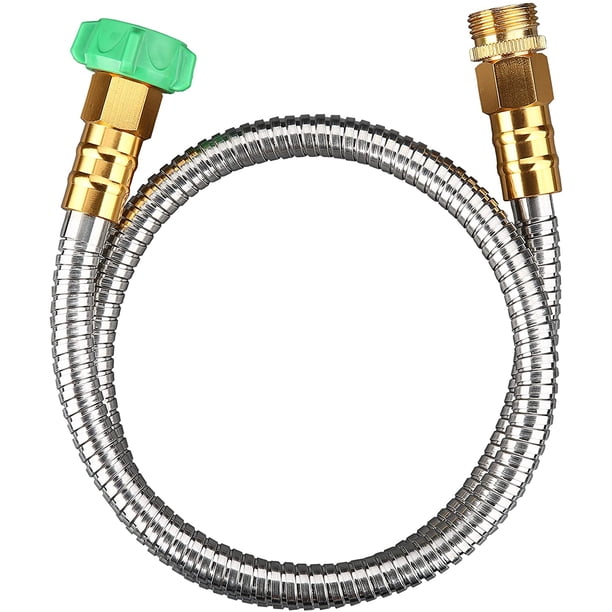
Connect that hose to the tank, then connect the big heavy brass manifold to the protected hose and tuck it away.
That will go a long way towards strain relief and leakage problems.
Check all hoses and tighten morning and dusk to catch the temperature swing effects.

It is there if say and RV or well pump fails to stop and just continues pumping until it cannot overcome the line pressure.
RV pumps that make that huge racket thumping sound - diaphragm pumps. The 3 or so PSI on the inlet are not a problem.
Like I said before, the big risk is a leak. That 4-way brass splitter is heavy, connects to a hose-bib that is really small, and relies on a thin rubber gasket to hold everything sealed.
Add the hoses to it which really strains the connector. The rubber gasket will compress and deform over time from just the load and high-low temperature swings.
And I’m speaking from experience here. Live on a farm and have those very same splitters dripping and leaking all over the place. Every now and then it fails catastrophic.
If you do go with the brass manifold, please do this:
Get a super short hose extender like this:

Connect that hose to the tank, then connect the big heavy brass manifold to the protected hose and tuck it away.
That will go a long way towards strain relief and leakage problems.
Check all hoses and tighten morning and dusk to catch the temperature swing effects.
- ygmir
- Posts: 30403
- Joined: Thu Sep 20, 2007 8:36 pm
- Burning Since: 2007
- Camp Name: qqqq
- Location: nevada county
Re: 1500 Gallon Water Tank Outlet Connection
not to be pedantic, but, do you have 1500 gallons of grey water storage? Just curious how you'll deal with it once it's not clean water any more?
Token is spot on. It does not matter how big your tank it, it's purely a function of "head pressure" (yes, I chose that term on purpose) .
make sure all fittings and connections are rated well over max pressure of your pump(s). There is also a device that would shut off the water in case of catastrophic failure, so your whole supply does not flood the neighborhood if some rando cuts a hose or knocks a fitting off.
Token is spot on. It does not matter how big your tank it, it's purely a function of "head pressure" (yes, I chose that term on purpose) .
make sure all fittings and connections are rated well over max pressure of your pump(s). There is also a device that would shut off the water in case of catastrophic failure, so your whole supply does not flood the neighborhood if some rando cuts a hose or knocks a fitting off.
YGMIR
Unabashed Nordic
Pagan
Unabashed Nordic
Pagan
- ygmir
- Posts: 30403
- Joined: Thu Sep 20, 2007 8:36 pm
- Burning Since: 2007
- Camp Name: qqqq
- Location: nevada county
Re: 1500 Gallon Water Tank Outlet Connection
super, thanks or the response. It's always advisable to have more grey water capacity than fresh water, due to unexpected additions from peoples melt water etc.
YGMIR
Unabashed Nordic
Pagan
Unabashed Nordic
Pagan
Re: 1500 Gallon Water Tank Outlet Connection
Garden hoses are manufactured using chemicals and processes that are not intended for drinking water. The plastics are not guaranteed to be BPA-free, and it turns out it's much easier to machine brass if you add a bit of lead. In fact, I looked up the splitter you posted and it also contains lead.
You need to source plastic or other lead-free plumbing fittings for potable water, and you need to source fresh water hoses (they are for RVs, basically just like a garden hose except made with safe materials).
Before anyone comes in saying "I drank from the hose as a kid and I'm fine" let me point out you're NOT fine, you think it's a good idea to haul your ass out in the middle of a desert for fun. And many of these chemicals are cumulative, if you have a chance to knowingly reduce your exposure you should take it.
You need to source plastic or other lead-free plumbing fittings for potable water, and you need to source fresh water hoses (they are for RVs, basically just like a garden hose except made with safe materials).
Before anyone comes in saying "I drank from the hose as a kid and I'm fine" let me point out you're NOT fine, you think it's a good idea to haul your ass out in the middle of a desert for fun. And many of these chemicals are cumulative, if you have a chance to knowingly reduce your exposure you should take it.