

ok my first year i brought a disposable 'nighttime camera' with me..i used flash, and all my pictures were basically dust..
next year i brought my digital camera, and all my nightime pictures were blurry messes..
this year i was told to use a 'night time camera' (800 speed), and NOT use flash..well i just went and picked up my pics and none of them came out..ARgghhH!!..
what is the secret of nightime photography on the playa?..i would like to capture the beauty of BRC in all it's blinking glory, BUT HOW???
my co-workers have been asking to see pics for years now, and i would like to show them more than daytime pics..
any input, hints, tips, greatly apprieciated..thankz..
jeremy..
night time pictures on the playa?!?!
night time pictures on the playa?!?!
Paradise is not a place..it's a state of mind..
-
Borris

- Posts: 276
- Joined: Mon Sep 01, 2003 11:10 pm
- Burning Since: 2003
- Camp Name: DPW
- Location: East Bay
Nighttime photography.
the secret is having a camera with a good lightmeter, using long exposures with or without a flash and with or without a tripod and knowing that even 800 flm needs some light for the exposure.
Manual SLR's are best for low light nighttime shoots, and usualy have a good enough lightmeter.
Manual SLR's are best for low light nighttime shoots, and usualy have a good enough lightmeter.
Shit, where was i for the last week... ehm...
nighttime shots are a bit difficult out there. Your best bet is an old 35mm SLR (you can find a Pentax K-1000 with a lens for reeaal cheap) that has a Bulb setting (shutter open as long as you hold down the button), a tripod, a cable release (keeps the shutter open for long periods without you having to keep a finger on the button) and relqatively fasty (400-800) film. You don't really need a light meter per se, just try different lenghts of time with the shutter open. I usually use 400 film and an f-stop setting of 5.6-8 and vary exposure times between 5 seconds and 1 minute, YMMV.
It's all about experimentation!
It's all about experimentation!
thank you both for the replies..you've got me researching manual slr's and photography basics..i figure i better start now to be sure to get it right next year..
but what about digital camera's?..is it possible to get a decent nighttime picture with one?..most of my pics last year using the night setting on my (now stolen) digital elph were just blurry, but they weren't dark like with a regular camera..would a tripod cure this?..or is a digi cam just out of the question in this situation?..it sure would be more portable than a bulky slr..thankz all..god i'm homesick already..Portland is NOT Black Rock City..
but what about digital camera's?..is it possible to get a decent nighttime picture with one?..most of my pics last year using the night setting on my (now stolen) digital elph were just blurry, but they weren't dark like with a regular camera..would a tripod cure this?..or is a digi cam just out of the question in this situation?..it sure would be more portable than a bulky slr..thankz all..god i'm homesick already..Portland is NOT Black Rock City..
Paradise is not a place..it's a state of mind..
-
Borris
- Posts: 276
- Joined: Mon Sep 01, 2003 11:10 pm
- Burning Since: 2003
- Camp Name: DPW
- Location: East Bay
Digital nightime.
Digital cameras tend to behave similarly to film ones.
if the picture was blurry that means that it had a long exposure time and fixing this with a tripod is a good solution.
when talking about light metering i didn't refer to an extrernal light meter but rather to an Internal one in the camera. the Pentax internal meter is good, the Nikon FM2 or F3 is even better, the Nikon N90 or N8008 or Canon EOS 50 is very good and so on.
Digital cameras have light meters as well. the auto setings are just saying to the camera how it should behave under the curent light conditions.
look for some stuff on exposure and photography on the net it will help u understand how things are working.
My favorite low light tech is long exposure for some colour blurr with a rear curtain sync flash to freeze and light my main object.
if the picture was blurry that means that it had a long exposure time and fixing this with a tripod is a good solution.
when talking about light metering i didn't refer to an extrernal light meter but rather to an Internal one in the camera. the Pentax internal meter is good, the Nikon FM2 or F3 is even better, the Nikon N90 or N8008 or Canon EOS 50 is very good and so on.
Digital cameras have light meters as well. the auto setings are just saying to the camera how it should behave under the curent light conditions.
look for some stuff on exposure and photography on the net it will help u understand how things are working.
My favorite low light tech is long exposure for some colour blurr with a rear curtain sync flash to freeze and light my main object.
Shit, where was i for the last week... ehm...

Thanks for bringing this up period...
What a great topic! I've been frustrated with night photography every Burning Man I've been at. Though I have gotten rather interesting results, like the picture below from 2002.

However most of the shots are a bust.
So many thanks for the tips.
However most of the shots are a bust.
So many thanks for the tips.
-
genex

- Posts: 6
- Joined: Wed Sep 03, 2003 12:21 am
- Burning Since: 1999
- Camp Name: Salty Jack
- Location: SF
- Contact:
Part of it is the flash at night when there's dust. As you can see in the previous post, the dust really catches the light on of the flash, so if you can, you want to not use it.
Of course at that point, you need to still get enough light on the film/CCD/CMOS so you need to keep the shutter open longer, which you can't necessarily do with the point and shoot and disposables.
Many of the new digitals work well and have this kind of functionality and any SLR should as well.
Here's an example of some low light stuff. Shot at 400 ISO at 1/40 sec at an aperture of 2.8.

Hope that helps!
gene[/img]
Of course at that point, you need to still get enough light on the film/CCD/CMOS so you need to keep the shutter open longer, which you can't necessarily do with the point and shoot and disposables.
Many of the new digitals work well and have this kind of functionality and any SLR should as well.
Here's an example of some low light stuff. Shot at 400 ISO at 1/40 sec at an aperture of 2.8.
Hope that helps!
gene[/img]
Dust and Digicams
If you lower the resolution on your digicam to 640 x 480 or so (useing flash), it will not show the dust. Makes for somewhat grainy pics, but I got some great closeups/portrait on the fly, shots I would have missed if I had to set up a tripod or would have been blury due to long exposure (moving subject).>Part of it is the flash at night when there's dust. As you can see in the >previous post, the dust really catches the light on of the flash
thank you - great topic
I am going to buy a digital camera. I want soomething small and portable as most of the places that I would be shooting are playa-like. Any recommendations from those of you in the know? I hate waiting for the flash too. Definitely want to be able to override that little feature. Thanks, gonna go shower with my new playa-met girls now. peace. 
-
electrolux

- Posts: 55
- Joined: Wed Sep 03, 2003 4:56 pm
- Location: east van, bc
Re: thank you - great topic
Just before Burning Man I picked up a Toshiba PDR-M25 on eBay for about $100 (would have spent more, but didn't want to risk heat and dust damage to a more expensive camera). Though it's a cheap model, it does have lots of features including the option to turn off the flash.Damskippy wrote:I am going to buy a digital camera. I want soomething small and portable as most of the places that I would be shooting are playa-like. Any recommendations from those of you in the know? I hate waiting for the flash too. Definitely want to be able to override that little feature. Thanks, gonna go shower with my new playa-met girls now. peace.
Here are some pictures I took at night this year:
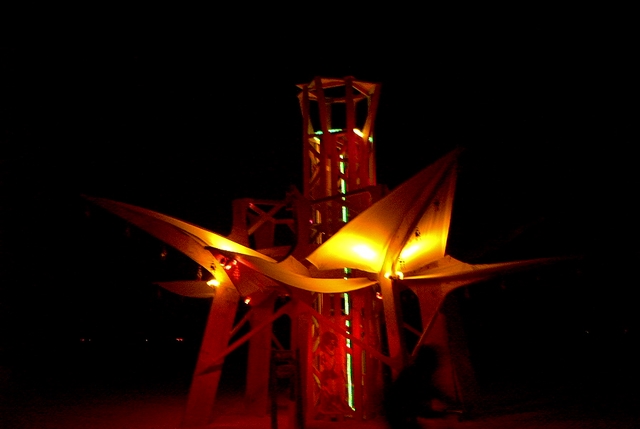
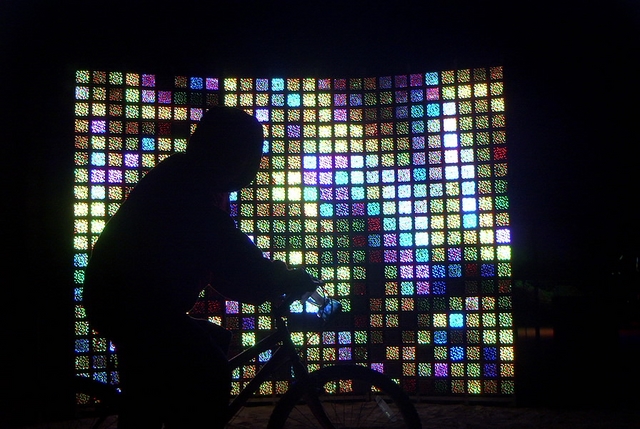
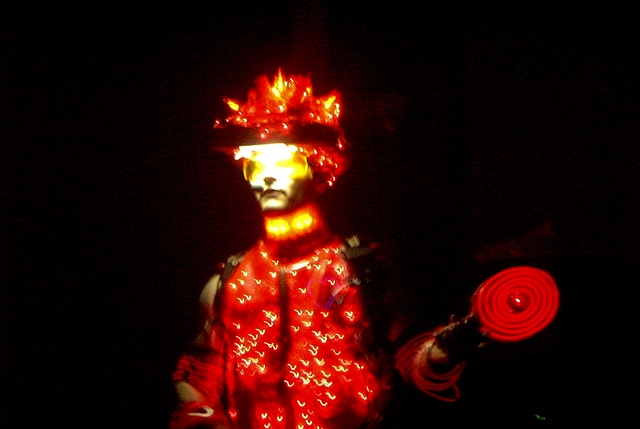
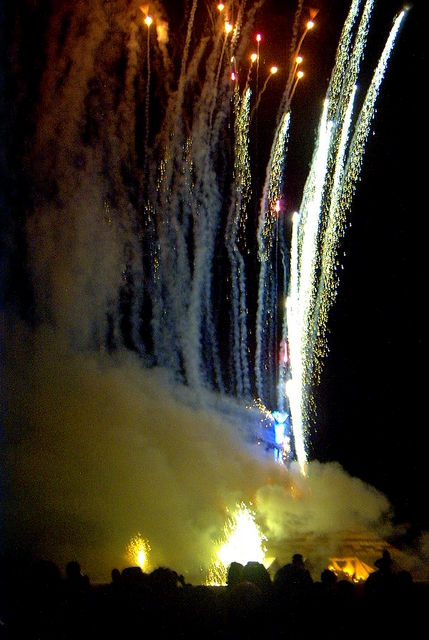
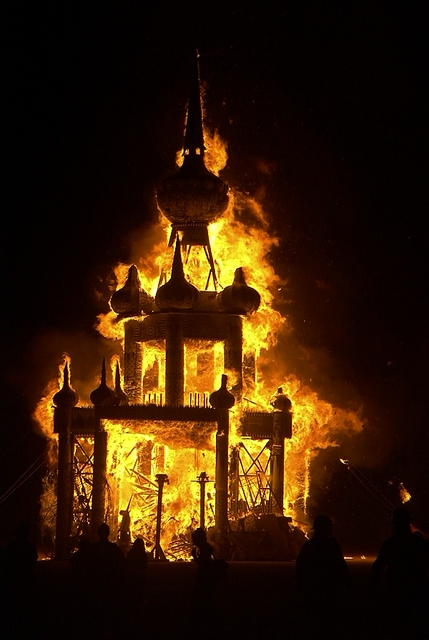
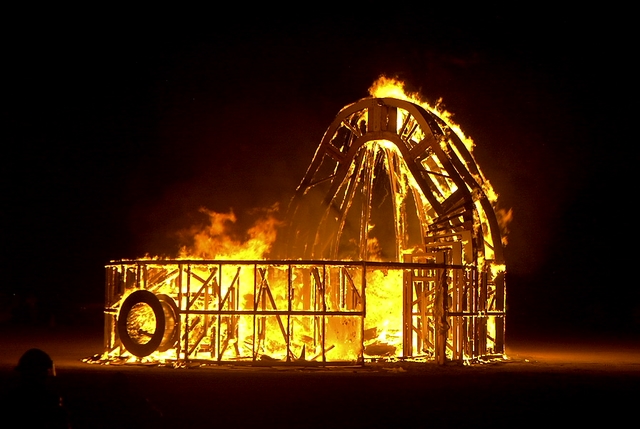
With a tripod I would have had even better results when using the longer exposure times (1sec and 2sec), since that would have eliminated some motion blurring. Also, large objects on fire are the easiest to photograph at night.
None of the pictures I took using a flash look as good as the pictures taken without a flash.
Feel free to check out 220 of my BM03 photographs here:
http://www.waste.org/~alone/gallery/

dusty night photos
i used my digital camera, and realized that a tripod is essential for next year...and i am looking into how i can deflect the flash so that it doesn't pick up all the dust particals...however...i was able to enjoy some night shots after i changed the "levels" in photoshop.
your best best to show your friends pics is to find a link here, and then show them the prof. shots taken! what's the dif??
good luck to you...z
your best best to show your friends pics is to find a link here, and then show them the prof. shots taken! what's the dif??
good luck to you...z
-
Steven bradford
- Posts: 351
- Joined: Thu Sep 04, 2003 11:29 pm
- Location: Seattle
- Contact:
Monopods are really useful, and much less of a pain to cart around. Generally, with 400 film or the 400 "setting" on a digi cam, exposures without flame are around 1/4 to a 15th of a second, rather than three seconds. Usually a monopod will be steady enough in this range.
Another trick is to also use your self timer, which dissasociates the movement of your finger on the shutter release from the moment of exposure. or use a remote shutter release if you can.
Holding your breat after exhaling helps aslo.
Another trick is to also use your self timer, which dissasociates the movement of your finger on the shutter release from the moment of exposure. or use a remote shutter release if you can.
Holding your breat after exhaling helps aslo.
Steve
Paint or Be Painted
http://www.seanet.com/~bradford/Body_Painting_Technique.html
Paint or Be Painted
http://www.seanet.com/~bradford/Body_Painting_Technique.html


dj big "E"
fang kick ass shot of the temple i have a sweet one of temple during sandstorm i hope to put on here soon.Anyways my only recommendation is to be around lots of fire it lights up subjects nicely.FOr the most part my night shots blew thoe lmao.live and learn thats what it's all about . dj big "E"
-
Kinetic
My Nikon Coolpix 885 takes great daytime shots. At night it royally sucks. You would think they could make the electronic equivalent of ISO 2000 film or higher. Maybe my camera can do better but I haven't had time to explore it yet.
Besides there are thousands of other better shots out there to look at!
Besides there are thousands of other better shots out there to look at!
-
joeytheglassblower
- Posts: 8
- Joined: Wed Sep 10, 2003 9:49 pm
nightpics
yeah, fucking beautiful pics fang
I actually got to be on the inner circle of the burn of the man and the temple with cirq de flambe. You totally captured it
thank you.
joeytheglassblower
I actually got to be on the inner circle of the burn of the man and the temple with cirq de flambe. You totally captured it
thank you.
joeytheglassblower

-
Steven bradford
- Posts: 351
- Joined: Thu Sep 04, 2003 11:29 pm
- Location: Seattle
- Contact:
I just stumbled across a cool online gallery of long exposure moonlight shots, and the photographer has an excellent tips page
http://www.lostamerica.com/lostframe.html
http://www.lostamerica.com/lostframe.html
Steve
Paint or Be Painted
http://www.seanet.com/~bradford/Body_Painting_Technique.html
Paint or Be Painted
http://www.seanet.com/~bradford/Body_Painting_Technique.html
-
PleasureSean
- Posts: 29
- Joined: Wed Sep 10, 2003 1:49 am
- Location: SF
- Contact:
Here's what I do at night
One of the things that I've found works well on the playa is to decrease the intensity of the flash. Most digital cameras have an exposure or flash compensation adjustment - play with yours until you find the sweet spot where the dust particiles don't get illuminated but your subject does. On my Olympus digitial, it is typically at -1.3 or -1.7. Then later in photoshop you can brighten up the pics if necessary and voila - nice nighttime shots. This works best for stuff closer than 10 feet away.
For film cameras, especially those throw-away point and shoot cameras - put a piece of electrical tape over about 1/2 to 2/3 of the flash to cut down it's intensity (these flashes are naturally overbright, so you want to cover a lot of it). In a pinch, you can put your finger over the flash as well.
http://www.pleasuresean.com/BurningmanPhotoPage.html
For film cameras, especially those throw-away point and shoot cameras - put a piece of electrical tape over about 1/2 to 2/3 of the flash to cut down it's intensity (these flashes are naturally overbright, so you want to cover a lot of it). In a pinch, you can put your finger over the flash as well.
http://www.pleasuresean.com/BurningmanPhotoPage.html
When loss recedes from surfeit, pleasure is its own reward.

I was happy with most of my night shots taken with my digital Olympus C-5050. I bought a underwater casing for it to keep the dust out of it which worked great. I just wish I had brought a tripod. I stayed away from using the flash at night for most of the pics but turned it on for a few and I was surprised that more dust particles didn't show up when I did use the flash because I know that is a common problem. Not sure why they didn't show up in mine.
Here's one where I used the flash: http://www.agape1.net/burningman03/theman/theman22.jpg
and here's a couple without flash: http://www.agape1.net/burningman03/theman/theman20.jpg
http://www.agape1.net/burningman03/theman/theman14.jpg
Another thing that helps in night time pictures is using the slow flash if your camera has that option.
Paula
Here's one where I used the flash: http://www.agape1.net/burningman03/theman/theman22.jpg

and here's a couple without flash: http://www.agape1.net/burningman03/theman/theman20.jpg

http://www.agape1.net/burningman03/theman/theman14.jpg

Another thing that helps in night time pictures is using the slow flash if your camera has that option.
Paula
-
glam_daddy

- Posts: 94
- Joined: Wed Sep 10, 2003 1:33 pm
- Location: San Francisco
- Contact:
Like others have mentioned, tripod is the way too go... OR, if there is enough fire you can get enough natural light for a great pic. I got the pic below by just holding my arm up all half hazzardly like and just snapping at the right moment. Its my favorite BM pic I have ever taken.

http://www.jordansplace.net