

We have a dump about 30 min. south of here that is piped for gas.. It's in an old artilery range (WWII) between two large hills.. They kept it covered a lot while filling it..At the same time laying pipe.. Now it is all covered and powering a small power plant..
It may be a U of O project..The amy camps name is Adare (spelling?) just outside Corvallis OR.. That's where the U of O is.. You may get some research out of that area..
As for the stone digester.. It could be made of stainless steel.. The thing in China may have been made before time and is used every day without a thought..The farms have pigs for meat.. Some good old pig shit would work.. China was here a long time before Moses or us white guys..
Pig farms reminds me of a story out of the UK..May have been Popular Mecahics.. Anyway the guy didn't like the smell of the pig farm across the road from him..The guy thought: put a lid on it.. He did and found a way to trap and compress the gas.. Now he drives to work on it and the farmer plows the feilds with it.. Gas was 49 cents then so...well you know.. Said he lost 10% HP..
Eniugh of this "shit".. Now back to Contraptioning..
Hey LeChat, What Are You Working On?
-
unjonharley

- Posts: 10434
- Joined: Tue Sep 09, 2003 11:05 am
- Burning Since: 2001
- Camp Name: Elliot's naked bycycel repair
- Location: Salem Or.
-
unjonharley
- Posts: 10434
- Joined: Tue Sep 09, 2003 11:05 am
- Burning Since: 2001
- Camp Name: Elliot's naked bycycel repair
- Location: Salem Or.
-
unjonharley
- Posts: 10434
- Joined: Tue Sep 09, 2003 11:05 am
- Burning Since: 2001
- Camp Name: Elliot's naked bycycel repair
- Location: Salem Or.
-
LeChatNoir

- Posts: 5907
- Joined: Mon Sep 01, 2003 8:52 am
- Location: Louisville, Ky
There was good progress over the weekend, despite a lack of time to work on things as much as I’d have liked. That is, however, most often the case.
The following photos show some work that has been done for a week or so, along with things finished this weekend. I’ve had the frame assembled for some time now, and have shown glimpses of it in previous pics. The wheels have also been mounted for a little while, but it's been up on sawhorses since the front wheels were off and on quite a bit to fit the brakes. The sawhorses also helped keep it at a height that we could crawl underneath when Chaba and Niko were here and we were building the “motor mountsâ€
The following photos show some work that has been done for a week or so, along with things finished this weekend. I’ve had the frame assembled for some time now, and have shown glimpses of it in previous pics. The wheels have also been mounted for a little while, but it's been up on sawhorses since the front wheels were off and on quite a bit to fit the brakes. The sawhorses also helped keep it at a height that we could crawl underneath when Chaba and Niko were here and we were building the “motor mountsâ€
The New and Improved Black Cat... now with 25% more blather
-
LeChatNoir
- Posts: 5907
- Joined: Mon Sep 01, 2003 8:52 am
- Location: Louisville, Ky
At this point the main parts of the structure are pretty much done with the heaviest part left being the flywheel and pump mechanism. From here on out the lightest materials possible can be used, as long as they will still perform as needed, mind you. This makes me feel good, since in spite of all my figuring, in the back of my mind I’ve been a bit worried about this thing being too heavy to motivate. So my brother and I sat down on the deck frame and let all of our weight be on The Contraption. (And I must state here for the record that neither of us are exactly puny lads).
We were able to move it easily by grasping the rear wheel rim and putting just a little bit of pressure on it. It was very smooth and easy. When the tires get on the rear rims, it should be even better. I could even back it up by grabbing that stubby little reverse gear arm and pulling. Knowing the mechanical advantages that we will have with the pump lever arms, and gear ratios, I’m feeling very reassured at the moment about this thing being fully successful.
Yeah!!!!
We were able to move it easily by grasping the rear wheel rim and putting just a little bit of pressure on it. It was very smooth and easy. When the tires get on the rear rims, it should be even better. I could even back it up by grabbing that stubby little reverse gear arm and pulling. Knowing the mechanical advantages that we will have with the pump lever arms, and gear ratios, I’m feeling very reassured at the moment about this thing being fully successful.
Yeah!!!!
The New and Improved Black Cat... now with 25% more blather
Great work LeC, thanks for sharing everything with us. If you want to remove the rust from your control handles and other pieces here is a tip from stovebolt.com.
Electrolytic derusting
What is the method?
Electrolysis is a technique for returning surface rust to iron. It uses the effect of an small low voltage electric current and a suitable electrolyte (solution). It has advantages over the old standbys, like vinegar, Coke, muriatic acid, Naval Jelly, wire brushing, sand blasting etc -- These methods all remove material to remove the rust, including un-rusted surfaces. With many, the metal is left with a "pickled" look or a characteristic color and texture. The electrolytic method removes nothing: by returning surface rust to metallic iron, rust scale is loosened and can be easily removed. Un-rusted metal is not affected in any way.
What about screws, pivots, etc that are "rusted tight"?
The method will frequently solve these problems, without the need for force, which can break things. Is it safe? The solutions used are not hazardous; the voltages and currents are low, so there is no electrical hazard. No noxious fumes are produced. The method is self limiting: it is impossible to over clean an object. Small amounts of hydrogen are emitted in the electrolysis process. Good ventilation or an outdoor work site is all that is needed.
What do I need?
A plastic tub; a stainless steel or iron electrode, water and washing soda (Arm & Hammer, for example) and a battery charger. About a tablespoon of soda to a gallon of water. If you have trouble locating the washing soda, others have reported success with baking soda. Also household lye will work just fine. It's a tad more nasty -- always wear eye protection and be sure to add the lye to the water (NOT water to lye!!!) The solution is weak, and is not harmful, though you might want to wear gloves. NOTE: It is the current that cleans, not the solution; nothing is gained by making a more concentrated solution -- DON'T!
How long does the solution last?
Forever, though the loosened rust will make it pretty disgusting after a while. Evaporation and electrolysis will deplete the water from the solution. Add water ONLY to bring the level back.
What about the stainless/iron electrode?
The electrode wants to be large (within reason); if possible, larger than the object being cleaned. The iron electrode works best if it "surrounds" the object to be cleaned, since the cleaning is "line of sight" to a certain extent. An iron electrode will be eaten away with time. Stainless steel has the advantage (some alloys, but not all) in that it is not eaten away. I have had good success with sheet stainless salvaged from a paper towel dispenser. It has a large surface area and is easily shaped to fit the container.
How do I connect the battery charger?
THE POLARITY IS CRUCIAL!! The iron or stainless electrode is connected to the positive (red) terminal. The object being cleaned, to the negative(black). Submerge the object, making sure you have good contact, which can be difficult with heavily rusted objects. Get it backwards and your object will be relentlessly eaten away! Make connections on a part of your electrode that protrudes out of the solution, or your clamps will erode rapidly.
How do I know if it is working?
Turn on the power. If your charger has a meter, be sure some current is flowing. Again, on heavily rusted objects, good electrical contact may be hard to make-it is essential. Multi-part objects may not have good electrical connections between them. Fine bubbles will rise from the object when cleaning is in progress.
How long do I leave it?
The time depends on the size of the object and of the iron electrode, and on the amount of rust. You will have to test the object by trying to wipe off the rust. If it is not completely clean, try again. Typical cleaning time for moderately rusted objects is a few hours. Heavily rusted objects can be left over night.
How do I get the rust off after I remove the object?
Rub the object under running water. A paper towel will help. For heavily rusted objects, a plastic pot scrubber can be used, carefully. Depending on the amount of original rust, you may have to re-treat. The amount of mechanical action will depend on the fragility of the object. Use your discretion.
My object is too big to fit. Can I clean part of it?
Yes. You can clean one end and then the other. Lap marks should be minimal if the cleaning was thorough.
After I take it out, then what?
The clean object will acquire surface rust very quickly, so wipe it dry and dry further in a warm oven or with a hair dryer/heat gun. You may want to apply a light oil or a coat of wax to prevent further rusting.
Will the method remove pitting?
No. It only operates on the rust in immediate contact with unrusted metal. What's gone is gone. What will it look like when I am done? The surface of rusted metal is left black. Rusted pits are still pits. Shiny unrusted metal is untouched.
What about nickle plating, paint, japanning and the like?
Sound plating will not be affected. Plating under which rust has penetrated will usually be lifted. The solution is likely to soften most paints.Test with a drop of solution in an inconspicuous place. Remove wood handles if possible before treating.
How can I handle objects that are awkward to clean?
There are lots of variants: suspending an electrode inside to clean a cavity in an object; using a sponge soaked in the electrolyte with a backing electrode to clean spots on large objects or things that shouldn't be submerged (like with lots of wood)
How can I dispose of the solution?
The bath will last until it gets so disgusting that you decide it is time for a fresh one. There is nothing especially nasty about it-it's mildly basic-so disposal is not a concern, except you may not want all the crud in your drains.
Can I use metal containers?
This is highly risky. Galvanized metal can introduce zinc into the solution. If you have used lye, it will attack aluminum. You may have problems with electrical shorts, etc. Stick to plastic.
How can I clean odd shaped objects?
Be ingenious. Plastic PVC pipe and eave troughs, wooden boxes with poly vapor barrier, kids wading pools, etc.
Electrolytic derusting
What is the method?
Electrolysis is a technique for returning surface rust to iron. It uses the effect of an small low voltage electric current and a suitable electrolyte (solution). It has advantages over the old standbys, like vinegar, Coke, muriatic acid, Naval Jelly, wire brushing, sand blasting etc -- These methods all remove material to remove the rust, including un-rusted surfaces. With many, the metal is left with a "pickled" look or a characteristic color and texture. The electrolytic method removes nothing: by returning surface rust to metallic iron, rust scale is loosened and can be easily removed. Un-rusted metal is not affected in any way.
What about screws, pivots, etc that are "rusted tight"?
The method will frequently solve these problems, without the need for force, which can break things. Is it safe? The solutions used are not hazardous; the voltages and currents are low, so there is no electrical hazard. No noxious fumes are produced. The method is self limiting: it is impossible to over clean an object. Small amounts of hydrogen are emitted in the electrolysis process. Good ventilation or an outdoor work site is all that is needed.
What do I need?
A plastic tub; a stainless steel or iron electrode, water and washing soda (Arm & Hammer, for example) and a battery charger. About a tablespoon of soda to a gallon of water. If you have trouble locating the washing soda, others have reported success with baking soda. Also household lye will work just fine. It's a tad more nasty -- always wear eye protection and be sure to add the lye to the water (NOT water to lye!!!) The solution is weak, and is not harmful, though you might want to wear gloves. NOTE: It is the current that cleans, not the solution; nothing is gained by making a more concentrated solution -- DON'T!
How long does the solution last?
Forever, though the loosened rust will make it pretty disgusting after a while. Evaporation and electrolysis will deplete the water from the solution. Add water ONLY to bring the level back.
What about the stainless/iron electrode?
The electrode wants to be large (within reason); if possible, larger than the object being cleaned. The iron electrode works best if it "surrounds" the object to be cleaned, since the cleaning is "line of sight" to a certain extent. An iron electrode will be eaten away with time. Stainless steel has the advantage (some alloys, but not all) in that it is not eaten away. I have had good success with sheet stainless salvaged from a paper towel dispenser. It has a large surface area and is easily shaped to fit the container.
How do I connect the battery charger?
THE POLARITY IS CRUCIAL!! The iron or stainless electrode is connected to the positive (red) terminal. The object being cleaned, to the negative(black). Submerge the object, making sure you have good contact, which can be difficult with heavily rusted objects. Get it backwards and your object will be relentlessly eaten away! Make connections on a part of your electrode that protrudes out of the solution, or your clamps will erode rapidly.
How do I know if it is working?
Turn on the power. If your charger has a meter, be sure some current is flowing. Again, on heavily rusted objects, good electrical contact may be hard to make-it is essential. Multi-part objects may not have good electrical connections between them. Fine bubbles will rise from the object when cleaning is in progress.
How long do I leave it?
The time depends on the size of the object and of the iron electrode, and on the amount of rust. You will have to test the object by trying to wipe off the rust. If it is not completely clean, try again. Typical cleaning time for moderately rusted objects is a few hours. Heavily rusted objects can be left over night.
How do I get the rust off after I remove the object?
Rub the object under running water. A paper towel will help. For heavily rusted objects, a plastic pot scrubber can be used, carefully. Depending on the amount of original rust, you may have to re-treat. The amount of mechanical action will depend on the fragility of the object. Use your discretion.
My object is too big to fit. Can I clean part of it?
Yes. You can clean one end and then the other. Lap marks should be minimal if the cleaning was thorough.
After I take it out, then what?
The clean object will acquire surface rust very quickly, so wipe it dry and dry further in a warm oven or with a hair dryer/heat gun. You may want to apply a light oil or a coat of wax to prevent further rusting.
Will the method remove pitting?
No. It only operates on the rust in immediate contact with unrusted metal. What's gone is gone. What will it look like when I am done? The surface of rusted metal is left black. Rusted pits are still pits. Shiny unrusted metal is untouched.
What about nickle plating, paint, japanning and the like?
Sound plating will not be affected. Plating under which rust has penetrated will usually be lifted. The solution is likely to soften most paints.Test with a drop of solution in an inconspicuous place. Remove wood handles if possible before treating.
How can I handle objects that are awkward to clean?
There are lots of variants: suspending an electrode inside to clean a cavity in an object; using a sponge soaked in the electrolyte with a backing electrode to clean spots on large objects or things that shouldn't be submerged (like with lots of wood)
How can I dispose of the solution?
The bath will last until it gets so disgusting that you decide it is time for a fresh one. There is nothing especially nasty about it-it's mildly basic-so disposal is not a concern, except you may not want all the crud in your drains.
Can I use metal containers?
This is highly risky. Galvanized metal can introduce zinc into the solution. If you have used lye, it will attack aluminum. You may have problems with electrical shorts, etc. Stick to plastic.
How can I clean odd shaped objects?
Be ingenious. Plastic PVC pipe and eave troughs, wooden boxes with poly vapor barrier, kids wading pools, etc.
This account has been closed as demanded by Wedeliver.
-
LeChatNoir
- Posts: 5907
- Joined: Mon Sep 01, 2003 8:52 am
- Location: Louisville, Ky
Great tips toolmaker. That’s a nice find that I’ll tuck away for future reference. Fortunately, the majority of the parts that were crucial (i.e. shaft diameters, bores, etc) were in surprisingly good shape. Many of them were like new when I got them disassembled, due to the fact that they were entombed in thick grease. Lucky me! The levers look like hell, but are really very workable (Perfect). I took everything apart, steelwooled it with oil. Reassembled and there you go. My goal is to have this thing look like it was built 100 years ago and tucked into a barn. Rusty junker on the outside, efficient machine on the inside.
The other stuff came loose with a little bit of heat from the torch, some penetrating oil, and a small hammer. As was noted in your text above, though, one must be careful with such techniques, since they can damage parts.. Especially cast iron and heat treated components. A piece of mild steel to act as a punch helps a bunch when you need to peck something to get it loose.
Have I shared with you my thoughts on rust, in particular the rust on these very implements that are at the heart of this thing? Karine had asked me if I was going to sandblast all the rust off.
Let me do some digging and find it. I posted it on tribe somewhere, I think…
*dig*
*dig*
*dig*
*dig*
*dig*
Ah yes… here it is:
The other stuff came loose with a little bit of heat from the torch, some penetrating oil, and a small hammer. As was noted in your text above, though, one must be careful with such techniques, since they can damage parts.. Especially cast iron and heat treated components. A piece of mild steel to act as a punch helps a bunch when you need to peck something to get it loose.
Have I shared with you my thoughts on rust, in particular the rust on these very implements that are at the heart of this thing? Karine had asked me if I was going to sandblast all the rust off.
Let me do some digging and find it. I posted it on tribe somewhere, I think…
*dig*
*dig*
*dig*
*dig*
*dig*
Ah yes… here it is:
NO I'm not going to blast any of the rust off. That stuff is beautiful. It’s the type of rust you can only find on old metal. They don't smelt it like that anymore and one day it'll all be gone. Rusted away or blended into the mix with that stuff they call steel nowadays. Not sure which fate is worse. Look at that rust and let yourself slip into the sublime. That rust is breath manifest into the tangible. It's the oxygen in our lungs and that metal is us.
The New and Improved Black Cat... now with 25% more blather
-
LeChatNoir
- Posts: 5907
- Joined: Mon Sep 01, 2003 8:52 am
- Location: Louisville, Ky



-
Gravity Mike

- Posts: 139
- Joined: Mon Aug 09, 2004 2:47 pm
- Location: San Jose CA

-
EspressoDude

- Posts: 4920
- Joined: Tue Jan 24, 2006 7:30 pm
- Location: the first Vancouver
- Contact:
Excellent looking project.. Hope you have the room to get it to the playa.
 idea. Put the whole thing outside now in the rain so the rest of it can gather the correct "patina" and color
idea. Put the whole thing outside now in the rain so the rest of it can gather the correct "patina" and color Is 4 shots enuff? no foo-foo drinks; just naked Espresso
Tactical Espresso Service http://home.comcast.net/~espressocamp/
Field Artillery Tractor
FOGBANK, GOD OF HELLFIRE
BLACK ROCK f/x Trojan Horse,Anubis,2014Temple
burn shit and blow shit up
Tactical Espresso Service http://home.comcast.net/~espressocamp/
Field Artillery Tractor
FOGBANK, GOD OF HELLFIRE
BLACK ROCK f/x Trojan Horse,Anubis,2014Temple
burn shit and blow shit up
-
LeChatNoir
- Posts: 5907
- Joined: Mon Sep 01, 2003 8:52 am
- Location: Louisville, Ky
Oh, yes...EspressoDude wrote:Excellent looking project.. Hope you have the room to get it to the playa.
It's being built with the playa in mind. It will be there one way or another. And in yet another case of twisted minds thinking alike... I fully intend to leave it out in the rain so it'll get that nice weathered look. but there's a problem...
New rust does not look like old rust. I've got some ideas that I think will overcome this until its aged enough to actually blend on its own (patina and paint techniques), but I'd listen to any ideas you all might have, too.
The New and Improved Black Cat... now with 25% more blather


There are many staining acids.
I can get you a specific one.
Just give me data on the metal and what you want.
I can get you a specific one.
Just give me data on the metal and what you want.
"Everything is more wonderful when you do it with a car, don't you think?"
-girl by the fire, watching a tree moved by car bumper in the bonfire
It would be a shame if I had to resort to self-deception to preserve my faith in objective reality.
-girl by the fire, watching a tree moved by car bumper in the bonfire
It would be a shame if I had to resort to self-deception to preserve my faith in objective reality.
I have actually been playing around with some patinas on steel.
I started last Fall.
I think I finally found a good "rust" one - but you have to first patina it black, and then patina it again.
http://www.karinewilson.com/files/PageSwoosh.jpg
I started last Fall.
I think I finally found a good "rust" one - but you have to first patina it black, and then patina it again.
http://www.karinewilson.com/files/PageSwoosh.jpg
-
EspressoDude
- Posts: 4920
- Joined: Tue Jan 24, 2006 7:30 pm
- Location: the first Vancouver
- Contact:
I think you will want to get as much of the mill scale off as possible and chemically clean with phosphoric acid (naval jelly) to let the water get at the steel. The acid will leave a grey color. ( if you use a brass brush, some of the brass will plate onto the steel for an interesting color )
Maybe use a ball peen hammer or welder's hammer to make dimples/dents to simulate the rust pockets.
 Just make sure the rust is "playa rated"!!!!
Maybe use a ball peen hammer or welder's hammer to make dimples/dents to simulate the rust pockets.
Just make sure the rust is "playa rated"!!!! Is 4 shots enuff? no foo-foo drinks; just naked Espresso
Tactical Espresso Service http://home.comcast.net/~espressocamp/
Field Artillery Tractor
FOGBANK, GOD OF HELLFIRE
BLACK ROCK f/x Trojan Horse,Anubis,2014Temple
burn shit and blow shit up
Tactical Espresso Service http://home.comcast.net/~espressocamp/
Field Artillery Tractor
FOGBANK, GOD OF HELLFIRE
BLACK ROCK f/x Trojan Horse,Anubis,2014Temple
burn shit and blow shit up
-
LeChatNoir
- Posts: 5907
- Joined: Mon Sep 01, 2003 8:52 am
- Location: Louisville, Ky
You're right ED...
I think removing the millscale will help. Not sure I want to acid clean it... could I drip it on and then nutralize what goes on the ground with baking soda? I'm pretty concious of stuff like that. If not power wire brushing with a steel brush should take most of it off. I think if we use the patina solution like Karine used, then we can get it close to that deep red/brown that I'm looking for.
And I'm wireburshing any places where the rust might be flakey and come off on on the playa. I don't want that. Happily enough, such places are few on this old stuff. It's mostly just a hard oxide layer that is set on.
I think removing the millscale will help. Not sure I want to acid clean it... could I drip it on and then nutralize what goes on the ground with baking soda? I'm pretty concious of stuff like that. If not power wire brushing with a steel brush should take most of it off. I think if we use the patina solution like Karine used, then we can get it close to that deep red/brown that I'm looking for.
And I'm wireburshing any places where the rust might be flakey and come off on on the playa. I don't want that. Happily enough, such places are few on this old stuff. It's mostly just a hard oxide layer that is set on.
Deep red oxide on mild steel.There are many staining acids.
I can get you a specific one.
Just give me data on the metal and what you want.
The New and Improved Black Cat... now with 25% more blather
-
unjonharley
- Posts: 10434
- Joined: Tue Sep 09, 2003 11:05 am
- Burning Since: 2001
- Camp Name: Elliot's naked bycycel repair
- Location: Salem Or.
-
LeChatNoir
- Posts: 5907
- Joined: Mon Sep 01, 2003 8:52 am
- Location: Louisville, Ky
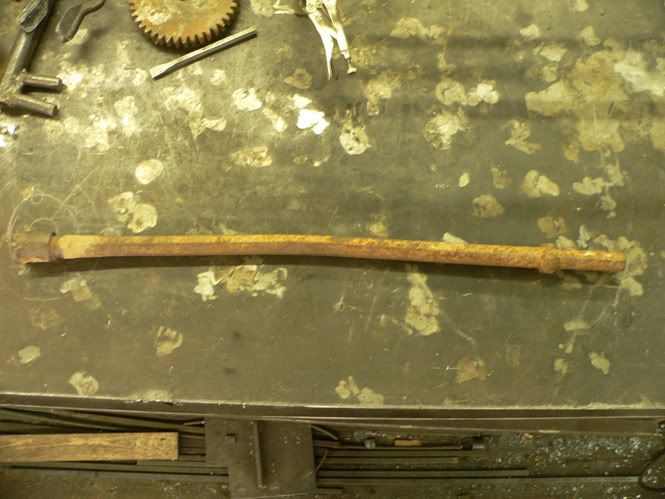
I forged out the tiller handle and made the shaft tonight. I remembered this piece of rusty scrap that I had tucked in one of the cluttered corners of the shop and so went digging. I knew it was faceted and would make a good shaft for the tiller handle to mount to. When I found it I realized that it was a rock drill from some type of very large hammer drilling machine. I knew without a doubt that I had to use it, and use it especially for BBSue, ‘cuase I suspect she may have crossed paths with one of these at some point.
Here it is on the table in the state that I found it in, before straightening the shaft up:
And a close up (albeit blurry) of the removable tip:

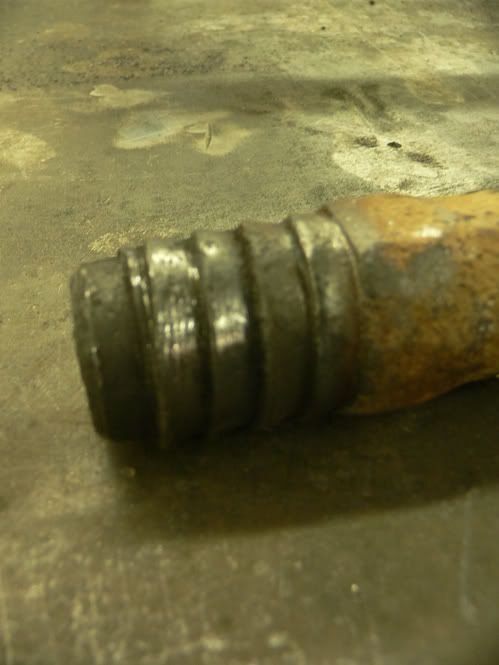
This thing had a special type of thread on it, called a Buttress thread. For those who may not know about that, a Buttress thread is designed to take a lot of pressure in one direction, in this case the load on the tip of the drill. Rather than being shaped like an equilateral triangle (the typical bolt-thread cross-sectional shape), it's shaped more like a right triangle:
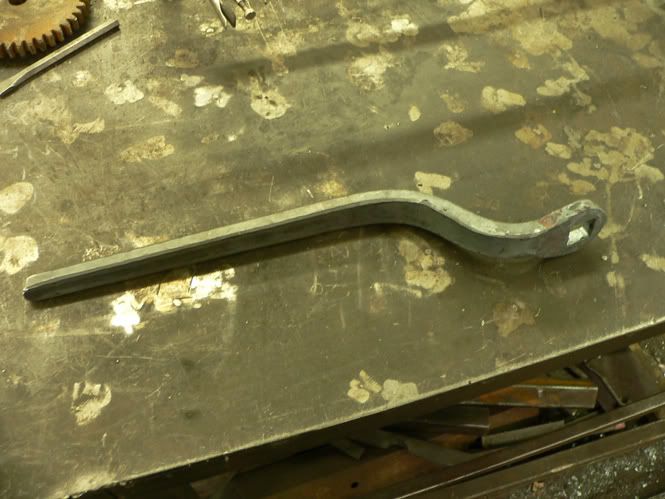
For the handle, I took a piece of 1/2" x 2" flat stock and drew it out to a tapered handle. Then a square hole had to be drifted though the end and then bend it to a curve:
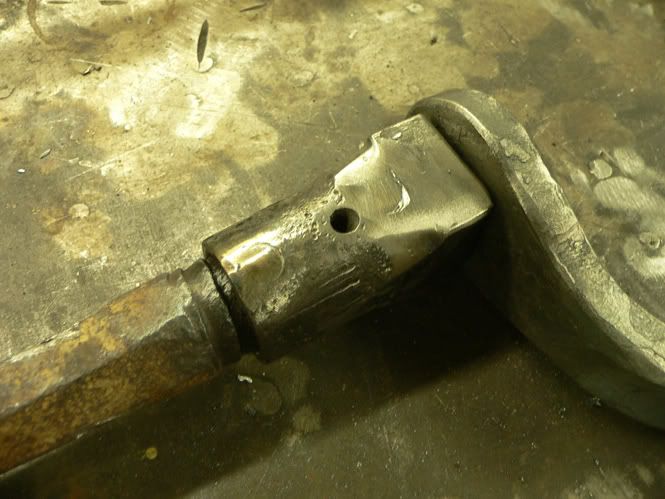
I forged a piece of 1-1/2" stock to have a 1" tenon on the end and fitted it to the handle, sawed it to a short length and welded it to the rock drill's removable tip.
I really wanted those cool threads to be visible in the finished product. Hope this makes you smile, Sue!!
Here it is on the table in the state that I found it in, before straightening the shaft up:
And a close up (albeit blurry) of the removable tip:
This thing had a special type of thread on it, called a Buttress thread. For those who may not know about that, a Buttress thread is designed to take a lot of pressure in one direction, in this case the load on the tip of the drill. Rather than being shaped like an equilateral triangle (the typical bolt-thread cross-sectional shape), it's shaped more like a right triangle:
For the handle, I took a piece of 1/2" x 2" flat stock and drew it out to a tapered handle. Then a square hole had to be drifted though the end and then bend it to a curve:
I forged a piece of 1-1/2" stock to have a 1" tenon on the end and fitted it to the handle, sawed it to a short length and welded it to the rock drill's removable tip.
I really wanted those cool threads to be visible in the finished product. Hope this makes you smile, Sue!!
The New and Improved Black Cat... now with 25% more blather
-
LeChatNoir
- Posts: 5907
- Joined: Mon Sep 01, 2003 8:52 am
- Location: Louisville, Ky
There is some brazing on the frame of the hayrake that I did not completely grind off on purpose. I think it was from a repair where a rivot had broken during it's appartent big crash.unjonharley wrote:I think you are on w/the mill scale.. Now clean your playa gear for some real acid dust..
BTW.. farmer did not have welders.. They brazed.. That would not rust..
The New and Improved Black Cat... now with 25% more blather
-
EspressoDude
- Posts: 4920
- Joined: Tue Jan 24, 2006 7:30 pm
- Location: the first Vancouver
- Contact:
Be f'n careful with that galvanizing zinc......Very poisonous when burned...do it outside and stay upwind...karine wrote:We'll torch the galvanized steel, and then applying patinas.
All your guys's (and girls's) ideas are SO HELPFUL! Thanks!
Is 4 shots enuff? no foo-foo drinks; just naked Espresso
Tactical Espresso Service http://home.comcast.net/~espressocamp/
Field Artillery Tractor
FOGBANK, GOD OF HELLFIRE
BLACK ROCK f/x Trojan Horse,Anubis,2014Temple
burn shit and blow shit up
Tactical Espresso Service http://home.comcast.net/~espressocamp/
Field Artillery Tractor
FOGBANK, GOD OF HELLFIRE
BLACK ROCK f/x Trojan Horse,Anubis,2014Temple
burn shit and blow shit up
-
LeChatNoir
- Posts: 5907
- Joined: Mon Sep 01, 2003 8:52 am
- Location: Louisville, Ky
Always...EspressoDude wrote:Be f'n careful with that galvanizing zinc......Very poisonous when burned...do it outside and stay upwind...karine wrote:We'll torch the galvanized steel, and then applying patinas.
All your guys's (and girls's) ideas are SO HELPFUL! Thanks!
I usually wear a good mask too.
The New and Improved Black Cat... now with 25% more blather

