Melchizedek's name can be translated (from Hebrew)
either as Zedek is my king
or as My king is righteous.
my mind begins to hum...

-
the fire elf

- Posts: 7300
- Joined: Fri Jul 30, 2004 10:43 pm
- Burning Since: 2002
- Location: nation
...
it was a lesson in ignominy:
crucify
c.1300, from O.Fr. crucifer,
from V.L. *crucificare, from L.L. crucifigere "to fasten to a cross,"
from cruci, dat. of L. crux "cross" + figere "fasten" (see fix).
An ancient mode of capital punishment
considered especially ignominious by the Romans.
truth seeker sought truth of:
1. disgrace; dishonor; public contempt.
2. shameful or dishonorable quality or conduct or an instance of this.
crucify
c.1300, from O.Fr. crucifer,
from V.L. *crucificare, from L.L. crucifigere "to fasten to a cross,"
from cruci, dat. of L. crux "cross" + figere "fasten" (see fix).
An ancient mode of capital punishment
considered especially ignominious by the Romans.
truth seeker sought truth of:
1. disgrace; dishonor; public contempt.
2. shameful or dishonorable quality or conduct or an instance of this.
instantiate vacuous truth

-
the fire elf
- Posts: 7300
- Joined: Fri Jul 30, 2004 10:43 pm
- Burning Since: 2002
- Location: nation

-
the fire elf
- Posts: 7300
- Joined: Fri Jul 30, 2004 10:43 pm
- Burning Since: 2002
- Location: nation

...
universe says it's time to start streetfighting training
i choose krav maga
http://en.wikipedia.org/wiki/Krav_maga
Krav Maga generally assumes a no quarter situation;
the attacks and defenses are intended to inflict the most pain possible
on the opponent
in the least amount of time
i choose krav maga
http://en.wikipedia.org/wiki/Krav_maga
Krav Maga generally assumes a no quarter situation;
the attacks and defenses are intended to inflict the most pain possible
on the opponent
in the least amount of time
sphera spinning circa gradually midst photon shaft grazing electron soo flit while neutron's gazing
-
the fire elf
- Posts: 7300
- Joined: Fri Jul 30, 2004 10:43 pm
- Burning Since: 2002
- Location: nation
...
The Pashtun people are an ethno-linguistic group
with populations primarily in eastern and southern Afghanistan
and in the North-West Frontier Province,
Federally Administered Tribal Areas
and Balochistan provinces of Pakistan.
The Pashtuns are typically characterized
by their Pashto language,
adherence to Pashtunwali and Islam.
Pashtuns have survived a turbulent history
over several centuries, during which they have
rarely been politically united.
Pashtun martial prowess has been renowned
since Alexander the Great's invasion in the fourth century BCE.
Pashtuns played a pivotal role in the Soviet war
in Afghanistan,
as many joined the Mujahideen.
The Pashtuns gained world-wide attention
with the rise and fall of the Taliban,
since they were the main ethnic contingent in the movement.
Modern Pashtuns have been prominent
in the rebuilding of Afghanistan
where they are the largest ethnic group
and are an important community in Pakistan,
where they are the second-largest ethnic group.
The Pashtuns are the world's largest segmentary lineage tribal group.
The total population of the group
is estimated to be at least 40 million,
but an accurate count remains elusive
due to the nomadic nature of many tribes,
the practice of secluding women
and the lack of an official census in Afghanistan since 1979.
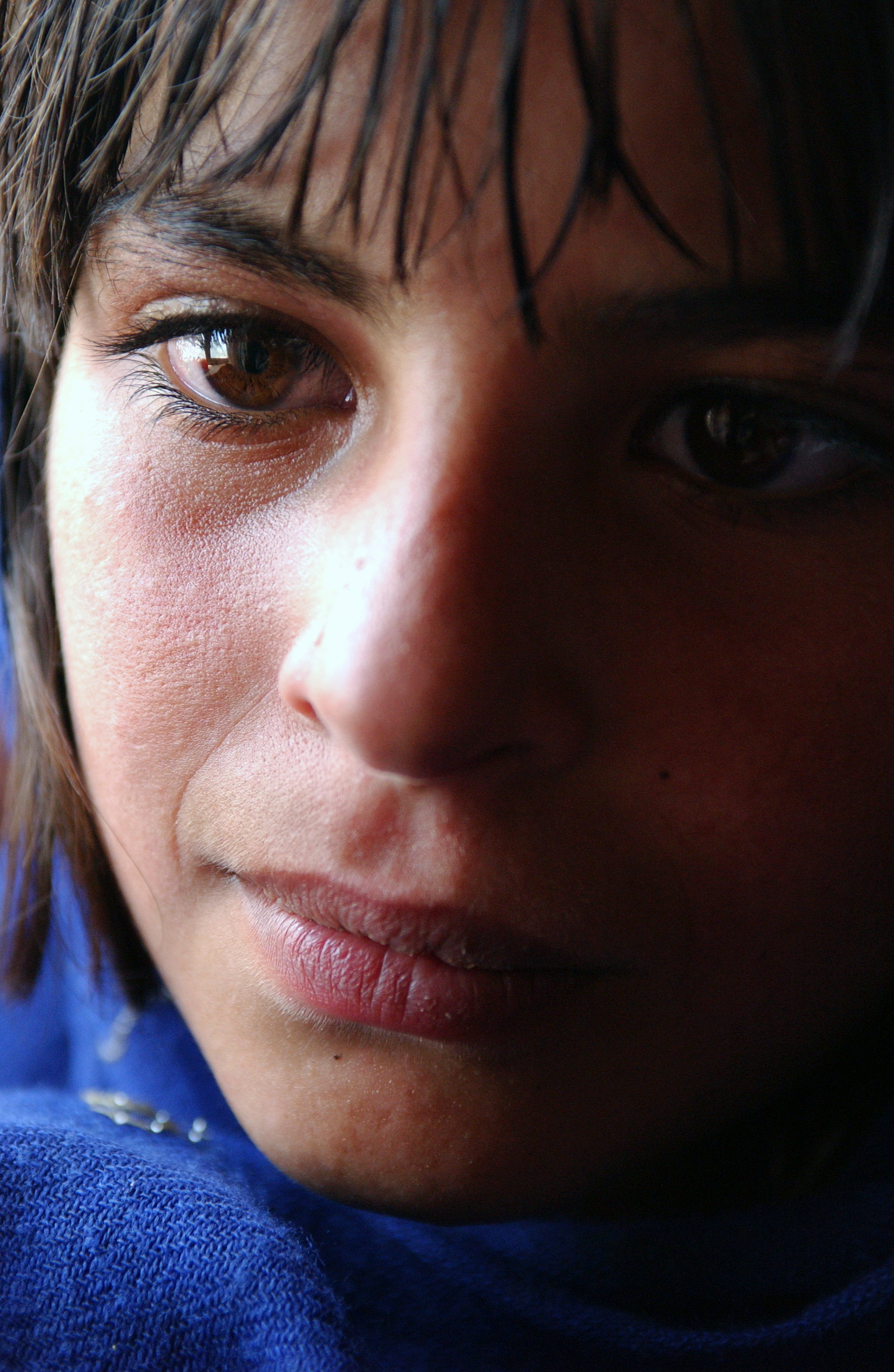
with populations primarily in eastern and southern Afghanistan
and in the North-West Frontier Province,
Federally Administered Tribal Areas
and Balochistan provinces of Pakistan.
The Pashtuns are typically characterized
by their Pashto language,
adherence to Pashtunwali and Islam.
Pashtuns have survived a turbulent history
over several centuries, during which they have
rarely been politically united.
Pashtun martial prowess has been renowned
since Alexander the Great's invasion in the fourth century BCE.
Pashtuns played a pivotal role in the Soviet war
in Afghanistan,
as many joined the Mujahideen.
The Pashtuns gained world-wide attention
with the rise and fall of the Taliban,
since they were the main ethnic contingent in the movement.
Modern Pashtuns have been prominent
in the rebuilding of Afghanistan
where they are the largest ethnic group
and are an important community in Pakistan,
where they are the second-largest ethnic group.
The Pashtuns are the world's largest segmentary lineage tribal group.
The total population of the group
is estimated to be at least 40 million,
but an accurate count remains elusive
due to the nomadic nature of many tribes,
the practice of secluding women
and the lack of an official census in Afghanistan since 1979.
instantiate vacuous truth


http://en.wikipedia.org/wiki/Ishayas%27_Ascension#Comparison_with_Transcendental_Meditation wrote:Ascension has the following similarities & differences from Transcendental Meditation:
Similarities:
* Use of a puja ceremony
* Mental recitation of a phrase
* Similar theory of consciousness (7 levels, etc.)
Differences:
* TM uses a non-English mantra; Ascension Attitudes are given in the student's native language
* TM students receive one mantra; Ascension has multiple Attitudes
* TM mantra does not change for the life of the student; Ascension attitudes include a component which can change at will
(though to the non-traditional ascenders it may well be that: ceremony, recitation used as a crutch, and theories are merely acculturated thoughts)
-
the fire elf
- Posts: 7300
- Joined: Fri Jul 30, 2004 10:43 pm
- Burning Since: 2002
- Location: nation



-
the fire elf
- Posts: 7300
- Joined: Fri Jul 30, 2004 10:43 pm
- Burning Since: 2002
- Location: nation


-
the fire elf
- Posts: 7300
- Joined: Fri Jul 30, 2004 10:43 pm
- Burning Since: 2002
- Location: nation


-
the fire elf
- Posts: 7300
- Joined: Fri Jul 30, 2004 10:43 pm
- Burning Since: 2002
- Location: nation
...
The basic processes of DNA repair
are highly conserved among both prokaryotes and eukaryotes
and even among bacteriophage (viruses that infect bacteria);
however, more complex organisms with more complex genomes
have correspondingly more complex repair mechanisms.[31]
The ability of a large number of protein structural motifs
to catalyze relevant chemical reactions
has played a significant role in the elaboration of repair
mechanisms during evolution.
For an extremely detailed review of hypotheses
relating to the evolution of DNA repair, see.[32]
The fossil record indicates that single celled life began
to proliferate on the planet
at some point during the Precambrian period,
although exactly when recognizably modern life first emerged
is unclear.
Nucleic acids became the sole and universal means of encoding
genetic information, requiring DNA repair mechanisms
that in their basic form have been inherited
by all extant life forms
from their common ancestor.
The emergence of Earth's oxygen-rich atmosphere
(known as the "oxygen catastrophe")
due to photosynthetic organisms,
as well as the presence of potentially damaging free radicals in the cell
due to oxidative phosphorylation,
necessitated the evolution of DNA repair mechanisms
that act specifically to counter the types of damage
induced by oxidative stress.
[edit] Rate of evolutionary change
On some occasions, DNA damage is not repaired,
or is repaired by an error-prone mechanism
which results in a change from the original sequence.
When this occurs, mutations may propagate into the genomes
of the cell's progeny.
Should such an event occur in a germ line cell
that will eventually produce a gamete,
the mutation has the potential to be passed on
to the organism's offspring.
The rate of evolution in a particular species
(or, more narrowly, in a particular gene)
is a function of the rate of mutation.
Consequently, the rate and accuracy of DNA repair mechanims
have an influence over the process of evolutionary change.[33]
------------------------------------------------------------------------------------
[31]^ Cromie GA, Connelly JC, Leach DR (2001). Recombination at double-strand breaks and DNA ends: conserved mechanisms from phage to humans. Mol Cell. 8(6):1163–74.
[32]^ O'Brien PJ. (2006). Catalytic promiscuity and the divergent evolution of DNA repair enzymes. Chem Rev 106(2):720–52.
[33]^ Maresca B, Schwartz JH (2006). Sudden origins: a general mechanism of evolution based on stress protein concentration and rapid environmental change. Anat Rec B New Anat. Jan;289(1):38–46
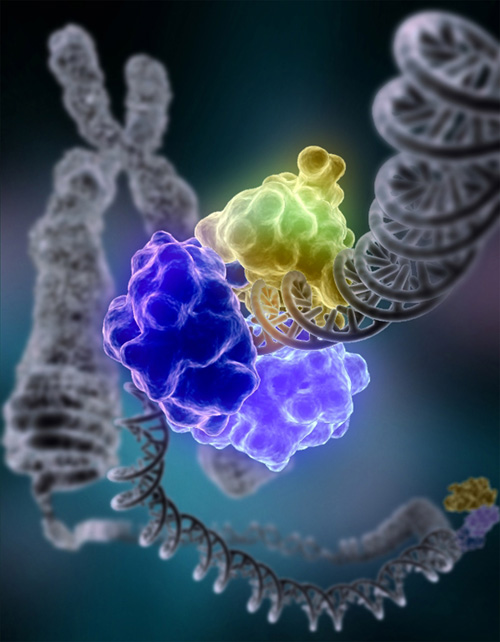
DNA damage,
due to environmental factors and normal metabolic processes
inside the cell,
occurs at a rate of 1,000 to 1,000,000 molecular lesions per cell per day.
A special enzyme, DNA ligase (shown here in color),
encircles the double helix to repair a broken strand of DNA.
DNA ligase is responsible for repairing the millions of DNA breaks
generated during the normal course of a cell's life.
Without molecules that can mend such breaks,
cells can malfunction, die, or become cancerous.
DNA ligases catalyse the crucial step of joining breaks in duplex DNA
during DNA repair, replication and recombination,
and require either Adenosine triphosphate (ATP)
or Nicotinamide adenine dinucleotide (NAD+)
as a cofactor.
Shown here is DNA ligase I repairing chromosomal damage.
The three visable protein structures are:
The DNA binding domain (DBD)
which is bound to the DNA minor groove both upstream and downstream
of the damaged area.
The OB-fold domain (OBD)
unwinds the DNA slightly over a span of six base pairs
and is generally involved in nucleic acid binding.
The Adenylation domain (AdD)
contains enzymatically active residues
that join the broken nucleotides together
by catalyzing the formation of an internucleotide ester bond
between phosphate and deoxyribose.
It is likely that all mammalian DNA ligases
(Ligases I, III, and IV)
have a similar ring-shaped architecture
and are able to recognize DNA in a similar manner.
are highly conserved among both prokaryotes and eukaryotes
and even among bacteriophage (viruses that infect bacteria);
however, more complex organisms with more complex genomes
have correspondingly more complex repair mechanisms.[31]
The ability of a large number of protein structural motifs
to catalyze relevant chemical reactions
has played a significant role in the elaboration of repair
mechanisms during evolution.
For an extremely detailed review of hypotheses
relating to the evolution of DNA repair, see.[32]
The fossil record indicates that single celled life began
to proliferate on the planet
at some point during the Precambrian period,
although exactly when recognizably modern life first emerged
is unclear.
Nucleic acids became the sole and universal means of encoding
genetic information, requiring DNA repair mechanisms
that in their basic form have been inherited
by all extant life forms
from their common ancestor.
The emergence of Earth's oxygen-rich atmosphere
(known as the "oxygen catastrophe")
due to photosynthetic organisms,
as well as the presence of potentially damaging free radicals in the cell
due to oxidative phosphorylation,
necessitated the evolution of DNA repair mechanisms
that act specifically to counter the types of damage
induced by oxidative stress.
[edit] Rate of evolutionary change
On some occasions, DNA damage is not repaired,
or is repaired by an error-prone mechanism
which results in a change from the original sequence.
When this occurs, mutations may propagate into the genomes
of the cell's progeny.
Should such an event occur in a germ line cell
that will eventually produce a gamete,
the mutation has the potential to be passed on
to the organism's offspring.
The rate of evolution in a particular species
(or, more narrowly, in a particular gene)
is a function of the rate of mutation.
Consequently, the rate and accuracy of DNA repair mechanims
have an influence over the process of evolutionary change.[33]
------------------------------------------------------------------------------------
[31]^ Cromie GA, Connelly JC, Leach DR (2001). Recombination at double-strand breaks and DNA ends: conserved mechanisms from phage to humans. Mol Cell. 8(6):1163–74.
[32]^ O'Brien PJ. (2006). Catalytic promiscuity and the divergent evolution of DNA repair enzymes. Chem Rev 106(2):720–52.
[33]^ Maresca B, Schwartz JH (2006). Sudden origins: a general mechanism of evolution based on stress protein concentration and rapid environmental change. Anat Rec B New Anat. Jan;289(1):38–46
DNA damage,
due to environmental factors and normal metabolic processes
inside the cell,
occurs at a rate of 1,000 to 1,000,000 molecular lesions per cell per day.
A special enzyme, DNA ligase (shown here in color),
encircles the double helix to repair a broken strand of DNA.
DNA ligase is responsible for repairing the millions of DNA breaks
generated during the normal course of a cell's life.
Without molecules that can mend such breaks,
cells can malfunction, die, or become cancerous.
DNA ligases catalyse the crucial step of joining breaks in duplex DNA
during DNA repair, replication and recombination,
and require either Adenosine triphosphate (ATP)
or Nicotinamide adenine dinucleotide (NAD+)
as a cofactor.
Shown here is DNA ligase I repairing chromosomal damage.
The three visable protein structures are:
The DNA binding domain (DBD)
which is bound to the DNA minor groove both upstream and downstream
of the damaged area.
The OB-fold domain (OBD)
unwinds the DNA slightly over a span of six base pairs
and is generally involved in nucleic acid binding.
The Adenylation domain (AdD)
contains enzymatically active residues
that join the broken nucleotides together
by catalyzing the formation of an internucleotide ester bond
between phosphate and deoxyribose.
It is likely that all mammalian DNA ligases
(Ligases I, III, and IV)
have a similar ring-shaped architecture
and are able to recognize DNA in a similar manner.
-
the fire elf
- Posts: 7300
- Joined: Fri Jul 30, 2004 10:43 pm
- Burning Since: 2002
- Location: nation
...

Amid a network of blood vessels and star-shaped support cells,
neurons in the brain signal each other.
The mists of color show the flow of important molecules
like glucose and oxygen.
This image is a snapshot from a 52-second simulation
created by animation artist Kim Hager
at the University of California, Los Angeles.
Such visualizations make biological processes more accessible
and easier to understand.


-
the fire elf
- Posts: 7300
- Joined: Fri Jul 30, 2004 10:43 pm
- Burning Since: 2002
- Location: nation
...
http://en.wikipedia.org/wiki/Samadhi wrote:Nirvikalpa Samadhi is the end result.
There are no more kalpas (imaginings, wishes or other products
from work of the mind),
because the mind is finally under control.
Upon entering Nirvikalpa Samadhi, the differences we saw before
have faded and we can see everything as one.
In this condition nothing but pure Awareness remains
and nothing is missing to take away from Wholeness and Perfection.
Entering samadhi in the beginning takes effort
and holding on to a state of samadhi takes even more effort.
The beginning stages of samadhi (Laja and Savikalpa Samadhi)
are only temporary.
By "effort" it is not meant that the mind has to work more.
Instead, it means work to control the mind and release the self.
Note that normal levels of meditation (mostly the lower levels)
can be held automatically, as in "being in the state of meditation"
rather than overtly "meditating."
The ability to obtain positive results from meditation
is much more difficult than simply meditating.
instantiate vacuous truth

-
the fire elf
- Posts: 7300
- Joined: Fri Jul 30, 2004 10:43 pm
- Burning Since: 2002
- Location: nation
...

Incorruptibility is the property of a body — usually a human body —
that does not decompose after death.
Such a body is sometimes referred to as incorruptible (adjective)
or as an incorruptible (noun).
Incorruptibility is seen as distinct from the good preservation of a body,
or mummification.
Incorruptible bodies are often said to have the Odour of Sanctity,
a sweet smell.
In Anglican, Catholic and Orthodox Christian cultures,
if a body remains incorruptible after death,
this is generally seen to be a sign that the individual is a Saint.
The converse is not true: not every Saint is expected to have
an incorruptible corpse.
According to the Catholic Church, a body is not deemed incorruptible
if it has undergone an embalming process
or other means of preserving the dead.
In other cultures, however, an incorrupted body is a sign that the corpse is a vampire.
The opposite is also true.
Bodies that had decayed too fast were also treated as vampires.
The causes of incorruptibility are disputed.
The two main positions can be summarized as an argument for a spiritual cause,
or an argument for a physical or environmental cause.
The argument for a spiritual cause may include a belief
that the pious nature of the individual in some way permeated the flesh
(a metaphysical cause having a physical effect),
or a belief that decomposition was prevented
by the intervention of a deity.
The argument for a physical cause includes a belief
that the corpse has been subjected to environmental conditions
such that decomposition is seriously retarded.
There are a number of ways of retarding decomposition,
but the mechanism commonly stated is that of saponification.
Incorruptibility is seen almost overwhelmingly
only in Anglican, Catholic or Orthodox Christian cultures.
However, it is argued by some
that this is more due to the cultural phenomenon
of exhuming the bodies of pious people
to discover if they are incorrupt or not,
a practice that is uncommon in other cultures,
even other Christian cultures.
Instances of incorruptibility
Among the Saints and holy men and women whose bodies are said to be or have been incorrupt are (also see list in The Incorruptibles):
Christian
* St. Agnes of Montepulciano-Roman Catholic Nun
* St. Alexander of Svir, Russian Orthodox monk
* Sts. Anthony, John, and Eustathios, Russian Orthodox martyrs of Vilnius
* St. Bernadette-Visionary of Lourdes, Roman Catholic Nun
* St. Casimir, Patron of Poland and Lithuania- Roman Catholic
* St. Catherine Labouré- Roman Catholic Nun
* St. Charbel Maklouf, Maronite Roman Catholic monk
* St. Clare of Assisi- Roman Catholic Nun
* St. Cuthbert- Roman Catholic
* St. Frances Xavier Cabrini (Mother Cabrini)USA- Roman Catholic Nun
* St. Francis Xavier- Apostel of the Far East - Roman Catholic Missionary (History of His Incorrupt Body)
* Innocent of Irkutsk, Orthodox saint
* Blessed Jacinta Marto, visionary at Fatima- Roman Catholic
* St. John Vianney (Jean Vianney), Roman Catholic, parish priest of Ars
* John of Shanghai and San Francisco, Orthodox saint
* Saint Louise de Marillac- Roman Catholic Nun
* Blessed Queen Mafalda of Portugal- Roman Catholic
* St. Margaret Mary (Marie Alacoque)- Roman Catholic Nun
* St. Matrona of Chios, Orthodox saint
* Pope Pius IX - Roman Catholic
* Pope St. Pius X - Roman Catholic
* Pope John XXIII, Blessed - Roman Catholic
* St. Raphael (Hawaweeny) of Brooklyn, Orthodox saint
* St. Rita of Cascia- Roman Catholic Nun
* St. Vincent de Paul- Roman Catholic Priest
* Vissarion Korkoliacos, Greek Orthodox monk
* Blessed Anna Marie Taigi - Roman Catholic
* St. Catherine of Bologna - Roman Catholic
* St. John Bosco - Roman Catholic
* St. Maria Mazarello - Roman Catholic
* St. John Newmann - Roman Catholic
* St. Cicelia - Roman Catholic Martyr
* St. Zita - Roman Catholic
* St. Clare of Montepulciano - Roman Catholic Nun
* St. Veronica Giulianni - Roman Catholic Nun
* Blessed Imelda - Roman Catholic Dominican Nun
* Blessed Margareth of Castello - Roman Catholic
Other:
* Dashi-Dorzho Itigilov and three other Buddhist holy men
* Huineng, Zen Buddhist Patriarch
* Ramakrishna Paramahansa, Hindu holy man
* Paramahansa Yogananda, Hindu holy man
The mechanism of DNA ligase is to form covalent phosphodiester bonds
between 3' hydroxyl ends of one nucleotide with the 5' phosphate end of another.
ATP is required for the ligase reaction.
A pictorial example of how a ligase works (with sticky ends):

becomes

Ligase will also work with blunt ends, although higher enzyme concentrations and different reaction conditions are required.

-
the fire elf
- Posts: 7300
- Joined: Fri Jul 30, 2004 10:43 pm
- Burning Since: 2002
- Location: nation


-
the fire elf
- Posts: 7300
- Joined: Fri Jul 30, 2004 10:43 pm
- Burning Since: 2002
- Location: nation

-
the fire elf
- Posts: 7300
- Joined: Fri Jul 30, 2004 10:43 pm
- Burning Since: 2002
- Location: nation