

Hey peeps,
I saw some amazing UV (blacklight) LED blinkies this year at BM and must have some! They are the watch-stlye battery operated kind with a magnet on the back. Like these but UV:
http://www.buyglow.com/?content=51&category_id=18
Anyone know where I can find some? Its for a performance here in Seattle.
Peas!
-skinbyte
Looking for UV LED blinkies
-
Leesh4ever
- Posts: 1
- Joined: Fri May 23, 2008 1:15 pm
Skinbyte
Hey you....you will know who this is, if it is who I think it is.....
Hope all is well. Sorry no info on your question, but just wanted to say HI!
Hope all is well. Sorry no info on your question, but just wanted to say HI!
-
working_class_hero
- Posts: 7
- Joined: Sun Jun 08, 2008 9:31 am
- Location: seattle
- Contact:


-
Teo del Fuego
- Posts: 1391
- Joined: Wed Dec 07, 2005 10:31 am
- Burning Since: 2005
-
Ugly Dougly

- Posts: 17612
- Joined: Wed Sep 10, 2003 9:31 am
- Burning Since: 1996
- Location: เชียงใหม่
http://www.tireflys.com/bicycle.html
Dangerous? I doubt it. You're probably getting more UV light being out on the playa without sunglasses. Although if anyone has specs on the little blinkers, please share.
Dangerous? I doubt it. You're probably getting more UV light being out on the playa without sunglasses. Although if anyone has specs on the little blinkers, please share.
I wear UV protection on and off the playa.
Even the blue-black filtered black lights I have upset my ophthalmologist.
I think it's a matter of cumulative damage, but the intensity from a source with low visible light dumps a high load into dilated pupils.
The visible light from the fluorescence itself is safe.
Like many things, by the time you detect a problem personally, it's too late.
Even the blue-black filtered black lights I have upset my ophthalmologist.
I think it's a matter of cumulative damage, but the intensity from a source with low visible light dumps a high load into dilated pupils.
The visible light from the fluorescence itself is safe.
Like many things, by the time you detect a problem personally, it's too late.
-
Ugly Dougly
- Posts: 17612
- Joined: Wed Sep 10, 2003 9:31 am
- Burning Since: 1996
- Location: เชียงใหม่
I picked up a new flashlight at REI recently- (I have CFRAS, Compulsive Flashlight and Radio Acquisition Syndrome) It's made by Gerber and has a little dial that allows you to choose from white, red, blue, green OR yoo-vee LEDs, plus has a clippy fob with a strong magnet and velcro. But it has a "clever" springloaded clip that allows you to remove the light from the fob/beltclip for use as a keyring light and I've almost lost it at least twice because of that. GOOP to the rescue!
Howdy From Kalamazoo
Robotland, do you have one of each of the lights on here yet?
http://ledmuseum.home.att.net/ledleft.htm
http://ledmuseum.home.att.net/museum.htm
The LED Museum is an incredible resource.
The guy doing it, does it all himself.
If you find it useful, donate a dollar or two.
These are interesting.
http://www.elektrolumens.com/
http://ledmuseum.home.att.net/ledleft.htm
http://ledmuseum.home.att.net/museum.htm
The LED Museum is an incredible resource.
The guy doing it, does it all himself.
If you find it useful, donate a dollar or two.
These are interesting.
http://www.elektrolumens.com/
-
Ugly Dougly
- Posts: 17612
- Joined: Wed Sep 10, 2003 9:31 am
- Burning Since: 1996
- Location: เชียงใหม่
I can't be sure what a maximum output is.
I can't make any conclusions about the levels I found without more reference levels.
The measured output from some pure color LEDs is small, but being a pure frequency, can be too intense to look at.
I think the 350 is from a curing uv, which is probably a different frequency.
Any figures will be almost pure UV.
One warning says that you can test a source through your glasses and if you still get fluorescence, that is too high a level.
Every source I looked up referred to warnings about off-axis and reflected light too.
I found some specific symptoms that show up quickly but most problems are related to cumulative lifetime exposure.
There is also a warning about anyone under thirty being much more vulnerable to uv.
There appear to be no safe exposure levels at younger ages.
The output from the better LEDs is almost pure UV in a specific frequency, so it may be very intense compared to the same output in visible light.
I don't have enough info or reference points to make a comparison, but it is supposed to be possible to get a strong reaction from a large poster with one LED. That sounds intense enough to be of concern.
I have a friend who's been slowly going blind from macular degeneration.
He was born at high altitude and the higher UV exposure there may very well be a factor, if not the cause.
He's not having a good time.
I think the warnings about not exposing eyes to the direct beam from these is well taken.
When I see people use these in a lab, they always wear protection and that is not even for direct exposure.
Repeating:
YOUNG CHILDREN HAVE NO SHIELDING IN THEIR EYES TO UV EXPOSURE.
Some develops by age 30.
Half of lifetime exposure is often by age 15.
I can't make any conclusions about the levels I found without more reference levels.
The measured output from some pure color LEDs is small, but being a pure frequency, can be too intense to look at.
I think the 350 is from a curing uv, which is probably a different frequency.
Any figures will be almost pure UV.
One warning says that you can test a source through your glasses and if you still get fluorescence, that is too high a level.
Every source I looked up referred to warnings about off-axis and reflected light too.
I found some specific symptoms that show up quickly but most problems are related to cumulative lifetime exposure.
There is also a warning about anyone under thirty being much more vulnerable to uv.
There appear to be no safe exposure levels at younger ages.
The output from the better LEDs is almost pure UV in a specific frequency, so it may be very intense compared to the same output in visible light.
I don't have enough info or reference points to make a comparison, but it is supposed to be possible to get a strong reaction from a large poster with one LED. That sounds intense enough to be of concern.
I have a friend who's been slowly going blind from macular degeneration.
He was born at high altitude and the higher UV exposure there may very well be a factor, if not the cause.
He's not having a good time.
I think the warnings about not exposing eyes to the direct beam from these is well taken.
When I see people use these in a lab, they always wear protection and that is not even for direct exposure.
Repeating:
YOUNG CHILDREN HAVE NO SHIELDING IN THEIR EYES TO UV EXPOSURE.
Some develops by age 30.
Half of lifetime exposure is often by age 15.
-
Ugly Dougly
- Posts: 17612
- Joined: Wed Sep 10, 2003 9:31 am
- Burning Since: 1996
- Location: เชียงใหม่
LEDs are very directional. I can't tell if the product literature is measuring point power or overall power.
If you're doing an installation, it would not hurt A DAMN BIT to shield the LEDs from direct exposure.
http://www.safety.rochester.edu/ih/uvlight.html
Tanning Booth:
LED:
If you're doing an installation, it would not hurt A DAMN BIT to shield the LEDs from direct exposure.
http://www.safety.rochester.edu/ih/uvlight.html
http://www.puretan.net/Puretan/Puretan- ... dia1Id=419There is no Occupational Safety and Health Administration (OSHA) standard for exposure to ultraviolet light, but the National Institute for Occupational Safety and Health (NIOSH) recommends that the time of exposure to an intensity of 100 microwatts per square centimeter at wavelength 254 nanometers not exceed 1 minute. When averaged over an eight-hour work day, this value is 0.2 microwatts per square centimeter.
Tanning Booth:
http://home.att.net/~ledmuseum/leduv.htmElectrical Requirements
- 218-232v, 60a dedicated single phase circuit (70-amp with facial)
Dimensional Specifications
- Tube Lift: 84.75"L x 50.5"W
- Gas Pistons: 84.5"L x 48"W
Lamp Options
- Canopy: 21 puretan VHO/R+ or VHO/RF+
- Couch: 21 puretan Spectralarium VHO/R+
Facial Lamp Options
- 8 Cosmo-Tech/ Phillips 400W high-pressure quartz
Tanning Session Time
- Maximum 10 Minutes
CSA/NRTL certified for your safety and protection
LED:
I wouldn't really worry about it. (BTW, I wrote safety regs for a major laser company.)According to my unbelievably crude TDC Mark VII power measuring apparatus, this LED has an optical output of 0.315mW (315µW - µW=microwatts) at a forward current (If) of 20.52mA.
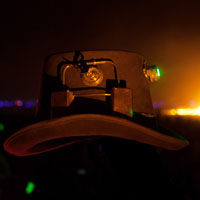
Hmm, last week I got up some UV Lazer LEDs (from another site). The idea is to embed them in phosphorescent material so they wouldn't be directly visible.
-
Teo del Fuego
- Posts: 1391
- Joined: Wed Dec 07, 2005 10:31 am
- Burning Since: 2005
I bought a 100 UV LEDS offa some Hong Kong site on the internet, no problems, Very cheap, I think $5-6 bucks for the lot. (Resistors cost about the same.) For UV LEDS to harm your eyesight you would need to tape them directly to your eyeballs. Otherwise, only those unfamiliar with them or professional nervous nelly types need to fear.
For my bike I put the LEDS inside of white ping pong balls to make a larger glowing effect. It worked mighty nice, I must say. Also used UV LEDs in my Steampunk Bike to illouminate the dial gages.
For my bike I put the LEDS inside of white ping pong balls to make a larger glowing effect. It worked mighty nice, I must say. Also used UV LEDs in my Steampunk Bike to illouminate the dial gages.