


I got sick and tired of the finickyness of EL-Wire technology and devised a way to use high power LED's and Fiber Optic cable to achieve the same effect as EL-Wire, but with far better colors and without the high voltage.
Here is a PDF Document that I want to share with you on how I constructed my lighted clothing using this technology:
http://www.allyn.com/Bike_lighting.pdf
Truly,
Cleara
Document on how to create LED driven light tubes
-
Kinetik V

- Posts: 1652
- Joined: Fri Sep 07, 2007 10:43 am
- Burning Since: 2002
- Camp Name: Sanctuary West
I've had the same trouble with HID lighting that you described plus I've wanted to do some things to make my bike more visible at night when riding in downtown Denver. I think you just posted a viable solution to my challenges with your PDF. THANK YOU!
Kinetic V
~~~~~~
I bring order to chaos. And I bring chaos to those who deserve it, wherever that may be.
~~~~~~
I bring order to chaos. And I bring chaos to those who deserve it, wherever that may be.

Brightness is comprable with EL-Wire, but more corrent
The brightness is comprable wiht EL-Wire. However, it will be drawing slightly more current. In fact, with some of the colors, mainly the 'warm' colors of orange, red, and yellow, you will get brighter results.
If I have a length of side emitting fiber that's three feet or less, I can illuminate it with one high power LED at one end. However, it it's over three feet, then I put an LED at each end.
Each LED takes up to 350 milliampres. However, I operate them at about 200 to 250 because I am conservative and don't want to overheat any.
You can achieve some interesting results if you put a different color LED at each end.
The entire jacket that I made pulls about two and a half amps at 12 volts. I group the LED's in clusters of 3 with a current dropping resistor. The full lengh clear vinyl raincoat pulls about 4.5 amps.
Cleara
If I have a length of side emitting fiber that's three feet or less, I can illuminate it with one high power LED at one end. However, it it's over three feet, then I put an LED at each end.
Each LED takes up to 350 milliampres. However, I operate them at about 200 to 250 because I am conservative and don't want to overheat any.
You can achieve some interesting results if you put a different color LED at each end.
The entire jacket that I made pulls about two and a half amps at 12 volts. I group the LED's in clusters of 3 with a current dropping resistor. The full lengh clear vinyl raincoat pulls about 4.5 amps.
Cleara

Dork, I posted about Allyn's stuff on eplaya before.
How did you miss it?
http://eplaya.burningman.org/viewtopic. ... ire#384347
And you were on this thread, Dork!
http://eplaya.burningman.org/viewtopic. ... ire#371200
I posted some much longer ago too.
There are tri-color LEDs now that can shift color.
Allyn, how about posting all the material here on the thread so it can be referred to without loading the pdf?
I think it will be useful.
The different color choices with LEDs seem to be a big plus.
How do the wide angle LEDs work with the fiber optics, such as the Luxeons?
How did you miss it?
http://eplaya.burningman.org/viewtopic. ... ire#384347
And you were on this thread, Dork!
http://eplaya.burningman.org/viewtopic. ... ire#371200
I posted some much longer ago too.
There are tri-color LEDs now that can shift color.
Allyn, how about posting all the material here on the thread so it can be referred to without loading the pdf?
I think it will be useful.
The different color choices with LEDs seem to be a big plus.
How do the wide angle LEDs work with the fiber optics, such as the Luxeons?
Tri Color LED's
Folks:
Just to let you know, I did look into the tri color LED's, both the low power variety as well as the Luxeon high power tri color LED's.
The issue that I have is that the side emitting optical fiber is too narrow in order to all three of the individual color emitters to properly 'face' the end of the fiber; ie; very little of the light from each emitter would end up going into the fiber because the fiber was not lined up with emitter.
In order to use the tri color LED's I would have to use 1/4 inch wide side emitting fiber. That is much too large and stiff for my clothing.
Perhaps if you want to outline a vehicle or a large sculpture, you can use 1/4 inch diameter fiber, but it also expensive (about $2.50 to $3.00 per foot.
Cleara
Just to let you know, I did look into the tri color LED's, both the low power variety as well as the Luxeon high power tri color LED's.
The issue that I have is that the side emitting optical fiber is too narrow in order to all three of the individual color emitters to properly 'face' the end of the fiber; ie; very little of the light from each emitter would end up going into the fiber because the fiber was not lined up with emitter.
In order to use the tri color LED's I would have to use 1/4 inch wide side emitting fiber. That is much too large and stiff for my clothing.
Perhaps if you want to outline a vehicle or a large sculpture, you can use 1/4 inch diameter fiber, but it also expensive (about $2.50 to $3.00 per foot.
Cleara
-
Kinetik V
- Posts: 1652
- Joined: Fri Sep 07, 2007 10:43 am
- Burning Since: 2002
- Camp Name: Sanctuary West
The 1/4 inch fiber sounds like what I need to put auxiliary lighting under a 4x4 pickup and my trailer. I need something that can take some abuse (think excessive vibration)...I tried el-wire which didn't last long. I'm trying to put something together so that if I needed to check for damage or change a tire I can flip the switch and have lighting without looking for a flashlight with dead batteries at 2 am on the side of I-80...I don't want to repeat that experience again.
Two questions...do you know how well the fiber holds up to high heat and if it's chemical resistant?
Two questions...do you know how well the fiber holds up to high heat and if it's chemical resistant?
Kinetic V
~~~~~~
I bring order to chaos. And I bring chaos to those who deserve it, wherever that may be.
~~~~~~
I bring order to chaos. And I bring chaos to those who deserve it, wherever that may be.
-
Kinetik V
- Posts: 1652
- Joined: Fri Sep 07, 2007 10:43 am
- Burning Since: 2002
- Camp Name: Sanctuary West
I HATE GLASS. I've had many bad experiences with it, don't want tubes, don't want filaments inside of shatterprone glass tubes; save the glass for window panes, drinking glasses, and flower vases. Did I mention that I freakin >> HATE << GLASS?
Besides...Jungo Road would make quick work of anything glass for the project I have in mind.
Besides...Jungo Road would make quick work of anything glass for the project I have in mind.
Kinetic V
~~~~~~
I bring order to chaos. And I bring chaos to those who deserve it, wherever that may be.
~~~~~~
I bring order to chaos. And I bring chaos to those who deserve it, wherever that may be.
Side Emitting Fiber Optics is Plastic
The side emitting optic fiber is plastic. It cannot be subjected to any heat at all.
It also cannot be in the cold and bent back and forth often. I am having problems with the light pipes in my raincoat cracking if I am outside and it's below 30 degreens. I have had to replace a few.
For under a vehicle, I would suggest using the 1/4 inch fiber and then insert that into 3/8th inch ID clear PVC tubing. Then clamp that onto whatever.
I am assuming, of course, that it will be affixed to either the trailer or the vehicle; ie; two separate pieces; and not one that will be flexing with the trailer hitch.
And, I am assuming that it will be no where near the exhaust system, especialy the muffler or the catalytic converter, which, I understand, gets very hot.
Despite these limitations, I feel that it is more robust than compact flourescents or anything else with glass or filiments.
If you plan to use this for illumination (not decoration), then I would strongly reccomend two LED's one at each end. Also look into the Luxeon white LED's. They have some whites ones that are more power than the colored ones. Some of them run on 500 milliampres.
Cleara
It also cannot be in the cold and bent back and forth often. I am having problems with the light pipes in my raincoat cracking if I am outside and it's below 30 degreens. I have had to replace a few.
For under a vehicle, I would suggest using the 1/4 inch fiber and then insert that into 3/8th inch ID clear PVC tubing. Then clamp that onto whatever.
I am assuming, of course, that it will be affixed to either the trailer or the vehicle; ie; two separate pieces; and not one that will be flexing with the trailer hitch.
And, I am assuming that it will be no where near the exhaust system, especialy the muffler or the catalytic converter, which, I understand, gets very hot.
Despite these limitations, I feel that it is more robust than compact flourescents or anything else with glass or filiments.
If you plan to use this for illumination (not decoration), then I would strongly reccomend two LED's one at each end. Also look into the Luxeon white LED's. They have some whites ones that are more power than the colored ones. Some of them run on 500 milliampres.
Cleara
-
Kinetik V
- Posts: 1652
- Joined: Fri Sep 07, 2007 10:43 am
- Burning Since: 2002
- Camp Name: Sanctuary West
I like the PVC tubing idea...that may work. I've used an IR handheld thermometer to develop a crude heatmap of the vehicle so I think I can work something out...the PVC tubing would help with expanding placement options... and yes...2 separate pieces, actually 2 completely independent projects. Heck I see lots of potential applications for these materials for projects. And yes I would doublepump the fiber too.
Gyre: Murphy's Law certainly loves to come into play on road trips. I want stuff that I can hardmount and I know it's there, that is pretty robust and has a high likelihood of working when I need it. I want something that I can hardwire, and I don't have to hold on to when I've got trucks blasting by me at 75 mph.
This idea might also be adapted for use to light up the back platform of a pickup that is used for loading / unloading a motorized scooter...she doesn't like to go out at night anymore because loading and unloading the scooter in the dark is such a pain. So a little bit of supplemental lighting might be just the thing for that application.
Gyre: Murphy's Law certainly loves to come into play on road trips. I want stuff that I can hardmount and I know it's there, that is pretty robust and has a high likelihood of working when I need it. I want something that I can hardwire, and I don't have to hold on to when I've got trucks blasting by me at 75 mph.
This idea might also be adapted for use to light up the back platform of a pickup that is used for loading / unloading a motorized scooter...she doesn't like to go out at night anymore because loading and unloading the scooter in the dark is such a pain. So a little bit of supplemental lighting might be just the thing for that application.
Kinetic V
~~~~~~
I bring order to chaos. And I bring chaos to those who deserve it, wherever that may be.
~~~~~~
I bring order to chaos. And I bring chaos to those who deserve it, wherever that may be.
Compact fluorescent bulbs will take a lot of heat.
The limit is the base and socket.
The bulb itself is rated at over 200 degrees.
You would want to mount the ballasts in a protected location, of course.
HID metal halide bulbs will take a great deal of shock too.
I was looking at using some on offroad heavy trucks in alaska and the only thing I was told to do is add bulb supports for the larger sizes (1 kwatt).
The limit there seems to be how well the glass envelope is attached to the socket.
And I would think anything that would shatter the tougher glass would also destroy an LED.
I've never smashed one though.
There are also HID fixtures made for this purpose too.
I use glass lamps under my wagon for reversing lamps.
But some are also available made of lexan.
Fyi, you can get lexan rectangular headlamps to replace glass sealed beams.
They probably make worklight versions or perhaps these would work.
They are very light weight.
I would use fluorescent in acrylic casings if I were you, unless you want to be able to run them off small batteries.
That lower voltage and easier starting in extreme cold are the only advantages to LEDs in this case that I can see.
You should be able to use multiple LEDs.
They do make them in heavy plastic for this purpose, but you can do it yourself.
The compactness is an advantage, but the light output from LEDs can't compete with fluorescent in white for lumens or power consumption.
Colors are a different thing.
The limit is the base and socket.
The bulb itself is rated at over 200 degrees.
You would want to mount the ballasts in a protected location, of course.
HID metal halide bulbs will take a great deal of shock too.
I was looking at using some on offroad heavy trucks in alaska and the only thing I was told to do is add bulb supports for the larger sizes (1 kwatt).
The limit there seems to be how well the glass envelope is attached to the socket.
And I would think anything that would shatter the tougher glass would also destroy an LED.
I've never smashed one though.
There are also HID fixtures made for this purpose too.
I use glass lamps under my wagon for reversing lamps.
But some are also available made of lexan.
Fyi, you can get lexan rectangular headlamps to replace glass sealed beams.
They probably make worklight versions or perhaps these would work.
They are very light weight.
I would use fluorescent in acrylic casings if I were you, unless you want to be able to run them off small batteries.
That lower voltage and easier starting in extreme cold are the only advantages to LEDs in this case that I can see.
You should be able to use multiple LEDs.
They do make them in heavy plastic for this purpose, but you can do it yourself.
The compactness is an advantage, but the light output from LEDs can't compete with fluorescent in white for lumens or power consumption.
Colors are a different thing.
Allyn's Information on Fiber Optics:
(I couldn't post the photos)
A Method of Illumination of Bicycles and Clothing
February 23, 2008
http://www.allyn.com/Bike_lighting.pdf
Table of Contents
Introduction...............................................................................................................................................4
LED / Optic Fiber Assembly......................................................................................................................7
Bicycle Lighting System.........................................................................................................................20
Tips on Lighted Raincoats......................................................................................................................23
Introduction
I have been exploring ways of illuminating my bicycle and clothing so that I can be easily seen at night.
My first attempts at illuminating clothing was by using Christmas lights, starting first in the 1960's with strings of regular 115 volt Christmas lights.
This had the severe disadvantage of requiring me to be close to a 115 volt electrical outlet.
This made things very inconvenient.
Furthermore, the Christmas lights of that era (1960's) were tungsten (incandescent), which made them very inefficient.
Following my attempts at lighted clothing using Christmas lights, I used Electroluminescent Wire, called ElWire.
The following diagram shows the basic operation of ElWire:
The high voltage / high frequency electrical current excites the phosphor.
The phosphor emits light.
The light passes through the colored PVC sleeve, giving you the color of the ElWire.
I encountered problems with ElWire almost immediately after I started using it.
1 More information on El Wire is available at www.glowire.com or http://en.wikipedia.org/wiki/El_wire
The first, and most significant problem was that it was not durable enough to be used on clothing.
It is fine for a stationary piece of art where it is not flexing all the time.
For clothing, it would wear out, often after only one or two days of being worn on clothing.
The construction of ElWire consists of a solid copper wire, around which a very fine wire filament is spiral wound.
The fine wire filament is very fragile.
The phosphor coating can be easily cracked.
If either the phosphor coating is cracked, allowing the fine wire filament to touch the solid copper wire core, or the fine wire filament breaks (due to bending or pressure on the wire), the ElWire no longer glows and will need to be replaced.
The second problem was that it used a high voltage.
The illumination is from electrical stimulation of a phosphor coating on the wire.
This needs a high frequency and high voltage (90 volts at 1000 cycles), which is a shock hazard, especially when worn in the rain.
The third problem is that the colors tend to be 'cold'.
The light source for ElWire; the phosphor; is a bluish white color.
The colors are rendered by using colored PVC sleeves over the phosphor.
Because of the bluish white color of the phosphor, rendition of the 'warm' colors such as red, yellow, and orange are poor.
The current technology that I use is a combination of high power light emitting diodes (called LED's) and side emitting optical fiber.
The bright LED is fastened to one end of the optic fiber.
The LED's light shines into the fiber at the end and then is dispersed from the optic fiber throughout its length.
The following diagram shows the basic operation of the LED / side emitting optic fiber technology:
2 A source for high power LED's as well as good information is at http://www.luxeonstar.com/
3 A source for side emitting optic fiber is at http://www.fiberopticproducts.com/Sideglow.htm
The combination of LED's and side emitting optical fiber has four main advantages over ElWire.
The side emitting optical fiber is plastic.
It can bend.
There are no thin phosphor coatings or delicate fine wire filaments.
The LED's operate at a low voltage.
The individual LED's need about 2 to 3 volts.
There is no shock hazard.
LED's are available in many colors.
The colors of individual LED's are very clean colors.
The colors are generated by electrical action on special 'doping' of the silicon inside the LED.
Because the color is generated by the LED itself, no special coatings or color bulbs are needed.
The rendition of the reds, yellows, and oranges are far superior to those from ElWire.
A pleasant effect can result from fastening LED's at both ends of a piece of optic fiber; each LED a different color.
For example, if you fasten a red LED at one end and a blue LED at the other end, you will see a violet color from the optic fiber.
Although the side emitting optic fiber is more robust than ElWire, I have found that it can break if it is bent several times in colder weather.
On clothing, this can be a problem in knees and sleeves, especially if it is sewn inside seams.
I will discuss this issue and how to mitigate it later on in this paper.
The method that I use to install side emitting optic fiber is discussed in detail, followed by some detail on the home brew lighting system on my bicycle.
(I couldn't post the photos)
A Method of Illumination of Bicycles and Clothing
February 23, 2008
http://www.allyn.com/Bike_lighting.pdf
Table of Contents
Introduction...............................................................................................................................................4
LED / Optic Fiber Assembly......................................................................................................................7
Bicycle Lighting System.........................................................................................................................20
Tips on Lighted Raincoats......................................................................................................................23
Introduction
I have been exploring ways of illuminating my bicycle and clothing so that I can be easily seen at night.
My first attempts at illuminating clothing was by using Christmas lights, starting first in the 1960's with strings of regular 115 volt Christmas lights.
This had the severe disadvantage of requiring me to be close to a 115 volt electrical outlet.
This made things very inconvenient.
Furthermore, the Christmas lights of that era (1960's) were tungsten (incandescent), which made them very inefficient.
Following my attempts at lighted clothing using Christmas lights, I used Electroluminescent Wire, called ElWire.
The following diagram shows the basic operation of ElWire:
The high voltage / high frequency electrical current excites the phosphor.
The phosphor emits light.
The light passes through the colored PVC sleeve, giving you the color of the ElWire.
I encountered problems with ElWire almost immediately after I started using it.
1 More information on El Wire is available at www.glowire.com or http://en.wikipedia.org/wiki/El_wire
The first, and most significant problem was that it was not durable enough to be used on clothing.
It is fine for a stationary piece of art where it is not flexing all the time.
For clothing, it would wear out, often after only one or two days of being worn on clothing.
The construction of ElWire consists of a solid copper wire, around which a very fine wire filament is spiral wound.
The fine wire filament is very fragile.
The phosphor coating can be easily cracked.
If either the phosphor coating is cracked, allowing the fine wire filament to touch the solid copper wire core, or the fine wire filament breaks (due to bending or pressure on the wire), the ElWire no longer glows and will need to be replaced.
The second problem was that it used a high voltage.
The illumination is from electrical stimulation of a phosphor coating on the wire.
This needs a high frequency and high voltage (90 volts at 1000 cycles), which is a shock hazard, especially when worn in the rain.
The third problem is that the colors tend to be 'cold'.
The light source for ElWire; the phosphor; is a bluish white color.
The colors are rendered by using colored PVC sleeves over the phosphor.
Because of the bluish white color of the phosphor, rendition of the 'warm' colors such as red, yellow, and orange are poor.
The current technology that I use is a combination of high power light emitting diodes (called LED's) and side emitting optical fiber.
The bright LED is fastened to one end of the optic fiber.
The LED's light shines into the fiber at the end and then is dispersed from the optic fiber throughout its length.
The following diagram shows the basic operation of the LED / side emitting optic fiber technology:
2 A source for high power LED's as well as good information is at http://www.luxeonstar.com/
3 A source for side emitting optic fiber is at http://www.fiberopticproducts.com/Sideglow.htm
The combination of LED's and side emitting optical fiber has four main advantages over ElWire.
The side emitting optical fiber is plastic.
It can bend.
There are no thin phosphor coatings or delicate fine wire filaments.
The LED's operate at a low voltage.
The individual LED's need about 2 to 3 volts.
There is no shock hazard.
LED's are available in many colors.
The colors of individual LED's are very clean colors.
The colors are generated by electrical action on special 'doping' of the silicon inside the LED.
Because the color is generated by the LED itself, no special coatings or color bulbs are needed.
The rendition of the reds, yellows, and oranges are far superior to those from ElWire.
A pleasant effect can result from fastening LED's at both ends of a piece of optic fiber; each LED a different color.
For example, if you fasten a red LED at one end and a blue LED at the other end, you will see a violet color from the optic fiber.
Although the side emitting optic fiber is more robust than ElWire, I have found that it can break if it is bent several times in colder weather.
On clothing, this can be a problem in knees and sleeves, especially if it is sewn inside seams.
I will discuss this issue and how to mitigate it later on in this paper.
The method that I use to install side emitting optic fiber is discussed in detail, followed by some detail on the home brew lighting system on my bicycle.
-
Zhust

- Posts: 710
- Joined: Tue Feb 15, 2005 12:46 pm
- Burning Since: 2004
- Camp Name: Camp CampCampCamp
- Location: Rochester, NY
- Contact:
Re: Document on how to create LED driven light tubes
Funny -- I was going to work on a coat with side-emitting fiber optic using high-power LED's. I'll be using Luxeon Portables (surface-mount 1W LED's, although I guess the new Rebels are similar). Soldered to a circuit board, I'll be using an aluminum block with holes to house the fiber optic against the LED's, and for the aluminum to act as a heat sink.
But that whole project is somewhere in the pipeline and I haven't seen it lately.
But that whole project is somewhere in the pipeline and I haven't seen it lately.
May your deeds return to you tenfold,
---Zhust, Curiosityist
---Zhust, Curiosityist
-
junglesmacks

- Posts: 5828
- Joined: Wed May 26, 2010 9:54 pm
- Burning Since: 1986
- Location: Your mom's tent
-
Mister Jellyfish Mister
- Posts: 2367
- Joined: Thu Mar 11, 2004 12:02 pm
- Location: Sparks, Nevada
- Contact:
One thing lots of Burners have been waiting for is UV (Black Light) El Wire and I don't think the phosphor coating will hit that light frequency. Has anybody tried UV LED's with this fiber optic lighting technique?
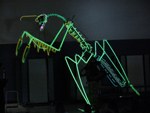
Also, when Killbuck and I built the Mantis puppet in 2007, We ran the green el wire back and forth within the clear PVC pipes for the limbs from three to five times, then covered the pipe with green drafter's velum, then clear packing tape. This was preferred for a smooth diffusion that would have been too "spotty" with LED array strips. Many asked if we were using fiber optics to get 1" diameter tubing to glow like that.
Since they have that multi-strand side emitting fiber optic tube, it would be great if we could find some kind of flat lengths that could be wrapped around fat pipe or whatever, terminating at a single light source.
Mantis Project website: http://www.mutantvehicle.com/mantis.htm
Also, when Killbuck and I built the Mantis puppet in 2007, We ran the green el wire back and forth within the clear PVC pipes for the limbs from three to five times, then covered the pipe with green drafter's velum, then clear packing tape. This was preferred for a smooth diffusion that would have been too "spotty" with LED array strips. Many asked if we were using fiber optics to get 1" diameter tubing to glow like that.
Since they have that multi-strand side emitting fiber optic tube, it would be great if we could find some kind of flat lengths that could be wrapped around fat pipe or whatever, terminating at a single light source.
Mantis Project website: http://www.mutantvehicle.com/mantis.htm
Art cred: Georgie Boy 2011: www.mutantvehicle.com/georgie_boy.htm ; Ein Hammer 2010; Fluffer 2009; Zsu Zsu 2008; U-Me 2007; Mantis 2006; MiniMan and Pikes Of Paranoia 2005; Time Machine Mutant Vehicle 2004. www.MutantVehicle.com