


Playa conditions for 2009?
-
wedeliver

- Posts: 1871
- Joined: Thu Sep 16, 2004 11:10 am
- Burning Since: 1998
- Location: Tionesta, CA
- Contact:
I can make out snow on the ground again in our favorite place in the world
http://www.burningman.com/preparation/t ... ebcam.html
here is the image.
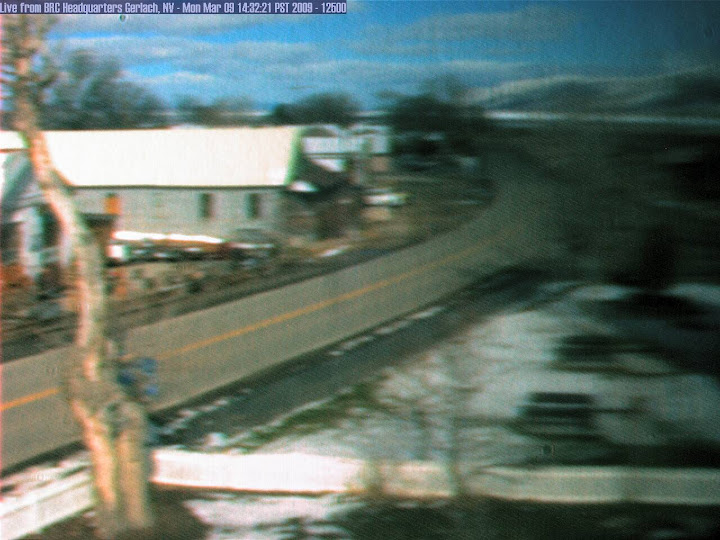
http://www.burningman.com/preparation/t ... ebcam.html
here is the image.
I'm a topless shirtcocking yahoo hippie
www.eaglesnestrvpark.com
www.eaglesnestrvpark.com
I can hardly wait to be there again...
SNOW IS GREAT! Hopefully it actually melts rather than evapurating.
-
oneeyeddick

- Posts: 5589
- Joined: Wed Oct 24, 2007 6:08 pm
- Burning Since: 1996
- Location: Probably in your pants
-
ygmir

- Posts: 30403
- Joined: Thu Sep 20, 2007 8:36 pm
- Burning Since: 2007
- Camp Name: qqqq
- Location: nevada county
IIRC it's called sublimation........Oldguy wrote:Actually One eye, water can change from a solid state ( ice ) to a gassious state ( vapor ) without going through the liquid state. Snow due to its crystalline structure and surface area can change state faster than solid ice. Basic physics 101.
YGMIR
Unabashed Nordic
Pagan
Unabashed Nordic
Pagan
-
penguin

- Posts: 556
- Joined: Wed Jan 14, 2009 8:04 pm
- Burning Since: 2009
- Camp Name: Playafire
- Location: Southwestern High Desert
Shoot, I thought it was called magic!ygmir wrote:IIRC it's called sublimation........Oldguy wrote:Actually One eye, water can change from a solid state ( ice ) to a gassious state ( vapor ) without going through the liquid state. Snow due to its crystalline structure and surface area can change state faster than solid ice. Basic physics 101.

-
oneeyeddick
- Posts: 5589
- Joined: Wed Oct 24, 2007 6:08 pm
- Burning Since: 1996
- Location: Probably in your pants
-
klondike_bar
- Posts: 495
- Joined: Fri Nov 28, 2008 8:56 am
- Location: Toronto, Ontario
actually, it would be chemistry 101. in fact, im pretty sure that was chemistry grade 9....Oldguy wrote:Actually One eye, water can change from a solid state ( ice ) to a gassious state ( vapor ) without going through the liquid state. Snow due to its crystalline structure and surface area can change state faster than solid ice. Basic physics 101.
-
oneeyeddick
- Posts: 5589
- Joined: Wed Oct 24, 2007 6:08 pm
- Burning Since: 1996
- Location: Probably in your pants
-
penguin
- Posts: 556
- Joined: Wed Jan 14, 2009 8:04 pm
- Burning Since: 2009
- Camp Name: Playafire
- Location: Southwestern High Desert
oneeyeddick wrote:not all towns have chemistry classes, as some are too small......like.........PORT TOWNSEND !!!
ZING !!!
(thanks for the easy setup guys, I feel better now that I got it out)
That doesn't sound that small.Regarding Port Townsend http://en.wikipedia.org/wiki/Port_Townsend,_Washington wrote:Port Townsend is a city in Jefferson County, Washington, United States, approximately 40 miles (64 km) north-northwest of Seattle. The population was 8,334 at the 2000 census. It is the county seat and only incorporated city of Jefferson County[6]. In addition to its natural scenery at the northeast tip of the Olympic Peninsula, the city is also known for the many Victorian buildings remaining from its late 19th-century heyday, numerous annual cultural events, and as a maritime center for independent boatbuilders and related industries and crafts. The Port Townsend Historic District is a U.S. National Historic Landmark District.

Sure looks to me like not only is Port Townsend not that small, but they DO have a chemistry class!Regarding Chemistry http://www.ptsd.wednet.edu/highschool/curriculum/science/chemistry.html wrote:Prerequisite: Successful completion of Science 1 and 2 with a C grade or better. Co-requisite: Algebra II Trig. Chemistry is a laboratory and mathematics oriented course covering topics which include atomic and nuclear chemistry, gas laws, acid-base chemistry, solution chemistry, kinetics, equilibrium, electrochemistry, and organic chemistry. Practical applications of the study of chemistry to materials, household chemicals, environmental chemistry, etc., will be emphasized through the use of projects.
*takes your ZING !!! away*

Actually Klondike Bar, sublimation is also about states of matter which is definately about physics: check this article under phase transitions.
Thermodynamics Overview
By Andrew Zimmerman Jones, About.com
Temperature and Humidity
Thermodynamics
What is Thermodynamics?:
Thermodynamics is the field of physics that deals with the relationship between heat and other properties (such as pressure, density, temperature, etc.) in a substance.
Specifically, thermodynamics focuses largely on how a heat transfer is related to various energy changes within a physical system undergoing a thermodynamic process. Such processes usually result in work being done by the system and are guided by the laws of thermodynamics.
Basic Concepts of Heat Transfer:
•Thermal Contact is when two substances can affect each other's temperature.
•Thermal Equilibrium is when two substances in thermal contact no longer transfer heat.
•Thermal Expansion takes place when a substance expands in volume as it gains heat. Thermal contraction also exists.
•Conduction is when heat flows through a heated solid.
•Convection is when heated particles transfer heat to another substance, such as cooking something in boiling water.
•Radiation is when heat is transferred through electromagnetic waves, such as from the sun.
•Insulation is when a low-conducting material is used to prevent heat transfer.
Thermodynamic Processes:
A system undergoes a thermodynamic process when there is some sort of energetic change within the system, generally associated with changes in pressure, volume, internal energy (i.e. temperature), or any sort of heat transfer.
There are several specific types of thermodynamic processes that have special properties:
•Adiabatic process - a process with no heat transfer into or out of the system.
•Isochoric process - a process with no change in volume, in which case the system does no work.
•Isobaric process - a process with no change in pressure.
•Isothermal process - a process with no change in temperature.
States of Matter:
The 5 states of matter
•gas
•liquid
•solid
•plasma
•superfluid (such as a Bose-Einstein Condensate)
Phase Transitions
•condensation - gas to liquid
•freezing - liquid to solid
•melting - solid to liquid
•sublimation - solid to gas
•vaporization - liquid or solid to gas
Heat Capacity:
The heat capacity, C, of an object is the ratio of change in heat (energy change - denoted by delta-Q) to change in temperature (delta-T).
C = delta-Q / delta-T
The heat capacity of a substance indicates the ease with which a substance heats up. A good thermal conductor would have a low heat capacity, indicating that a small amount of energy causes a large temperature change. A good thermal insulator would have a large heat capacity, indicating that much energy transfer is needed for a temperature change.
Ideal Gas Equations:
There are various ideal gas equations which relate temperature (T1), pressure (P1), and volume (V1). These values after a thermodynamic change is indicated by (T2), (P2), and (V2). For a given amount of a substance, n (measured in moles), the following relationships hold:
Boyle's Law (T is constant):
P1V1 = P2V2
Charles/Gay-Lussac Law (P is constant):
V1/T1 = V2/T2
Ideal Gas Law:
P1V1/T1 = P2V2/T2 = nR
R is the ideal gas constant, R = 8.3145 J/mol*K. For a given amount of matter, therefore, nR is constant, which gives the Ideal Gas Law.
Laws of Thermodynamics:
•Zeroeth Law of Thermodynamics - Two systems each in thermal equilibrium with a third system are in thermal equilibrium to each other.
•First Law of Thermodynamics - The change in the energy of a system is the amount of energy added to the system minus the energy spent doing work.
•Second Law of Thermodynamics - It is impossible for a process to have as its sole result the transfer of heat from a cooler body to a hotter one.
•Third Law of Thermodynamics - It is impossible to reduce any system to absolute zero in a finite series of operations. This means that a perfectly efficient heat engine cannot be created.
The Second Law & Entropy:
The Second Law of Thermodynamics can be restated to talk about entropy, which is a quantitative measurement of the disorder in a system. The change in heat divided by the absolute temperature is the entropy change of the process. Defined this way, the Second Law can be restated as:
In any closed system, the entropy of the system will either remain constant or increase.
By "closed system" it means that every part of the process is included when calculating the entropy of the system.
More About Thermodynamics:
In some ways, treating thermodynamics as a distinct discipline of physics is misleading. Thermodynamics touches on virtually every field of physics, from astrophysics to biophysics, because they all deal in some fashion with the change of energy in a system. Without the ability of a system to use energy within the system to do work - the heart of thermodynamics - there would be nothing for physicists to study.
That having been said, there are some fields use thermodynamics in passing as they go about studying other phenomena, while there are a wide range of fields which focus heavily on the thermodynamics situations involved. Here are some of the sub-fields of thermodynamics:
•Cryophysics / Cryogenics / Low Temperature Physics - the study of physical properties in low temperature situations, far below temperatures experienced on even the coldest regions of the Earth. An example of this is the study of superfluids.
•Fluid Dynamics / Fluid Mechanics - the study of the physical properties of "fluids," specifically defined in this case to be liquids and gases.
•High Pressure Physics - the study of physics in extremely high pressure systems, generally related to fluid dynamics.
•Meteorology / Weather Physics - the physics of the weather, pressure systems in the atmosphere, etc.
•Plasma Physics - the study of matter in the plasma state.
................
A hah, got you We are both correct
Thermodynamics Overview
By Andrew Zimmerman Jones, About.com
Temperature and Humidity
Thermodynamics
What is Thermodynamics?:
Thermodynamics is the field of physics that deals with the relationship between heat and other properties (such as pressure, density, temperature, etc.) in a substance.
Specifically, thermodynamics focuses largely on how a heat transfer is related to various energy changes within a physical system undergoing a thermodynamic process. Such processes usually result in work being done by the system and are guided by the laws of thermodynamics.
Basic Concepts of Heat Transfer:
•Thermal Contact is when two substances can affect each other's temperature.
•Thermal Equilibrium is when two substances in thermal contact no longer transfer heat.
•Thermal Expansion takes place when a substance expands in volume as it gains heat. Thermal contraction also exists.
•Conduction is when heat flows through a heated solid.
•Convection is when heated particles transfer heat to another substance, such as cooking something in boiling water.
•Radiation is when heat is transferred through electromagnetic waves, such as from the sun.
•Insulation is when a low-conducting material is used to prevent heat transfer.
Thermodynamic Processes:
A system undergoes a thermodynamic process when there is some sort of energetic change within the system, generally associated with changes in pressure, volume, internal energy (i.e. temperature), or any sort of heat transfer.
There are several specific types of thermodynamic processes that have special properties:
•Adiabatic process - a process with no heat transfer into or out of the system.
•Isochoric process - a process with no change in volume, in which case the system does no work.
•Isobaric process - a process with no change in pressure.
•Isothermal process - a process with no change in temperature.
States of Matter:
The 5 states of matter
•gas
•liquid
•solid
•plasma
•superfluid (such as a Bose-Einstein Condensate)
Phase Transitions
•condensation - gas to liquid
•freezing - liquid to solid
•melting - solid to liquid
•sublimation - solid to gas
•vaporization - liquid or solid to gas
Heat Capacity:
The heat capacity, C, of an object is the ratio of change in heat (energy change - denoted by delta-Q) to change in temperature (delta-T).
C = delta-Q / delta-T
The heat capacity of a substance indicates the ease with which a substance heats up. A good thermal conductor would have a low heat capacity, indicating that a small amount of energy causes a large temperature change. A good thermal insulator would have a large heat capacity, indicating that much energy transfer is needed for a temperature change.
Ideal Gas Equations:
There are various ideal gas equations which relate temperature (T1), pressure (P1), and volume (V1). These values after a thermodynamic change is indicated by (T2), (P2), and (V2). For a given amount of a substance, n (measured in moles), the following relationships hold:
Boyle's Law (T is constant):
P1V1 = P2V2
Charles/Gay-Lussac Law (P is constant):
V1/T1 = V2/T2
Ideal Gas Law:
P1V1/T1 = P2V2/T2 = nR
R is the ideal gas constant, R = 8.3145 J/mol*K. For a given amount of matter, therefore, nR is constant, which gives the Ideal Gas Law.
Laws of Thermodynamics:
•Zeroeth Law of Thermodynamics - Two systems each in thermal equilibrium with a third system are in thermal equilibrium to each other.
•First Law of Thermodynamics - The change in the energy of a system is the amount of energy added to the system minus the energy spent doing work.
•Second Law of Thermodynamics - It is impossible for a process to have as its sole result the transfer of heat from a cooler body to a hotter one.
•Third Law of Thermodynamics - It is impossible to reduce any system to absolute zero in a finite series of operations. This means that a perfectly efficient heat engine cannot be created.
The Second Law & Entropy:
The Second Law of Thermodynamics can be restated to talk about entropy, which is a quantitative measurement of the disorder in a system. The change in heat divided by the absolute temperature is the entropy change of the process. Defined this way, the Second Law can be restated as:
In any closed system, the entropy of the system will either remain constant or increase.
By "closed system" it means that every part of the process is included when calculating the entropy of the system.
More About Thermodynamics:
In some ways, treating thermodynamics as a distinct discipline of physics is misleading. Thermodynamics touches on virtually every field of physics, from astrophysics to biophysics, because they all deal in some fashion with the change of energy in a system. Without the ability of a system to use energy within the system to do work - the heart of thermodynamics - there would be nothing for physicists to study.
That having been said, there are some fields use thermodynamics in passing as they go about studying other phenomena, while there are a wide range of fields which focus heavily on the thermodynamics situations involved. Here are some of the sub-fields of thermodynamics:
•Cryophysics / Cryogenics / Low Temperature Physics - the study of physical properties in low temperature situations, far below temperatures experienced on even the coldest regions of the Earth. An example of this is the study of superfluids.
•Fluid Dynamics / Fluid Mechanics - the study of the physical properties of "fluids," specifically defined in this case to be liquids and gases.
•High Pressure Physics - the study of physics in extremely high pressure systems, generally related to fluid dynamics.
•Meteorology / Weather Physics - the physics of the weather, pressure systems in the atmosphere, etc.
•Plasma Physics - the study of matter in the plasma state.
................
A hah, got you
We are both correct -
chiefdanfox
- Posts: 786
- Joined: Sun Mar 19, 2006 11:14 pm
- Burning Since: 1986
- Location: Bodega Bay, CA

-
ygmir
- Posts: 30403
- Joined: Thu Sep 20, 2007 8:36 pm
- Burning Since: 2007
- Camp Name: qqqq
- Location: nevada county
I first learned it in "earth science" in grade school.......discussing the water cycle on earth, and, how it goes from snow to clouds.......either melting then evaporating, or, sublimating directly, then condensing.klondike_bar wrote:actually, it would be chemistry 101. in fact, im pretty sure that was chemistry grade 9....Oldguy wrote:Actually One eye, water can change from a solid state ( ice ) to a gassious state ( vapor ) without going through the liquid state. Snow due to its crystalline structure and surface area can change state faster than solid ice. Basic physics 101.
the rain discussion was falling, evaporating, condensing.........
YGMIR
Unabashed Nordic
Pagan
Unabashed Nordic
Pagan
-
Elderberry

- Moderator
- Posts: 14976
- Joined: Tue Jul 17, 2007 10:00 pm
- Burning Since: 2007
- Camp Name: Camp Kelly
- Location: Palm Springs
- Contact:
Obviously, you didn't go to a public school in California.klondike_bar wrote:actually, it would be chemistry 101. in fact, im pretty sure that was chemistry grade 9....Oldguy wrote:Actually One eye, water can change from a solid state ( ice ) to a gassious state ( vapor ) without going through the liquid state. Snow due to its crystalline structure and surface area can change state faster than solid ice. Basic physics 101.
JK
Elderberry
When I was a kid I used to pray every night for a new bicycle.
Then I realized that the Lord doesn't work that way so I stole one and asked Him to forgive me
When I was a kid I used to pray every night for a new bicycle.
Then I realized that the Lord doesn't work that way so I stole one and asked Him to forgive me
-
oneeyeddick
- Posts: 5589
- Joined: Wed Oct 24, 2007 6:08 pm
- Burning Since: 1996
- Location: Probably in your pants
penguin wrote:oneeyeddick wrote:not all towns have chemistry classes, as some are too small......like.........PORT TOWNSEND !!!
ZING !!!
(thanks for the easy setup guys, I feel better now that I got it out)That doesn't sound that small.Regarding Port Townsend http://en.wikipedia.org/wiki/Port_Townsend,_Washington wrote:Port Townsend is a city in Jefferson County, Washington, United States, approximately 40 miles (64 km) north-northwest of Seattle. The population was 8,334 at the 2000 census. It is the county seat and only incorporated city of Jefferson County[6]. In addition to its natural scenery at the northeast tip of the Olympic Peninsula, the city is also known for the many Victorian buildings remaining from its late 19th-century heyday, numerous annual cultural events, and as a maritime center for independent boatbuilders and related industries and crafts. The Port Townsend Historic District is a U.S. National Historic Landmark District.
Sure looks to me like not only is Port Townsend not that small, but they DO have a chemistry class!Regarding Chemistry http://www.ptsd.wednet.edu/highschool/curriculum/science/chemistry.html wrote:Prerequisite: Successful completion of Science 1 and 2 with a C grade or better. Co-requisite: Algebra II Trig. Chemistry is a laboratory and mathematics oriented course covering topics which include atomic and nuclear chemistry, gas laws, acid-base chemistry, solution chemistry, kinetics, equilibrium, electrochemistry, and organic chemistry. Practical applications of the study of chemistry to materials, household chemicals, environmental chemistry, etc., will be emphasized through the use of projects.
*takes your ZING !!! away*
Hold on a minute...NOBODY TAKES MY ZING AWAY !!!
when you provided the first link that shows Port Townsend at about 8000 people strong, and didn't agree that that is small , it made me think you must be from North Dakota or sumpin'.
and the you provided the second link showing that they do actually have a chemistry class, well, you omitted the most important part from this fact......
let me post the entire thing , as it reads in the link
(I will highlight important parts about the pre-requisite also)
-----------------------------------------------------------------------------------
Chemistry
Note: Physics and Chemistry are offered in alternating years. Chemistry will be offered again in the 2007-08 school year.
so...looks like they don't have a chemistry class, at least not right now.
Prerequisite: Successful completion of Science 1 and 2 with a C grade or better. Co-requisite: Algebra II Trig.(which they probably don't offer, except as a correspondence course) Chemistry is a laboratory and mathematics oriented course covering topics which include atomic and nuclear chemistry, gas laws, acid-base chemistry, solution chemistry, kinetics, equilibrium, electrochemistry, and organic chemistry. Practical applications of the study of chemistry to materials, household chemicals, environmental chemistry, etc., will be emphasized through the use of projects.
I rest my case, and re-claim my Zing
We have an obligation to make space for everyone, we have no obligation to make that space pleasant.
-
oneeyeddick
- Posts: 5589
- Joined: Wed Oct 24, 2007 6:08 pm
- Burning Since: 1996
- Location: Probably in your pants
mdmf007 wrote:Small world - My sailboat is moored in Port Townsendoneeyeddick wrote:not all towns have chemistry classes, as some are too small......like.........PORT TOWNSEND !!!
ZING !!!
(thanks for the easy setup guys, I feel better now that I got it out)
I bet it's a tiny little thing.
We have an obligation to make space for everyone, we have no obligation to make that space pleasant.

So, I got a bit curious, and googled "sublime etymology"...
What does a debutante mean when she says, "Simply sublime, dahling"? And what does that have to do with subliminal messages? Why does "sublime" mean "elevated," while "subliminal" implies "beneath"? "Sub" means "under, below, beneath, down" [AHD]. To "sub lime" should mean "to sit beneath the shade of a citrus tree." That, of course, would be wrong—unless you’re a punster. (read: eplayan)
It turns out that sublime and subliminal both have to do with the "lintel," Latin limen. The lintel is the beam that forms the upper part of a window or door, and supports part of the structure above it [AHD]. This lintel is thus a threshold; we get the word "limen" to mean the "threshold of a physiological or psychological response" [AHD]. "Sub" + "limen" gives us, in various forms, words that mean passing under, through, and over a metaphorical threshold. 1.
In chemistry, to sublime a chemical is to cause it to sublimate, to pass from gas to solid (or vice versa) without passing through the intermediary, or threshold, state of a liquid [OED, AHD]
What does a debutante mean when she says, "Simply sublime, dahling"? And what does that have to do with subliminal messages? Why does "sublime" mean "elevated," while "subliminal" implies "beneath"? "Sub" means "under, below, beneath, down" [AHD]. To "sub lime" should mean "to sit beneath the shade of a citrus tree." That, of course, would be wrong—unless you’re a punster. (read: eplayan)
It turns out that sublime and subliminal both have to do with the "lintel," Latin limen. The lintel is the beam that forms the upper part of a window or door, and supports part of the structure above it [AHD]. This lintel is thus a threshold; we get the word "limen" to mean the "threshold of a physiological or psychological response" [AHD]. "Sub" + "limen" gives us, in various forms, words that mean passing under, through, and over a metaphorical threshold. 1.
In chemistry, to sublime a chemical is to cause it to sublimate, to pass from gas to solid (or vice versa) without passing through the intermediary, or threshold, state of a liquid [OED, AHD]
-
oneeyeddick
- Posts: 5589
- Joined: Wed Oct 24, 2007 6:08 pm
- Burning Since: 1996
- Location: Probably in your pants
-
Bob

- Posts: 6747
- Joined: Wed Sep 03, 2003 10:00 am
- Burning Since: 1986
- Camp Name: Royaneh
- Location: San Francisco
- Contact:
North Dakota?!?
Slowly I turned... step by step... inch by inch...
Slowly I turned... step by step... inch by inch...
Amazing desert structures & stuff: http://sites.google.com/site/potatotrap/
"Let us say I suggest you may be human." -- Reverend Mother Gaius Helen Mohiam
"Let us say I suggest you may be human." -- Reverend Mother Gaius Helen Mohiam
-
Elderberry
- Moderator
- Posts: 14976
- Joined: Tue Jul 17, 2007 10:00 pm
- Burning Since: 2007
- Camp Name: Camp Kelly
- Location: Palm Springs
- Contact:
Just in from JackRabit Speaks:
JKSpeaking of playa, it's currently WET on the playa! Here at JRS central we get asked about playa conditions year after year, and while we offer it with a HUGE grain of salt, it does in fact bode well for the possibility of a nicely packed playa surface condition later this summer. (Mind you, we offer that tidbit with one caveat: the only constants are change, and dust at Burning Man, and you will need to embrace both to truly thrive in BRC. Might as well decide to start now, right?)
Oh, and also, did you hear? We're returning the city size back to what it was in 2007, making it just a leeetle beeeet eeeeeasier to get from Point A (aka Your Camp) to Point B (aka That Cool Thing You Are Supposed to Volunteer For/Go Check Out on The Other Side of the Playa). Thanks to everybody who gave us feedback about the city size ... see? We listen!
Elderberry
When I was a kid I used to pray every night for a new bicycle.
Then I realized that the Lord doesn't work that way so I stole one and asked Him to forgive me
When I was a kid I used to pray every night for a new bicycle.
Then I realized that the Lord doesn't work that way so I stole one and asked Him to forgive me
-
Sail Man
- Posts: 4523
- Joined: Tue Sep 30, 2008 10:03 am
- Burning Since: 2008
- Camp Name: Kidsville: Delicious
- Location: 20 Minutes into the Future
Ahhhhhh!! Another blow-boater!mdmf007 wrote:Small world - My sailboat is moored in Port Townsendoneeyeddick wrote:not all towns have chemistry classes, as some are too small......like.........PORT TOWNSEND !!!
ZING !!!
(thanks for the easy setup guys, I feel better now that I got it out)
 Who'da thunk you'd be such a grand person. Now I gotta take back all those things I said about you.
What ya got, I want details man, details!

My Catalina 27 in the slip last summer. Getting ready for another season
Excuse me Ma'am, your going to feel a small prick.
_______________________________________
Algorithms never survive the first thirty seconds of patient contact
_______________________________________
Algorithms never survive the first thirty seconds of patient contact


-
Sail Man
- Posts: 4523
- Joined: Tue Sep 30, 2008 10:03 am
- Burning Since: 2008
- Camp Name: Kidsville: Delicious
- Location: 20 Minutes into the Future
Yeah, but like burning man its a great way to spend some $. This spring its an upgrade to the 12v system, new switch panels, wiring, engine gauges, gas/propane monitor alarm. Got me a few other toys I've acquired to install. Summer and sailing season is too short here in Michigan. You don't want it to end, but by the same token, you want the burn to get here quickly as well.
Excuse me Ma'am, your going to feel a small prick.
_______________________________________
Algorithms never survive the first thirty seconds of patient contact
_______________________________________
Algorithms never survive the first thirty seconds of patient contact