Also there is the equipment for those who want there own vaporizer and I am so gonna get one of these.
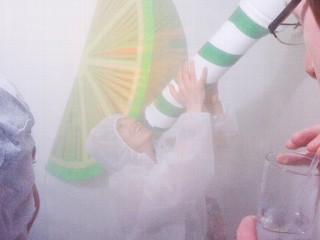
It's no secret that the Britons have long enjoyed a stiff gin and tonic from their local pubs at the end of a grueling day. But now, Londoners are lining up to enjoy their regular tipple in a very different way -- in vapor form.
Gin & Tonic Inhaled not stirred
At Alcoholic Architecture, an experimental bar that opened last Thursday for weekend business, customers actually breathe in their beverage. Co-creators Sam Bompas and Harry Parr say they are looking to change the way Britain looks at its favorite libation.
"We're reinventing the gin and tonic," Bompas told ABC News. "We're really sexing it up. It had a bit of a a fuddy-duddy image over here but we're taking it to the maximum size, the size of a room, so you literally walk into your cocktail."
Parr said there are several benefits to the atmospheric bar, which includes music but no food. "Well, when you breathe, instead of the alcohol going into your liver, it goes right into your bloodstream so breathing is a much quicker way of getting drunk."
Bompas said, "I think we've had a lot of people leaving with smiles on their faces."
Bompas and Parr, both 25, have long had an interest in synesthesia and the relationship between food and space. Other ventures from the dynamic duo include the scratch 'n' sniff cinema and a massive replica of St. Paul's Cathedral ... made out of jello.
Visiting Alcoholic Architecture is a unique experience. Customers are given a protective suit at the door, so that they can enjoy their evening without ruining their clothes. Once you're kitted up, there's time for one liquid libation at the upstairs bar before heading down into the dark-green mist.
Walking into the room of about 40 people, one is immediately assaulted by the cloying sweetness of gin and tonic on the back of the throat.
"It's sticky, very sticky ... and sweaty, nice sweaty, though," first-time visitor Andrea Gelardin told ABC News recently.
"It tastes like lime mixed with sweat," another customer added.
The "g 'n' t" mist is released with a high-tech vaporizer machine. Customers breathe through half a gallon of gin an hour, for about $7.25.
Perhaps Keevo Johnson from Seattle summarized it perfectly, saying, "I've been in an alcoholic fog before but never like this."
Don't Forget to 'Breathe Responsibly'
Regardless of whether people actually get drunk, the novelty of the experience makes everyone a little loopy. On a recent visit, a few people were using their straws to try to suck in the air more deeply.
"I'm steaming up," a visitor from Manchester joked. "It's definitely making me giggle."
As for the likelihood of a hangover, Bompas said it all depends on how much you breathe and how deeply you breathe, although spending 40 minutes in the room is supposed to be the equivalent of a single cocktail. "That's why we say to breathe responsibly," Parr said.
It's not the first time that inhaling alcohol has been marketed as an alternative to drinking. A machine known as the AWOL, an acronym for Alcohol Without Liquid, was recently introduced in the United Kingdom. The AWOL machine has a central body and a number of tubes from which the alcohol vapor is directly inhaled. It was denounced by some doctors as "solvent abuse for adults."
Bompas and Parr point out that customers at Alcoholic Architecture do not breathe the vapor in directly, and they say they consulted three different doctors before opening their doors. All of them gave them the full thumbs up, including an explosives expert.
"If you vaporize a lot of alcohol, there obviously is a risk of explosion," Parr said.
Each session at Alcoholic Architecture lasts an hour. At the end, sirens wailed and customers went home. Patrons seemed to have a good time, although, as Bompas put it, "I think people will still be drinking out of glasses."
Alcoholic Architecture has been a success, with tickets selling out almost immediately. Bompas and Parr already have plans to redo it on a much bigger scale, although it's unlikely to replace the traditional pub anytime soon.
"I think we can definitely build on it," Bompas said. "Like, maybe have a layered cocktail where each floor of a building is a different cocktail."
Alcohol Without Liquid (AWOL) is a process introduced first in Asia and Europe that allows people to take in liquor (distilled spirits) without actually consuming liquid. The machine vaporizes alcohol and mixes it with oxygen, allowing the consumer to breathe in the mixture. The machine has been dubbed AWOL, a play on the military term AWOL, Absent Without Official Leave. The AWOL machine produces a very fine alcoholic mist. The continual intake of this mist over a twenty-minute period is the equivalent of taking one shot of distilled spirits.
The machine was introduced to the United States in August 2004. The possible health and safety risks of inhaling alcohol vapors are unknown and many legislators are promoting legislation to ban alcohol inhalation machines. Michigan has made it illegal to possess, sell or use an AWOL machine, and as of June 2008, 22 other states have banned the device; Arizona, California, Colorado, Connecticut, Florida, Idaho, Illinois, Indiana, Iowa, Kansas, Kentucky, Louisiana, Maine, Michigan, Minnesota, Nevada, New York, North Carolina, Ohio, Pennsylvania, South Carolina, Tennessee, Virginia, and Wyoming. Support for such legislation comes from groups fighting underage drinking and drunk driving, including alcohol companies such as Diageo and industry groups such as the Distilled Spirits Council of the United States (DISCUS), among others.
The machine's marketers say it produces a "Euphoric High" and the effects of alcohol consumption without the high calories, carbohydrates, and hangovers associated with common consumption. In reality, distilled spirits contain no carbohydrates (nor any fat or cholesterol) that the machine could remove. However, ethanol is metabolized by the body at about 7 kilocalories per gram. Hangovers are allegedly prevented because the alcohol is delivered with oxygen to the brain. Vaporized alcohol also enters the bloodstream faster and its effects are more immediate than its liquid counterparts. If this is true, this will result in an enhanced euphoric affect, similar to drinking liquid on an empty stomach. (For similar rapid absorption, stimulants are insufflated instead of ingested. The rate of change is sensed by the nervous system.)
Marketers encourage purchasers to use the machine no more than twice in a 24-hour period to avoid overconsumption, as this might be dangerous.