

Global Cooling
-
dr.placebo

- Posts: 980
- Joined: Mon Sep 13, 2004 3:03 pm
- Burning Since: 1999
- Camp Name: Cleu Camp
- Location: Volcano, HI
- Contact:
It is an interesting paper, although some cooling effects of CO2 in the upper atmosphere have been established for a long time. What is especially interesting about this paper is that there is a puzzle about why the upper atmosphere cooling is greater than expected (or modeled). The big advances in science come from solving puzzles, so I'm interested in what this one will turn up.
-
geekster

- Posts: 4865
- Joined: Wed Sep 08, 2004 2:53 pm
- Location: Hospice For The Terminally Breathing
- Contact:
So far this July has seen the lowest amount of Arctic ice melt ever recorded. Current Arctic air temperatures above 80N latitude are also the lowest recorded at this time of year since 1958 when the data set begins.
We have about one more week left in the Arctic where any significant melting can occur from sun angle so even any assist from soot/dust contamination will not have any impact after a week or two from now as the sun will simply be too low in the sky. It is hard to tell the conditions right now at the Northernmost monitoring webcam (NOAA2) as it is currently covered with ice. The NOAA1 cam has not reported data since 7 July.
In North America, while the Eastern Seaboard swelters, the majority of the country is seeing temperatures much below normal. This runs in a band from central Canada, down through the US, and into Mexico. Mexico temperatures have been far below normal this year.
Now those of you who are consumers of the GISS product might find it confusing that Arctic temperatures are the lowest recorded but that is because GISS doesn't actually collect any data from that area. They sort of just "interpolate" it from various equations ... in other words, they make it up. The DMI product is from actual observations from stations placed on the ice all across the Arctic.
In fact, the areas where GISS shows the most warming in the world are places where they actually have no data and those big red hot dots on their graph are the output of another equation. They also do all sorts of other things, too, like change the weighting of land data relative to sea data to arrive at global temperature. So the GISS data in the early part of the 20th century, from 1900 to about 1920, is all sea surface data. Land measurement data is weighted at 0%. By 1979 GISS weights land data at 40% even though land only accounts for 30% of the surface. Then they continue to ratchet up the weighting of land data until it peaks at 73% in 1995.
At the same time the land data is being given more and more weight in the global calculation, more and more rural and high altitude reporting stations are being removed from the network so you get to a point where we are today with all of California being represented by three reporting stations, all of them coastal, all of them urban.
So at this point in time, global warming is manufactured in two ways by GISS. First, you remove over time all of the stations that would be expected to report cooler temperatures leaving only the hot stations in the network. This biases the land data high. Now you slowly increase the weighting given to the land data which then biases the global average even higher.
Have a look at this image:
http://earthobservatory.nasa.gov/IOTD/view.php?id=44664
Notice that arc of warm temperatures across the eastern US that looks like it would be centered off the coast of about New Jersey or Delaware. That is actually a very typical pattern in meteorology called the Bermuda High. That is a high pressure system that sets up off the East coast of the US anywhere between the vicinity of Bermuda and someplace near the Azores. Its strength and location is important for several reasons. Some years it fails to appear at all or it may be very weak. We can tell a lot about this year's Bermuda High from several indications it is giving us.
First of all, a high pressure system has a clockwise circulation around it. That means it is bringing in very warm air from the South, up the Eastern seaboard and out to sea across New England. We know it is apparently very strong for three reasons ... first would be the amount of hot air that it is bringing up. Second is how persistent it is. It is constantly able to break down low pressure troughs or push them up and over it. Third ... there are no hurricanes. When you have a very strong Bermuda high, you generally have few hurricanes because of the Easterly flow across the bottom of the high pressure area. This increases wind speeds which increases wind shear and prevents hurricanes from forming. Hurricanes love warm water in still air where the rising humid air can go straight up, curling as it does so in a counter-clockwise fashion. Hurricanes are a convection heat engine that transfers ocean surface heat to the upper atmosphere. A strong Bermuda high prevents that deep convection from taking place. Also, the strong trade winds created cool the sea surface further preventing hurricanes and we have plenty of evidence of very strong trade winds.
Look at those temperatures across equatorial Africa. See how much blue there is on that map? Those temperatures are well below normal. Look at the Caribbean islands. Same thing. Those low temperatures mean strong trade winds.
Here is the global sea surface temperature anomaly map for 15 July:

Note how cold the water is off the coast of South America at the equator. Also note the blue that shows up in the Atlantic on what would be the South side of that Bermuda high.
As you can see by this graphic:

The temperatures in the Caribbean and Gulf of Mexico were from -0.5 to +0.5 ... or pretty much right at normal. No "hot" water there.
This pattern seems to have strengthened since 15 July according to this 18 July map:
http://weather.unisys.com/surface/sst_anom.html
The waters at the Azores are very cool for this time of year at -2.5 degrees below normal.
This is all very unusual because we are heading into an extremely powerful la nina. Pacific equatorial sea surface temperatures are diving at the fastest rate ever recorded. Generally when we have a la nina condition in the Pacific, we have a strong hurricane year in the Atlantic but something is weird this time. It is like we have a la nina-like condition setting up in both oceans at the same time with equatorial temperatures falling globally.
What does all that mean? It means we have one HELL of a cold winter coming. Tropical ocean heat eventually makes it toward the poles by way of various sea currents both at the surface and below the surface and by air currents and storms. If you have a cold equator in the summer, you will have cold poles that winter. There is less energy feeding the global system as of today. In fact, we saw a day last week when there was not a single tropical depression, invest low, or storm anywhere on the planet in the Atlantic, Pacific, or Indian oceans. Nothing. Nada. Zippo. Today there is only one. Tropical Depression 4 West of the Philippines making a beeline for the Chinese coast where it should land as a weak tropical storm.
I will be willing to go out on a limb and suggest that this might be the coldest winter anyone under 35 has experienced in their lifetime and colder than anyone under 40 would remember. This will be more in line with the winters of the 1950's and 1960's and quite possibly like the ones of the late 1800's.
We have about one more week left in the Arctic where any significant melting can occur from sun angle so even any assist from soot/dust contamination will not have any impact after a week or two from now as the sun will simply be too low in the sky. It is hard to tell the conditions right now at the Northernmost monitoring webcam (NOAA2) as it is currently covered with ice. The NOAA1 cam has not reported data since 7 July.
In North America, while the Eastern Seaboard swelters, the majority of the country is seeing temperatures much below normal. This runs in a band from central Canada, down through the US, and into Mexico. Mexico temperatures have been far below normal this year.
Now those of you who are consumers of the GISS product might find it confusing that Arctic temperatures are the lowest recorded but that is because GISS doesn't actually collect any data from that area. They sort of just "interpolate" it from various equations ... in other words, they make it up. The DMI product is from actual observations from stations placed on the ice all across the Arctic.
In fact, the areas where GISS shows the most warming in the world are places where they actually have no data and those big red hot dots on their graph are the output of another equation. They also do all sorts of other things, too, like change the weighting of land data relative to sea data to arrive at global temperature. So the GISS data in the early part of the 20th century, from 1900 to about 1920, is all sea surface data. Land measurement data is weighted at 0%. By 1979 GISS weights land data at 40% even though land only accounts for 30% of the surface. Then they continue to ratchet up the weighting of land data until it peaks at 73% in 1995.
At the same time the land data is being given more and more weight in the global calculation, more and more rural and high altitude reporting stations are being removed from the network so you get to a point where we are today with all of California being represented by three reporting stations, all of them coastal, all of them urban.
So at this point in time, global warming is manufactured in two ways by GISS. First, you remove over time all of the stations that would be expected to report cooler temperatures leaving only the hot stations in the network. This biases the land data high. Now you slowly increase the weighting given to the land data which then biases the global average even higher.
Have a look at this image:
http://earthobservatory.nasa.gov/IOTD/view.php?id=44664
Notice that arc of warm temperatures across the eastern US that looks like it would be centered off the coast of about New Jersey or Delaware. That is actually a very typical pattern in meteorology called the Bermuda High. That is a high pressure system that sets up off the East coast of the US anywhere between the vicinity of Bermuda and someplace near the Azores. Its strength and location is important for several reasons. Some years it fails to appear at all or it may be very weak. We can tell a lot about this year's Bermuda High from several indications it is giving us.
First of all, a high pressure system has a clockwise circulation around it. That means it is bringing in very warm air from the South, up the Eastern seaboard and out to sea across New England. We know it is apparently very strong for three reasons ... first would be the amount of hot air that it is bringing up. Second is how persistent it is. It is constantly able to break down low pressure troughs or push them up and over it. Third ... there are no hurricanes. When you have a very strong Bermuda high, you generally have few hurricanes because of the Easterly flow across the bottom of the high pressure area. This increases wind speeds which increases wind shear and prevents hurricanes from forming. Hurricanes love warm water in still air where the rising humid air can go straight up, curling as it does so in a counter-clockwise fashion. Hurricanes are a convection heat engine that transfers ocean surface heat to the upper atmosphere. A strong Bermuda high prevents that deep convection from taking place. Also, the strong trade winds created cool the sea surface further preventing hurricanes and we have plenty of evidence of very strong trade winds.
Look at those temperatures across equatorial Africa. See how much blue there is on that map? Those temperatures are well below normal. Look at the Caribbean islands. Same thing. Those low temperatures mean strong trade winds.
Here is the global sea surface temperature anomaly map for 15 July:
Note how cold the water is off the coast of South America at the equator. Also note the blue that shows up in the Atlantic on what would be the South side of that Bermuda high.
As you can see by this graphic:
The temperatures in the Caribbean and Gulf of Mexico were from -0.5 to +0.5 ... or pretty much right at normal. No "hot" water there.
This pattern seems to have strengthened since 15 July according to this 18 July map:
http://weather.unisys.com/surface/sst_anom.html
The waters at the Azores are very cool for this time of year at -2.5 degrees below normal.
This is all very unusual because we are heading into an extremely powerful la nina. Pacific equatorial sea surface temperatures are diving at the fastest rate ever recorded. Generally when we have a la nina condition in the Pacific, we have a strong hurricane year in the Atlantic but something is weird this time. It is like we have a la nina-like condition setting up in both oceans at the same time with equatorial temperatures falling globally.
What does all that mean? It means we have one HELL of a cold winter coming. Tropical ocean heat eventually makes it toward the poles by way of various sea currents both at the surface and below the surface and by air currents and storms. If you have a cold equator in the summer, you will have cold poles that winter. There is less energy feeding the global system as of today. In fact, we saw a day last week when there was not a single tropical depression, invest low, or storm anywhere on the planet in the Atlantic, Pacific, or Indian oceans. Nothing. Nada. Zippo. Today there is only one. Tropical Depression 4 West of the Philippines making a beeline for the Chinese coast where it should land as a weak tropical storm.
I will be willing to go out on a limb and suggest that this might be the coldest winter anyone under 35 has experienced in their lifetime and colder than anyone under 40 would remember. This will be more in line with the winters of the 1950's and 1960's and quite possibly like the ones of the late 1800's.
Pabst Blue Ribbon - The beer that made Gerlach famous.
-
geekster
- Posts: 4865
- Joined: Wed Sep 08, 2004 2:53 pm
- Location: Hospice For The Terminally Breathing
- Contact:
Ok, the NOAA2 cam has finally cleared enough to see. Melt/precipitation ponds forming skim ice, cloudy skies as of the day of this posting but this image will change over time. It gets updated twice a day when things are working perfectly. UPDATE: Well crap, right after I put it up, they update it and the lens is covered with ice again. It will clear off again in a day or two though. The shot was new snow with skim ice on the precip/melt ponds. The temperature inside the instrument pod is 12C which is not the outside air temp.

And DMI has the average temperature above 80N at just about freezing. Notice in a couple of days the average temperatures begin their annual fall toward winter as the sun angle declines to a point where it offers less warmth at those latitudes.
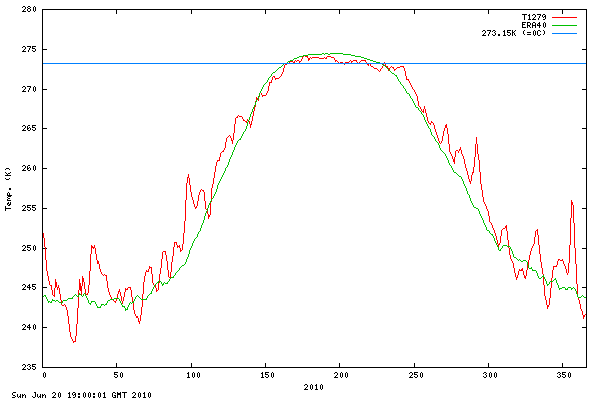
And DMI has the average temperature above 80N at just about freezing. Notice in a couple of days the average temperatures begin their annual fall toward winter as the sun angle declines to a point where it offers less warmth at those latitudes.
Pabst Blue Ribbon - The beer that made Gerlach famous.
-
can't sit still
- Posts: 4645
- Joined: Tue Aug 23, 2005 4:21 pm
- Location: SoCal

-
geekster
- Posts: 4865
- Joined: Wed Sep 08, 2004 2:53 pm
- Location: Hospice For The Terminally Breathing
- Contact:
Here is my problem with "global average" temperatures.
Imagine you have a room with 100 people in it. Now imagine you take the average of their height. Now imagine that the next year you remove some of the shortest people in the room and re-take the average. Now do that for several years running. Each year you report that the average height in the room is increasing yet none of them have grown.
That is pretty much the problem with the GHCN network. They have been systematically removing the rural and high altitude stations, the stations that report the coolest temperatures. At the same time, the rate of "missing" values in the stations they are keeping has been rising. A missing value means they must calculate a "fill" value. What is most interesting is that the data will have a "missing" value for a station but looking the station up on the Internet reveals no such "missing" value. The value is available.
The basic problem is that the data used to create the "global" averages is crap and can not be compared from one year to the next because each year has a different mix of stations providing the average.
And this is even before the data are "adjusted".
Imagine you have a room with 100 people in it. Now imagine you take the average of their height. Now imagine that the next year you remove some of the shortest people in the room and re-take the average. Now do that for several years running. Each year you report that the average height in the room is increasing yet none of them have grown.
That is pretty much the problem with the GHCN network. They have been systematically removing the rural and high altitude stations, the stations that report the coolest temperatures. At the same time, the rate of "missing" values in the stations they are keeping has been rising. A missing value means they must calculate a "fill" value. What is most interesting is that the data will have a "missing" value for a station but looking the station up on the Internet reveals no such "missing" value. The value is available.
The basic problem is that the data used to create the "global" averages is crap and can not be compared from one year to the next because each year has a different mix of stations providing the average.
And this is even before the data are "adjusted".
Pabst Blue Ribbon - The beer that made Gerlach famous.
-
Trishntek

- Posts: 3462
- Joined: Wed Jan 13, 2010 9:27 pm
- Burning Since: 2010
- Camp Name: Retrofrolic!
- Location: Ventura, CA, USA
- Contact:
geekster, thank you for clarity, documentation and faithful analysis.
RETROFROLIC, the place of Pink, Pain and Pleasure!
http://www.retrofrolic.com
Some call me Tnt,,,, works for me!
http://www.retrofrolic.com
Some call me Tnt,,,, works for me!
-
geekster
- Posts: 4865
- Joined: Wed Sep 08, 2004 2:53 pm
- Location: Hospice For The Terminally Breathing
- Contact:
Note that I am not passing judgment on warming, it is obvious that the climate did warm from about 1976 to 1998. The problem is that there is no evidence that the warming that occurred was any more than occurs naturally. Climate is not stable, it is always either cooling or warming. It might oscillate around some average value for a while but that "while" can be quite long. For example, the Pacific Decadal Oscillation takes about 60 years to complete a cycle from warm phase to cool phase and back. Each phase is about 30 years long.
And that is only one factor that influences our climate. There is nothing in the raw data record that shows the current warming is more, for example, than the last warm cycle in the 1930's.
Another thing to remember is that the modern thermometer was invented at the end of the coldest period on Earth in the past 12000 years or so. The warmest and most stable climate period in this interglacial was between about 7000 and 5000 years ago. For about the past 2000 years, climate has been oscillating increasingly between warm and cool, it has been destabilizing. Periods at the beginning and end of interglacial periods show this pattern in increasing instability. We went from one of the warmest periods of the Holocene to the second coldest of in a period of about 400 years when we transitioned from the Medieval Warm Period to the Little Ice Age and we transitioned back to the Modern Warm Period in about 1933. Temperatures then cooled until about 1976 and then warmed again to 1998, were flat through the decade of the 2000's and now appear to be cooling again.
The main difference one notices between a warm PDO cycle and a cool PDO is in El Nino / La Nina events. In a warm cycle, El Nino events are stronger and La Nina weaker. In a cool cycle, it is just the opposite. We had a very strong La Nina event in the winter of 2007/2008. Then we had an El Nino in the winter of 2009/2010.
This graphic shows what is called the Nino 3.4 anomaly:

This is a combination of Nino area 3 and area 4 which is shown here:

You can see "the mother of all el nino" events in 1998 and weaker ones in 2003 and 2006. We are currently headed rapidly into another La Nina event with equatorial Pacific sea surface temperatures declining at the fastest rate ever recorded. As of 7 July, equatorial sea surface temperatures in the Nino 3.4 region were 0.5 degrees below normal. You can see the current state of the PDO here:

That warm blip at the end is the El Nino event we just experienced about a year ago. You can see that from about 1976 to about 1998 (22 years) we were in a "warm" phase with longer and stronger El Nino conditions. You will notice the period from the start of the graph in 1950 to 1976 was mostly La Nina events. That period actually started in the early 1940's.
North American climate since 1998 has cooled a little more than 1 degree F.

Total warming since the late 1800's is practically 0. We are pretty close to the average temperature since then:

Note the above two graphs are Continental US temperatures only but the Continental US represents a pretty good sample of 1/4 of the surface of the Earth (Nothern half of the Western Hemisphere).
Note that none of these are "crackpot" data. These are all data from NOAA or other US government sources. Where I have used tinypic is where a graph is generated from a NOAA (NCDC) source as a dynamic graph and I saved the graphic and uploaded them to tinypic. The CONUS temperatures are a graph of "most recent 12 month period" for 1998 to present with the "average" shown being the average during the period 1901 to 2000:
Warm temperatures on the Eastern Seaboard notwithstanding, CONUS temperatures are continuing to fall.
Most Recent 12-Month Period (Jul - Jun) 1901 - 2000 Average = 52.80 degF
Most Recent 12-Month Period (Jul - Jun) 1998 - 2010 Trend = -0.81 degF / Decade
The second graphic is the entire period.
And that is only one factor that influences our climate. There is nothing in the raw data record that shows the current warming is more, for example, than the last warm cycle in the 1930's.
Another thing to remember is that the modern thermometer was invented at the end of the coldest period on Earth in the past 12000 years or so. The warmest and most stable climate period in this interglacial was between about 7000 and 5000 years ago. For about the past 2000 years, climate has been oscillating increasingly between warm and cool, it has been destabilizing. Periods at the beginning and end of interglacial periods show this pattern in increasing instability. We went from one of the warmest periods of the Holocene to the second coldest of in a period of about 400 years when we transitioned from the Medieval Warm Period to the Little Ice Age and we transitioned back to the Modern Warm Period in about 1933. Temperatures then cooled until about 1976 and then warmed again to 1998, were flat through the decade of the 2000's and now appear to be cooling again.
The main difference one notices between a warm PDO cycle and a cool PDO is in El Nino / La Nina events. In a warm cycle, El Nino events are stronger and La Nina weaker. In a cool cycle, it is just the opposite. We had a very strong La Nina event in the winter of 2007/2008. Then we had an El Nino in the winter of 2009/2010.
This graphic shows what is called the Nino 3.4 anomaly:
This is a combination of Nino area 3 and area 4 which is shown here:
You can see "the mother of all el nino" events in 1998 and weaker ones in 2003 and 2006. We are currently headed rapidly into another La Nina event with equatorial Pacific sea surface temperatures declining at the fastest rate ever recorded. As of 7 July, equatorial sea surface temperatures in the Nino 3.4 region were 0.5 degrees below normal. You can see the current state of the PDO here:
That warm blip at the end is the El Nino event we just experienced about a year ago. You can see that from about 1976 to about 1998 (22 years) we were in a "warm" phase with longer and stronger El Nino conditions. You will notice the period from the start of the graph in 1950 to 1976 was mostly La Nina events. That period actually started in the early 1940's.
North American climate since 1998 has cooled a little more than 1 degree F.
Total warming since the late 1800's is practically 0. We are pretty close to the average temperature since then:
Note the above two graphs are Continental US temperatures only but the Continental US represents a pretty good sample of 1/4 of the surface of the Earth (Nothern half of the Western Hemisphere).
Note that none of these are "crackpot" data. These are all data from NOAA or other US government sources. Where I have used tinypic is where a graph is generated from a NOAA (NCDC) source as a dynamic graph and I saved the graphic and uploaded them to tinypic. The CONUS temperatures are a graph of "most recent 12 month period" for 1998 to present with the "average" shown being the average during the period 1901 to 2000:
Warm temperatures on the Eastern Seaboard notwithstanding, CONUS temperatures are continuing to fall.
Most Recent 12-Month Period (Jul - Jun) 1901 - 2000 Average = 52.80 degF
Most Recent 12-Month Period (Jul - Jun) 1998 - 2010 Trend = -0.81 degF / Decade
The second graphic is the entire period.
Pabst Blue Ribbon - The beer that made Gerlach famous.
-
can't sit still
- Posts: 4645
- Joined: Tue Aug 23, 2005 4:21 pm
- Location: SoCal
I still see no definitive proof that CO2 traps heat in the atmosphere. Now,,, we don't need to worry;
http://oilprice.com/Environment/Global- ... g-CO2.html
http://oilprice.com/Environment/Global- ... g-CO2.html
I don't post things because I believe that they are the absolute truth. I post them because I believe that they should be considered.
-
geekster
- Posts: 4865
- Joined: Wed Sep 08, 2004 2:53 pm
- Location: Hospice For The Terminally Breathing
- Contact:
Well, everyone knows that CO2 traps heat. What is wrong with the models is that they assume a much greater sensitivity to CO2 than there actually is. CO2 levels have been much higher in the past in geological history. The planet didn't "cook" and the oceans didn't turn to acid. When modern corals first appeared, for example, atmospheric CO2 levels were about 5x today's levels.
What is not accounted for in the climate models is that fact that Earth's heat is regulated by a heat engine using water as the working fluid. When water evaporates at the surface and condenses at high altitude, it absorbs heat at the surface and releases it high above the greenhouse gasses in the atmosphere.
Water vapor is the primary greenhouse gas. It greatly swamps any impact from CO2. It is sort of like putting a sleeping bag over you (water vapor) and then pulling a sheet over that (co2). But ice crystals forming at 50,000 feet release tremendous amounts of heat well above even the water vapor. This heat is radiated directly into space
The climate models assume a clear, calm atmosphere and assume positive feedback mechanisms that have not been shown to exist in nature. It now appears that increasing CO2 may be a negative feedback as when you try to increase temperature, you increase this convective transfer of energy (the heat engine runs faster) and end up with more heat bypassing the greenhouse gasses.
Willis Eschenbach was published this month in E&E with the following article:
http://multi-science.metapress.com/cont ... 04708&pi=3
The pre-publication version is available here:
http://wattsupwiththat.com/2009/06/14/t ... ypothesis/ first appearing on Anthony Watts' site last year while still in peer review. It has now been reviewed and published.
What is not accounted for in the climate models is that fact that Earth's heat is regulated by a heat engine using water as the working fluid. When water evaporates at the surface and condenses at high altitude, it absorbs heat at the surface and releases it high above the greenhouse gasses in the atmosphere.
Water vapor is the primary greenhouse gas. It greatly swamps any impact from CO2. It is sort of like putting a sleeping bag over you (water vapor) and then pulling a sheet over that (co2). But ice crystals forming at 50,000 feet release tremendous amounts of heat well above even the water vapor. This heat is radiated directly into space
The climate models assume a clear, calm atmosphere and assume positive feedback mechanisms that have not been shown to exist in nature. It now appears that increasing CO2 may be a negative feedback as when you try to increase temperature, you increase this convective transfer of energy (the heat engine runs faster) and end up with more heat bypassing the greenhouse gasses.
Willis Eschenbach was published this month in E&E with the following article:
You can buy a PDF copy of the paper for £18.00 here:The Thunderstorm Thermostat Hypothesis is the hypothesis that tropical clouds and thunderstorms actively regulate the temperature of the earth. This keeps the earth at an equilibrium temperature regardless of changes in the forcings. Several kinds of evidence are presented to establish and elucidate the Thermostat Hypothesis-historical temperature stability of the Earth, theoretical considerations, satellite photos, and a description of the equilibrium mechanism.
http://multi-science.metapress.com/cont ... 04708&pi=3
The pre-publication version is available here:
http://wattsupwiththat.com/2009/06/14/t ... ypothesis/ first appearing on Anthony Watts' site last year while still in peer review. It has now been reviewed and published.
Pabst Blue Ribbon - The beer that made Gerlach famous.
-
geekster
- Posts: 4865
- Joined: Wed Sep 08, 2004 2:53 pm
- Location: Hospice For The Terminally Breathing
- Contact:
Here is one of the reasons people are so misinformed. The below graph is the one the GISS likes to put out as the global temperature:

The problem with that graph is that it is not based on actual temperature measurements. Most of it is made of derived temperatures based on 1200km smoothing. What that means is that a real data point influences what GISS calculates as the temperature for 1200km around it. It is like a hot day in Death Valley resulting in the temperature for Portland, Oregon being adjusted upward.
Here is the map that correlates to the 1200km smoothed data:

Holy Guano, batman! It looks like the poles are REALLY hot!
Well, lets have a look at a different GISS product. Lets look at the 250km smoothing. This means that a data point can only impact things 250km around it:

Now things look quite different. See all that gray area? That is area where GISS actually has no data. Notice how much of South America isn't covered. Same with Africa. Note the lack of coverage in the Arctic and Antarctica. The data in the 1200km map are calculated fill data. The interesting thing is that data prior to the 1990s actually DOES have reporting stations in most of those areas. And those stations are still there and still reporting data but for some reason GISS has decided to drop those stations from the data set and now simply calculates a value for those areas.
GISS actually has NO DATA for most of the land surface yet they issue a surface temperature product. THAT is the problem. The issue isn't whether climate is warming or not. The issue is that nobody produces a data set of good enough quality to really determine if it is or by how much.
You can not rely on the GISS data to be accurate. Now to be fair GISS has at least released their raw data and methods of calculation which everyone pretty much agrees is junk. The larger issue is product like HADCRUT which to this day has refused to release their data or share their "adjustment" methodology with anyone. In fact, the last word from HADCRUT was that they had lost all their data. The raw data is simply gone and the only thing left is the adjusted ("value added" in their words) product.
Now if we could take that graphic down to only 50km smoothing, it would look even worse. Most of the US would not be covered. Where there used to be well over 1000 stations in the US, there are now about 150 stations used in the calculation. So if you are comparing US temperature using the GHCN data from, say, 1970 to 2010, you can't really because the 1970 US average is derived from data from about 1800 stations. The 2010 average is derived from less than 10% of that. It is apples and oranges. So is the temperature warming? Maybe. How much change has there been? No idea. They keep changing the data from one year to the next. Even GISS data changes for some reason.
If you look at GISS plots from the 1990's and compare them to plots today, you will see that older temperatures have been cooled and modern temperatures have been warmed. It looks like 1955 is the pivot point. Anything older than 1955 has been cooled, with more cooling adjustment as you get older than 1955 and everything newer than 1955 warmed with more warming adjustment applied to newer data. Imagine taking the graph, placing a pin in it at 1955 and rotating the image 6 degrees counter-clockwise and you can see what the result is.
The problem is the integrity of the data. And the tragedy of ClimateGate is that you can see scientists actively involved in obstructing access to the data. THAT is the point. It isn't a matter of "belief" one way or the other for me, it is a matter of "how the hell am I supposed to reach a conclusion using this crap?".
The problem with that graph is that it is not based on actual temperature measurements. Most of it is made of derived temperatures based on 1200km smoothing. What that means is that a real data point influences what GISS calculates as the temperature for 1200km around it. It is like a hot day in Death Valley resulting in the temperature for Portland, Oregon being adjusted upward.
Here is the map that correlates to the 1200km smoothed data:
Holy Guano, batman! It looks like the poles are REALLY hot!
Well, lets have a look at a different GISS product. Lets look at the 250km smoothing. This means that a data point can only impact things 250km around it:
Now things look quite different. See all that gray area? That is area where GISS actually has no data. Notice how much of South America isn't covered. Same with Africa. Note the lack of coverage in the Arctic and Antarctica. The data in the 1200km map are calculated fill data. The interesting thing is that data prior to the 1990s actually DOES have reporting stations in most of those areas. And those stations are still there and still reporting data but for some reason GISS has decided to drop those stations from the data set and now simply calculates a value for those areas.
GISS actually has NO DATA for most of the land surface yet they issue a surface temperature product. THAT is the problem. The issue isn't whether climate is warming or not. The issue is that nobody produces a data set of good enough quality to really determine if it is or by how much.
You can not rely on the GISS data to be accurate. Now to be fair GISS has at least released their raw data and methods of calculation which everyone pretty much agrees is junk. The larger issue is product like HADCRUT which to this day has refused to release their data or share their "adjustment" methodology with anyone. In fact, the last word from HADCRUT was that they had lost all their data. The raw data is simply gone and the only thing left is the adjusted ("value added" in their words) product.
Now if we could take that graphic down to only 50km smoothing, it would look even worse. Most of the US would not be covered. Where there used to be well over 1000 stations in the US, there are now about 150 stations used in the calculation. So if you are comparing US temperature using the GHCN data from, say, 1970 to 2010, you can't really because the 1970 US average is derived from data from about 1800 stations. The 2010 average is derived from less than 10% of that. It is apples and oranges. So is the temperature warming? Maybe. How much change has there been? No idea. They keep changing the data from one year to the next. Even GISS data changes for some reason.
If you look at GISS plots from the 1990's and compare them to plots today, you will see that older temperatures have been cooled and modern temperatures have been warmed. It looks like 1955 is the pivot point. Anything older than 1955 has been cooled, with more cooling adjustment as you get older than 1955 and everything newer than 1955 warmed with more warming adjustment applied to newer data. Imagine taking the graph, placing a pin in it at 1955 and rotating the image 6 degrees counter-clockwise and you can see what the result is.
The problem is the integrity of the data. And the tragedy of ClimateGate is that you can see scientists actively involved in obstructing access to the data. THAT is the point. It isn't a matter of "belief" one way or the other for me, it is a matter of "how the hell am I supposed to reach a conclusion using this crap?".
Pabst Blue Ribbon - The beer that made Gerlach famous.
-
can't sit still
- Posts: 4645
- Joined: Tue Aug 23, 2005 4:21 pm
- Location: SoCal
Snow in the Amazon??
http://iceagenow.com/Could_2011_be_the_ ... Summer.htm
http://iceagenow.com/Could_2011_be_the_ ... Summer.htm
I don't post things because I believe that they are the absolute truth. I post them because I believe that they should be considered.
-
geekster
- Posts: 4865
- Joined: Wed Sep 08, 2004 2:53 pm
- Location: Hospice For The Terminally Breathing
- Contact:
Yeah, it's pretty bad in the Southern Hemisphere right now. Thousands of head of cattle have died and so have hundreds of people. There was a cold blast that went from Antarctica all the way across the equator. It is just amazing how cold it has been down there.
The Northern Hemisphere has had some pretty cold areas and the temperatures right at the North Pole this summer have been the coldest since regular observations were begun in the 1950's.
Equatorial ocean temperatures are plummeting, too. And today we have yet another day with no tropical storm activity anywhere on the planet, not in the Atlantic, Pacific, or Indian oceans. This is late July and we are only up to our second named storm of the year. The whole equatorial region is bleeding energy. We have a couple of weather patterns that are causing hot temperatures on the US Eastern seaboard and in parts of Europe, but man, the planet just doesn't seem to have a lot of energy at the equator this year.
Cold is bad for another reason, too. Cold means drought ... BAD drought. Cooler water means less evaporation. I don't think we have had a hurricane come ashore in the US for two years. On the bright side, at least Haiti hasn't had to worry about a hurricane on top of an earthquake so far.
The Northern Hemisphere has had some pretty cold areas and the temperatures right at the North Pole this summer have been the coldest since regular observations were begun in the 1950's.
Equatorial ocean temperatures are plummeting, too. And today we have yet another day with no tropical storm activity anywhere on the planet, not in the Atlantic, Pacific, or Indian oceans. This is late July and we are only up to our second named storm of the year. The whole equatorial region is bleeding energy. We have a couple of weather patterns that are causing hot temperatures on the US Eastern seaboard and in parts of Europe, but man, the planet just doesn't seem to have a lot of energy at the equator this year.
Cold is bad for another reason, too. Cold means drought ... BAD drought. Cooler water means less evaporation. I don't think we have had a hurricane come ashore in the US for two years. On the bright side, at least Haiti hasn't had to worry about a hurricane on top of an earthquake so far.
Pabst Blue Ribbon - The beer that made Gerlach famous.
-
Trishntek
- Posts: 3462
- Joined: Wed Jan 13, 2010 9:27 pm
- Burning Since: 2010
- Camp Name: Retrofrolic!
- Location: Ventura, CA, USA
- Contact:
All I can tell you is we have not needed the AC once this year. First time in the 7 years we lived here.
RETROFROLIC, the place of Pink, Pain and Pleasure!
http://www.retrofrolic.com
Some call me Tnt,,,, works for me!
http://www.retrofrolic.com
Some call me Tnt,,,, works for me!
-
Ugly Dougly

- Posts: 17612
- Joined: Wed Sep 10, 2003 9:31 am
- Burning Since: 1996
- Location: เชียงใหม่
-
dr.placebo
- Posts: 980
- Joined: Mon Sep 13, 2004 3:03 pm
- Burning Since: 1999
- Camp Name: Cleu Camp
- Location: Volcano, HI
- Contact:
NOAA has just released the 2009 State of the Climate Report.
Global climate is an integration across space and time, not a sparse set of events. The report references a lot of data. There are multiple independent reinforcing measurement methods and data sets that all point in the same direction.
Global climate is an integration across space and time, not a sparse set of events. The report references a lot of data. There are multiple independent reinforcing measurement methods and data sets that all point in the same direction.
The 2009 State of the Climate report released today draws on data for 10 key climate indicators that all point to the same finding: the scientific evidence that our world is warming is unmistakable. More than 300 scientists from 160 research groups in 48 countries contributed to the report, which confirms that the past decade was the warmest on record and that the Earth has been growing warmer over the last 50 years.
-
geekster
- Posts: 4865
- Joined: Wed Sep 08, 2004 2:53 pm
- Location: Hospice For The Terminally Breathing
- Contact:
Yeah, its interesting, though because it is still "adjusted" data and it is NOAA that is removing the cooler stations from the network. So it really isn't saying anything. It goes back to my previous analogy. If I take an average height of some population of people, then I remove all the short people and take another average, does my new average really mean anything?
Basically NOAA's data don't mean anything anymore. There's no integrity.
Basically NOAA's data don't mean anything anymore. There's no integrity.
Pabst Blue Ribbon - The beer that made Gerlach famous.
-
geekster
- Posts: 4865
- Joined: Wed Sep 08, 2004 2:53 pm
- Location: Hospice For The Terminally Breathing
- Contact:
The problem is that NOAA provides data to GISS, HADCRUT, and several other products. If NOAA's data are bad, then so is the output generated from those data.
The NOAA GHCN is used by practically every product on the planet. So one corrupt source pollutes all of them.
The NOAA GHCN is used by practically every product on the planet. So one corrupt source pollutes all of them.
Pabst Blue Ribbon - The beer that made Gerlach famous.
-
geekster
- Posts: 4865
- Joined: Wed Sep 08, 2004 2:53 pm
- Location: Hospice For The Terminally Breathing
- Contact:
This is a GHCN station in Rome, Italy. Think it might record temperatures higher than actual climate temperatures?

Also, there is the METAR reporting problem with the sign issue in the data.
http://wattsupwiththat.com/2010/04/17/g ... e-thought/
Also, there is the METAR reporting problem with the sign issue in the data.
http://wattsupwiththat.com/2010/04/17/g ... e-thought/
Pabst Blue Ribbon - The beer that made Gerlach famous.

http://www.ncdc.noaa.gov/sotc/index.php ... &month=junState of the Climate
Global Analysis
June 2009
National Oceanic and Atmospheric Administration
National Climatic Data Center
-
dr.placebo
- Posts: 980
- Joined: Mon Sep 13, 2004 3:03 pm
- Burning Since: 1999
- Camp Name: Cleu Camp
- Location: Volcano, HI
- Contact:
The report cites numerous trends, all pointing in the same direction (warmer), and only a few of the data sets have anything to do with NOAA.geekster wrote:The problem is that NOAA provides data to GISS, HADCRUT, and several other products. If NOAA's data are bad, then so is the output generated from those data.
The NOAA GHCN is used by practically every product on the planet. So one corrupt source pollutes all of them.
This conspiracy meme is getting somewhat frayed around the edges.
-
can't sit still
- Posts: 4645
- Joined: Tue Aug 23, 2005 4:21 pm
- Location: SoCal
Y'all continue to tell me that CO2 traps heat. As far as I'm concerned, y'all are full of hot air. All this modeling is a crock of crap because we do NOT know or understand all the parameters. Modeling is incestuous and blinding. Fortunately, the 19th century did not have computers. They had actual observations.
We've only recently learned that our universe is electric rather than gravitic. We've only recently learned that our sun is controlled and energized by interstellar and intergalactic plasma.
So, when some yahoo comes along and tells me that he has a complete, accurate understanding of terrestrial weather, I KNOW that he is full of shit.
The CO2 question was settled by observation a long time ago;
http://globalwarmingnot.blogtownhall.co ... _ago.thtml
Y'all can take your models and shove them in the trash can. Any model is only as good as the OBSERVATIONS that were used to calculate cause and effect. NO observation of the entire terrestrial system is possible.
Corrupt data and corrupt models and corrupt people.
We've only recently learned that our universe is electric rather than gravitic. We've only recently learned that our sun is controlled and energized by interstellar and intergalactic plasma.
So, when some yahoo comes along and tells me that he has a complete, accurate understanding of terrestrial weather, I KNOW that he is full of shit.
The CO2 question was settled by observation a long time ago;
http://globalwarmingnot.blogtownhall.co ... _ago.thtml
Y'all can take your models and shove them in the trash can. Any model is only as good as the OBSERVATIONS that were used to calculate cause and effect. NO observation of the entire terrestrial system is possible.
Corrupt data and corrupt models and corrupt people.
I don't post things because I believe that they are the absolute truth. I post them because I believe that they should be considered.
-
dr.placebo
- Posts: 980
- Joined: Mon Sep 13, 2004 3:03 pm
- Burning Since: 1999
- Camp Name: Cleu Camp
- Location: Volcano, HI
- Contact:
Assuming that you fly commercial aircraft you trust your life to computer modeling. If you have a recently designed car (say, the last 15 years) it functions as well as it does due to computer modeling. If you have had a CT scan then you used computer modeling. The computer chips and network protocols that you used to enter your message used computer modeling. Anyone who completely distrusts computer modeling is as much of a fool as anyone who trusts it completely.
Computer models are trustworthy only when they are validated against observations. To a very large extent climate models have had that verification using combinations of land, sea, and satellite data. These models are not perfect, they are varied, and of necessity they all make simplifying assumptions. And they all point in the same direction: warmer.
For a wonderful introduction to the history and science around climate change I would like to strongly recommend "The Discovery of Global Warming" by Spencer Weart, especially given that he has extensive free online material at:
http://www.aip.org/history/climate/
There are many experiments showing the absorbtion and emission properties of CO2. They go back to the 19th century, and are continually verified in practice. These results are not disproved by some vaguely described 1909 experiment involving greenhouses. Both CO2 spectra and the greenhouse gas forced retention of heat are amply confirmed in our atmosphere by satellite measurements. In your own words, CSS, the "CO2 question was settled by observation a long time ago." That the answer does not fit your belief system is not my problem.
Computer models are trustworthy only when they are validated against observations. To a very large extent climate models have had that verification using combinations of land, sea, and satellite data. These models are not perfect, they are varied, and of necessity they all make simplifying assumptions. And they all point in the same direction: warmer.
For a wonderful introduction to the history and science around climate change I would like to strongly recommend "The Discovery of Global Warming" by Spencer Weart, especially given that he has extensive free online material at:
http://www.aip.org/history/climate/
There are many experiments showing the absorbtion and emission properties of CO2. They go back to the 19th century, and are continually verified in practice. These results are not disproved by some vaguely described 1909 experiment involving greenhouses. Both CO2 spectra and the greenhouse gas forced retention of heat are amply confirmed in our atmosphere by satellite measurements. In your own words, CSS, the "CO2 question was settled by observation a long time ago." That the answer does not fit your belief system is not my problem.
-
theCryptofishist

- Posts: 40312
- Joined: Mon Feb 23, 2004 9:28 am
- Burning Since: 2017
- Location: In Exile

-
theCryptofishist
- Posts: 40312
- Joined: Mon Feb 23, 2004 9:28 am
- Burning Since: 2017
- Location: In Exile
-
geekster
- Posts: 4865
- Joined: Wed Sep 08, 2004 2:53 pm
- Location: Hospice For The Terminally Breathing
- Contact:
Well, not really. Venus reflects about 75% of the energy that strikes if from the sun. What makes it so hot at the surface is not CO2 and not the greenhouse effect.CO2 is what makes Venus the garden spot of the solar system.
Adiabatic heating caused by the tremendous atmospheric pressure.
At one atmosphere pressure (50km altitude from the surface), the temperature is much like the temperature of the Earth. Venus is hotter because the atmosphere is much thicker than Earth's is. Mars is 95% CO2 yet much colder than Earth because the atmosphere is very thin.
The pressure at the surface of Venus is nearly 90 Earth atmospheres and is about 450 degrees C everywhere on the planet. If you were to remove enough of Venus' atmosphere so that it weighed as much as Earth's atmosphere, Venus would become close to the same temperature as Earth. It isn't the CO2, it is the density. It is the pressure.
Venus is covered in thick clouds of sulfuric acid. That reflects a lot of the sunlight before it has a chance to penetrate to the surface. The surface of Venus receives no direct sunlight because of these thick clouds. Greenhouse heating works by visible light warming the surface and then the greenhouse gasses trapping the longwave radiation. The sun doesn't shine on the surface of Venus. It is also just as hot on the "night" side of Venus as it is on the daylight side. And a day on Venus is longer than the time it takes Venus to revolve around the sun. Venus receives about 2 times as much solar energy as Earth but it reflects more than twice as much as Earth does. The net energy reaching the atmosphere of Venus is less than that of Earth.
There is no water vapor in Venus' atmosphere. Water vapor is a much more efficient greenhouse gas than CO2 is. That is why nights in Miami are much warmer than nights in Tucson in April. They are both at roughly the same latitude but one has much dryer air that allows heat to radiate into space much easier.
The thing is that on Venus the atmosphere is just so darned thick.
According to Wikipedia
So basically when you get to an area of equal pressure, you come to an area of equal temperature (roughly). If you converted the Earth's atmosphere to all CO2 the Earth's temperature would rise about 30C and it would still not be anywhere near as thick as the atmosphere of Venus.Despite the harsh conditions on the surface, the atmospheric pressure and temperature at about 50 km to 65 km above the surface of the planet is nearly the same as that of the Earth, making its upper atmosphere the most Earth-like area in the Solar System, even more so than the surface of Mars.
It is suspected that Venus underwent recent massive volcanism that basically resurfaced the entire planet or it is constantly undergoing extensive volcanism.
What happened to the water? Well, Venus has no spin, or very little and it has no magnetic field. The solar wind is able to separate water vapor into hydrogen and oxygen and then strip them out of the atmosphere. If Earth's magnetic field collapsed for millions of years, our water vapor would also be stripped away by the solar wind faster than it is currently.
If Earth's atmosphere were so thick as to produce a pressure of 9,000 kPa (the amount of CO2 not mattering) the temperature would be about 400C, very close to the temperature of Venus.
CO2 doesn't cause Venus to be hot, it is the atmospheric pressure that causes it to be hot. You would have to go many miles deep under ocean and rock to get to a pressure on Earth as high as that of Venus.
Pabst Blue Ribbon - The beer that made Gerlach famous.
-
Trishntek
- Posts: 3462
- Joined: Wed Jan 13, 2010 9:27 pm
- Burning Since: 2010
- Camp Name: Retrofrolic!
- Location: Ventura, CA, USA
- Contact:
Computer modeling man-made objects and activities are based upon precise calculation with known values and predictable results.dr.placebo wrote:Assuming that you fly commercial aircraft you trust your life to computer modeling. If you have a recently designed car (say, the last 15 years) it functions as well as it does due to computer modeling. If you have had a CT scan then you used computer modeling. The computer chips and network protocols that you used to enter your message used computer modeling. Anyone who completely distrusts computer modeling is as much of a fool as anyone who trusts it completely.
Computer models are trustworthy only when they are validated against observations. To a very large extent climate models have had that verification using combinations of land, sea, and satellite data. These models are not perfect, they are varied, and of necessity they all make simplifying assumptions. And they all point in the same direction: warmer.
For a wonderful introduction to the history and science around climate change I would like to strongly recommend "The Discovery of Global Warming" by Spencer Weart, especially given that he has extensive free online material at:
http://www.aip.org/history/climate/
There are many experiments showing the absorbtion and emission properties of CO2. They go back to the 19th century, and are continually verified in practice. These results are not disproved by some vaguely described 1909 experiment involving greenhouses. Both CO2 spectra and the greenhouse gas forced retention of heat are amply confirmed in our atmosphere by satellite measurements. In your own words, CSS, the "CO2 question was settled by observation a long time ago." That the answer does not fit your belief system is not my problem.
Computer modeling global, climatic and weather activities must be based upon assumptions that nature is stabile and predictable. To believe the world should be as we know it now, as it was 1000 years ago, or as it was 10,000 years ago is fiction at best.
I've said it more than once and I'll say it again: It is always record-breaking hot somewhere; it is always record-breaking cold somewhere; it is always drought conditions somewhere; it is always flooding somewhere. How much or how little the increments may be, and given the heat of the sun on one hand, and the cold of deep space on the other hand, I'm thinking the Earth is remarkably stabile!
RETROFROLIC, the place of Pink, Pain and Pleasure!
http://www.retrofrolic.com
Some call me Tnt,,,, works for me!
http://www.retrofrolic.com
Some call me Tnt,,,, works for me!
-
can't sit still
- Posts: 4645
- Joined: Tue Aug 23, 2005 4:21 pm
- Location: SoCal
There are NO models that take into account ALL of the energy inputs to Terra. Those inputs aren't stable either. We measure some of them;
http://www.solarcycle24.com/index.htm
We ignore others. We fail to understand others. Geekster rightly pointed out that water vapor is the number 1 greenhouse gas. We have variables in energy input and huge varying disparities in our MAJOR greenhouse gas distribution and yet,,, people claim that they know the exact effect of CO2.
Comparing an airframe to a terrestrial system is less than WEAK. If you want to cite sat data, my first post was from the Senate Committee on the environment. They stated that all 4 sat weather systems agreed that global warming ceased in '98.
Keep it going !!
http://www.solarcycle24.com/index.htm
We ignore others. We fail to understand others. Geekster rightly pointed out that water vapor is the number 1 greenhouse gas. We have variables in energy input and huge varying disparities in our MAJOR greenhouse gas distribution and yet,,, people claim that they know the exact effect of CO2.
Comparing an airframe to a terrestrial system is less than WEAK. If you want to cite sat data, my first post was from the Senate Committee on the environment. They stated that all 4 sat weather systems agreed that global warming ceased in '98.
Keep it going !!
I don't post things because I believe that they are the absolute truth. I post them because I believe that they should be considered.