I'm reasonably familiar with computer modeling, having written at least a few over the past 40 years. One does computer modeling to gain insight and to make predictions about a variety of systems, both natural and artificial. The essence of doing modeling is that one is faced with a system that is too complex to solve for exactly. Every example I gave is related to a system where the external inputs are not precisely known.Trishntek wrote:Computer modeling man-made objects and activities are based upon precise calculation with known values and predictable results.
Another example where the inputs are even less known than terrestrial climate is galaxy formation. Yet such models are built, and provide insight, and make predictions that are checked against the observed galaxies. The predictions are reasonably well matched with the observations, and are generally thought to confirm the existence of dark matter.
There is no assertion that all of the model inputs are perfectly known, or that all of the mechanisms are perfectly understood. That is why we build models, and why having multiple models is essential. It is also why models are run using multiple different scenarios that capture different assumptions. When the models all point in the same direction one ignores such insight at one's peril.
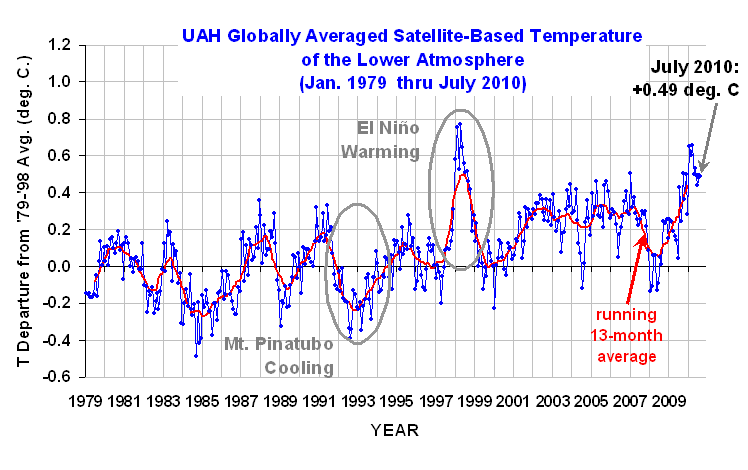
Most climatologists do not think that the warming ceased in 1998, and most of the data does not support that view:
http://www.skepticalscience.com/global- ... n-1998.htm