

So I have this tent trailer, as some of you might have read. I'm thinking of adding a deep cycle marine/rv battery to it. Attaching on the frame in the front. I want to basically power the lights inside (rv type dome lights) and a car stereo and speakers (to be installed).
It already is set up for power from hook-ups, and has an inverter.
I'm wondering how long the battery will last running the stereo? a good way to keep it charged (I'm thinking a solar panel)? Can I recharge the battery by hooking it up to my car battery and running it for a bit? And any other general notes about these batteries someone might have.
Also I might buy a cheap subwoffer box with tweeters from pep-boys, think I need an amp or can I get away with it powered from stereo (I worry that adding an amp will drain too much power).
I'm gonna make this trailer cool if it kills me!!!
Thanks.
Deep cycle batteries
Deep cycle batteries
"I gotta have more cowbell"
Bruce dickenson, legendary rock producer
Bruce dickenson, legendary rock producer
I like this site for the underlying math and knowledge:
http://www.landandseasolar.com/info.html
'course, it will depend on how loudly you play the stereo (louder takes more watts).
Still, on the stereo or with the documentation there should be a power rating (usually expressed as Amps at a particular voltage, such as 1 Amp @ 120 volts, or some such); search around to find this and you at least have the max draw.
Most inverters have an automatic low-voltage cutoff. You should be able to test the length of time at the anticipated volume using this.
http://www.landandseasolar.com/info.html
'course, it will depend on how loudly you play the stereo (louder takes more watts).
Still, on the stereo or with the documentation there should be a power rating (usually expressed as Amps at a particular voltage, such as 1 Amp @ 120 volts, or some such); search around to find this and you at least have the max draw.
Most inverters have an automatic low-voltage cutoff. You should be able to test the length of time at the anticipated volume using this.
"Yes, but is it art?" "No, Art is over there, on the couch."

by far the best battery investment you can make for this type of application is deep cycle golf cart batteries. They're about 100 bucks each, and you need to buy them in pairs (since they're only 6v each)
They store much more power than standard "deep cycle" or RV batteries and can be charged/discharged many more times than other types.
I have two of these batteries in my bus that run all kinds of stuff including: frige, tv, vcr,dvd, 100 feet of rope lighting, blacklights, and a huge 110 volt DJ sound system with a couple of 4 foot tall JBL cabinets.
I can run all of this stuff for about 6-8 hours.
A car stereo would run for a day or two on fully charged golf cart batteries. The big problem is how to recharge the batteries after they're depleted? Producing enough solar energy to keep the batteries charged, plus run all of your stuff while they're charging would cost a great deal of money and would be a lot of stuff to fiddle with.
I think you'd be better off spending $700 on a honda EU1000 generator. These are unbeliebably quiet, and they run for up to 8 hours on one gallon of fuel. They're extremely portable too.
They store much more power than standard "deep cycle" or RV batteries and can be charged/discharged many more times than other types.
I have two of these batteries in my bus that run all kinds of stuff including: frige, tv, vcr,dvd, 100 feet of rope lighting, blacklights, and a huge 110 volt DJ sound system with a couple of 4 foot tall JBL cabinets.
I can run all of this stuff for about 6-8 hours.
A car stereo would run for a day or two on fully charged golf cart batteries. The big problem is how to recharge the batteries after they're depleted? Producing enough solar energy to keep the batteries charged, plus run all of your stuff while they're charging would cost a great deal of money and would be a lot of stuff to fiddle with.
I think you'd be better off spending $700 on a honda EU1000 generator. These are unbeliebably quiet, and they run for up to 8 hours on one gallon of fuel. They're extremely portable too.
-
Tancorix

- Posts: 956
- Joined: Sun Dec 21, 2003 6:56 pm
- Location: Not here, not there. I'm somewhere though.
I have a couple of reference websites on this subject that I'd like to share:
http://www.uuhome.de/william.darden/
http://www.uuhome.de/william.darden/batlinks.htm#2
And here's another no BS site that covers a lot of other similar stuff that I've found very helpful:
http://www.phrannie.org/phredex.html
(All sites are work safe)
http://www.uuhome.de/william.darden/
http://www.uuhome.de/william.darden/batlinks.htm#2
And here's another no BS site that covers a lot of other similar stuff that I've found very helpful:
http://www.phrannie.org/phredex.html
(All sites are work safe)
-
unjonharley

- Posts: 10434
- Joined: Tue Sep 09, 2003 11:05 am
- Burning Since: 2001
- Camp Name: Elliot's naked bycycel repair
- Location: Salem Or.
I'm going with three (good) car batteries. Will use them for storage to power several things. Recharging takes less time. Deep cell takes hours. Where I can hot charge with a generator in a very short time. Even use them to charge the deep cells for the scooters. Test run charging the 12 volt scooter with one car battery & a 800 watt inverter. It worked well on a short charge for the 24 volt scooter. After I run the 24v down to nothing I'll test the charge with three car batteries and inverter. Right now I'm being cooled by that system. Going to keep testing until I get to the playa.
I'm the contraptioneer your mother warned you about.
-
Captain Goddammit

- Posts: 8594
- Joined: Sat Sep 06, 2003 9:34 am
- Burning Since: 2000
- Camp Name: First Camp
- Location: Seattle, WA
Yes. That will be the cheapest way to go.jbelson wrote:Can the batteries recharge by hooking up jumper cables to the car?
Hooking up a subwoofer with no amp will be pointless, won't "woof".
Can't say enough good things about Honda EU1000 generator, except that an EU2000 will run far more stuff for little extra dough, all-around better deal.
GreyCoyote: "At this rate it wont be long before he is Admiral Fukkit."

Deep Cycle and Recharging
Last year I used two 100 Ah 12VDC deep cycle batteries which I got at KMart for about $40/each to power a mobile Karaoke rig. (At 90% conversion efficiency to 120 VAC that would be 5040 Watts for two hours for each battery).
I got about 5 hours of running a computer, speakers, monitor and xmas lights off of each one.
I recharged them off a Honda EU3000i generator -- you could recharge it from your car as well (which is what I used to years ago).
If you do recharge from a generator which has 12VDC available, you might still want to use a 120 VAC charger. The Honda generator will only put about 10 Amp DC into a battery, but you can get over 50 Amps (if the battery can handle it) with a charger from the AC outlet via a auto-battery recharger (which will also treat your battery better).
Deep Cycle wear better with deep discharging and recharging, and pack more amp hours, than regular car batteries. Car batteries provide more amperage on demand for starting an engine than deep cycle batteries.
I’ve seen deep cycle batteries up to 240 Ah
I got about 5 hours of running a computer, speakers, monitor and xmas lights off of each one.
I recharged them off a Honda EU3000i generator -- you could recharge it from your car as well (which is what I used to years ago).
If you do recharge from a generator which has 12VDC available, you might still want to use a 120 VAC charger. The Honda generator will only put about 10 Amp DC into a battery, but you can get over 50 Amps (if the battery can handle it) with a charger from the AC outlet via a auto-battery recharger (which will also treat your battery better).
Deep Cycle wear better with deep discharging and recharging, and pack more amp hours, than regular car batteries. Car batteries provide more amperage on demand for starting an engine than deep cycle batteries.
I’ve seen deep cycle batteries up to 240 Ah
-
Mister Jellyfish Mister
- Posts: 2367
- Joined: Thu Mar 11, 2004 12:02 pm
- Location: Sparks, Nevada
- Contact:
Power Station
I've been planning a pit stop area at our camp to rest and recharge the deep cycle batteries for our mutant vehicle that power the el wire and LED's and audio. With the little alternator on the mini tractor that pulls it, can I charge other 12 volt batteries on the run instead of having long charge times at camp? Should I just run all of them in a parallel circuit along with the alternator? That way, we could just bring it back for more gas or a massage. :wink:
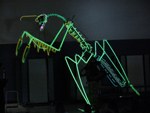
Art cred: Georgie Boy 2011: www.mutantvehicle.com/georgie_boy.htm ; Ein Hammer 2010; Fluffer 2009; Zsu Zsu 2008; U-Me 2007; Mantis 2006; MiniMan and Pikes Of Paranoia 2005; Time Machine Mutant Vehicle 2004. www.MutantVehicle.com
-
Captain Goddammit
- Posts: 8594
- Joined: Sat Sep 06, 2003 9:34 am
- Burning Since: 2000
- Camp Name: First Camp
- Location: Seattle, WA
Depends on how much output that alternator has.
Probably not much, and if so, I'd swap in a car alternator and solve the problem. Ideally I'd have a drive pulley to alternator pulley ratio that really spun the alternator fast, since the motor will probably spend all it's time on the playa idling, and therefore not creating full alternator output.
Probably not much, and if so, I'd swap in a car alternator and solve the problem. Ideally I'd have a drive pulley to alternator pulley ratio that really spun the alternator fast, since the motor will probably spend all it's time on the playa idling, and therefore not creating full alternator output.
GreyCoyote: "At this rate it wont be long before he is Admiral Fukkit."
-
EB

- Posts: 492
- Joined: Wed Jul 14, 2004 3:36 pm
- Burning Since: 2000
- Camp Name: Camp Obelix (2:45 & A)
- Contact:
Deep Cycle Question
This'll be my fourth BM so I picked up the Honda EU2000i genny (by way of the high praise it received from this board...) and now I'm looking to get the batteries it'll be re-charging...
The guy at the RV store wants to sell me four Interstate 6V's (U2200) @$90 a battery. While my power needs aren't that excessive (Xmas lights, couple fans, boom box, ipod, camera bat recharging) I don't mind overbuying, figuring I'll "grow" into it for future burns. But after reading the previous posts, I'm confused on a few things:
1.) To fully re-charge these batteries, I should forsake the HONDA DC recharger and buy a seperate AC recharger? Really? I don't dispute the math but it just seems counter-intuitive...
2.) Interstate's web site said the U2200's were 63 pounds a piece. It takes two of that size of battery to power a golf cart? That means, including the generator @50 lbs, I'll be adding nearly 300 lbs to my load? Yikes. Am I missing something here? Are there lighter, "playa" friendly batteries to take to BM?
EB
p.s. Please "over explain." When it comes to electricity, I'm a complete idiot.
The guy at the RV store wants to sell me four Interstate 6V's (U2200) @$90 a battery. While my power needs aren't that excessive (Xmas lights, couple fans, boom box, ipod, camera bat recharging) I don't mind overbuying, figuring I'll "grow" into it for future burns. But after reading the previous posts, I'm confused on a few things:
1.) To fully re-charge these batteries, I should forsake the HONDA DC recharger and buy a seperate AC recharger? Really? I don't dispute the math but it just seems counter-intuitive...
2.) Interstate's web site said the U2200's were 63 pounds a piece. It takes two of that size of battery to power a golf cart? That means, including the generator @50 lbs, I'll be adding nearly 300 lbs to my load? Yikes. Am I missing something here? Are there lighter, "playa" friendly batteries to take to BM?
EB
p.s. Please "over explain." When it comes to electricity, I'm a complete idiot.
-
unjonharley
- Posts: 10434
- Joined: Tue Sep 09, 2003 11:05 am
- Burning Since: 2001
- Camp Name: Elliot's naked bycycel repair
- Location: Salem Or.
Even with all this info and links, I'm still confused as hell. My latest thought was to get 2 6v golf cart batteries and run them parallel ( i think thats right). But then I dont think I could charge them with my car battery.
I'll mostly just be running a car stereo off of it. Plus I dont want to sink $300 into the whole set-up.
What would you do (without buying a generator)?
I'll mostly just be running a car stereo off of it. Plus I dont want to sink $300 into the whole set-up.
What would you do (without buying a generator)?
"I gotta have more cowbell"
Bruce dickenson, legendary rock producer
Bruce dickenson, legendary rock producer
Re: Deep Cycle Question
I just bought four of those paid 66.95 each for them. Don't buy from the RV store look on the interstate web site and find the dealer distributor in your area. They are the ones who sell to all the retail places a lot cheaper.EB wrote:
The guy at the RV store wants to sell me four Interstate 6V's (U2200) @$90 a battery.
Yes the generators are designed and optimized to put out ac current the dc circuit is only about 10 amps hrs (I believe) where a regular ac charger will be at least 80 - 100 amps hrs.EB wrote: 1.) To fully re-charge these batteries, I should forsake the HONDA DC recharger and buy a separate AC recharger? Really? I don't dispute the math but it just seems counter-intuitive...
There are a few generators that are made to put out DC current, they are more expensive and a specialty item.
I don't know about golf carts they may just run on 6 volts which is what one puts out. You would be butting 2 together in serial to make 12 volts and then putting that set together with the other set in parallel giving you 12 volts and more amps.EB wrote: 2.) Interstate's web site said the U2200's were 63 pounds a piece. It takes two of that size of battery to power a golf cart?
Lead acid deep discharge (like golf batteries) are the best. They take the charging and discharging better than anything else at a reasonable price. You can drain them 50 - 60% and recharge them 100's of times if you take care of them. Car batteries are already 12 volts so you can use just one but they don't have the amp hours. The rig you are talking about will give you 880 amp hrs at 6v or 440 amp hours at 12v which is what you are doing. The car batteries also won't take a deep discharge well they are designed to work best when not going bellow %80 charge. Every time you go bellow that the battery life is reduced. So in the long run you will throw away the car battery sooner.EB wrote: That means, including the generator @50 lbs, I'll be adding nearly 300 lbs to my load? Yikes. Am I missing something here? Are there lighter, "playa" friendly batteries to take to BM?
Also I don't think you need 4, If you already have the generator. The idea is run the batteries so you don't run the genny all the time. so with 220 amp hrs at 12v. that will run all your toys. when the 2 batteries get low turn on the genny and freshen them up .
Based on your list of stuff you can't be pulling more than 10 amps unless your fans are real big or you have thousands of lights.
So if you draw 10 amps per hour the 2 batteries would last 22 hours or if just running the batteries 1/2 way down 11 hours. Now some of your stuff is daytime stuff and some is nighttime so you should be fine. Once every day or 2 you turn the genny on and recharge the 2 batteries with a charger.
Hope that helps ask more questions if it doe not all make sense.
Bob A
[/quote]
Re: Deep Cycle Question
I just bought four of those paid 66.95 each for them. Don't buy from the RV store look on the interstate web site and find the dealer distributor in your area. They are the ones who sell to all the retail places a lot cheaper.EB wrote:
The guy at the RV store wants to sell me four Interstate 6V's (U2200) @$90 a battery.
Yes the generators are designed and optimized to put out ac current the dc circuit is only about 10 amps hrs (I believe) where a regular ac charger will be at least 80 - 100 amps hrs.EB wrote: 1.) To fully re-charge these batteries, I should forsake the HONDA DC recharger and buy a separate AC recharger? Really? I don't dispute the math but it just seems counter-intuitive...
There are a few generators that are made to put out DC current, they are more expensive and a specialty item.
I don't know about golf carts they may just run on 6 volts which is what one puts out. You would be butting 2 together in serial to make 12 volts and then putting that set together with the other set in parallel giving you 12 volts and more amps.EB wrote: 2.) Interstate's web site said the U2200's were 63 pounds a piece. It takes two of that size of battery to power a golf cart?
Lead acid deep discharge (like golf batteries) are the best. They take the charging and discharging better than anything else at a reasonable price. You can drain them 50 - 60% and recharge them 100's of times if you take care of them. Car batteries are already 12 volts so you can use just one but they don't have the amp hours. The rig you are talking about will give you 880 amp hrs at 6v or 440 amp hours at 12v which is what you are doing. The car batteries also won't take a deep discharge well they are designed to work best when not going bellow %80 charge. Every time you go bellow that the battery life is reduced. So in the long run you will throw away the car battery sooner.EB wrote: That means, including the generator @50 lbs, I'll be adding nearly 300 lbs to my load? Yikes. Am I missing something here? Are there lighter, "playa" friendly batteries to take to BM?
Also I don't think you need 4, If you already have the generator. The idea is run the batteries so you don't run the genny all the time. so with 220 amp hrs at 12v. that will run all your toys. when the 2 batteries get low turn on the genny and freshen them up .
Based on your list of stuff you can't be pulling more than 10 amps unless your fans are real big or you have thousands of lights.
So if you draw 10 amps per hour the 2 batteries would last 22 hours or if just running the batteries 1/2 way down 11 hours. Now some of your stuff is daytime stuff and some is nighttime so you should be fine. Once every day or 2 you turn the genny on and recharge the 2 batteries with a charger.
Hope that helps ask more questions if it doe not all make sense.
Bob A
[/quote]
You would run them in series. THat would give you 12 volts. parallel would give you only 6 volts.jbelson wrote:Even with all this info and links, I'm still confused as hell. My latest thought was to get 2 6v golf cart batteries and run them parallel ( i think thats right). But then I dont think I could charge them with my car battery.
I'll mostly just be running a car stereo off of it. Plus I dont want to sink $300 into the whole set-up.
What would you do (without buying a generator)?
You wouldn't be charging them off your car battery but your car alternator. If they were set up for 12 volts that would work.
However car alternators don't work best at idle and the fuel use is not very efficient.
That said my car is my backup charger for my 4 batteries. I'm using solar power, but if I run to low I will turn the car on to top them off.
Just make sure your alternator is in good shape, a bad one could be finished off leaving you stuck.
AS I said in my last post you would most likely only have to charge them 3 or 4 times the whole week.
Bob A
-
Tiahaar

- Posts: 1142
- Joined: Sat Sep 20, 2003 9:13 pm
- Burning Since: 2003
- Camp Name: Starship Palomino
- Location: Mojave Desert, CA (also Forever via Pandora)
Series is: (car+ to battery1+, battery1- to battery2+, battery2- to car-). Run the car of course to run the alternator heheh.
How about the 6v gell deep cells? Other than $$$ they are supposed to be highly durable too.
How about the 6v gell deep cells? Other than $$$ they are supposed to be highly durable too.
Burning Man 2003-25; Desert Carillon, HypnoHorse, Ulaume's Chimes, Iron Native, Black Rock Solar, Portal Collective, Center Camp Café Stage and Sound Tech, 747 Project
Starship Palomino
Starship Palomino
-
EB
- Posts: 492
- Joined: Wed Jul 14, 2004 3:36 pm
- Burning Since: 2000
- Camp Name: Camp Obelix (2:45 & A)
- Contact:
Inverter
Any thoughts on what type of inverter to purchase?
I've checked a few out online and they seem to run from 300w to 900w. Is there a logic to getting a smaller one or should I just get the biggest one I see (within reason of course...)
As I posted previously, I'll be running lights (10 strings of XMAS lights, forty feet of rope light) and a boombox at night and some fans during the day.
EB
I've checked a few out online and they seem to run from 300w to 900w. Is there a logic to getting a smaller one or should I just get the biggest one I see (within reason of course...)
As I posted previously, I'll be running lights (10 strings of XMAS lights, forty feet of rope light) and a boombox at night and some fans during the day.
EB
Re: Inverter
Depends on money what you want to spend how much can you spare when it breaks. The small ones you see in car stores warehouses etc. are pretty cheap and can put out anywhere from 200 - 1000 whatts and cost well under $100. I bought a 400w peak 800w from Costco for $29.00 for my car to charge my ipod and cell phone. For my camper I found a rebuilt 2000 watt one designed for campers and it charges the batteries to if connected to AC. If it wasn't 1/2 off I wouldn't have been able to afford it.EB wrote:Any thoughts on what type of inverter to purchase?
I've checked a few out online and they seem to run from 300w to 900w. Is there a logic to getting a smaller one or should I just get the biggest one I see (within reason of course...)
As I posted previously, I'll be running lights (10 strings of XMAS lights, forty feet of rope light) and a boombox at night and some fans during the day.
EB
The small ones are a little less efficient in their conversion of power and they may die do to the dust and heat. The camper style ones need a permanent home and are more efficient, And less likely to cry uncle if kept in a reasonably proper environment.
So buy what you can afford and look at the total watts you will be using at one time. You can over buy without wasting much if any power, but I wouldn't buy a 1500w and run 1 100watt light bulb on it. Buy 2 of the $30 specials and run both. If one dies you can still run 1/2 your stuff or ration.
Bob A
I'm putting a pair of 150 w panels on top of my camper this weekend. I've been reading and researching these for about a year. What you want to know how big, what you need, cost, where to get, etc.jbelson wrote:Has anyone used a solar recharging panel for their batteries? I'm talking the RV grade ones (approx. $85), not the pep-boys dash mounted types ($20).
I figure I'm gonna need something to keep some charge in the batteries.
Depending on how big you may need a charge controller this is a relatively inexpensive device that shuts down the charge from the panels if the batteries get full. Small ones not such a big deal since the won't fill the battery as fast.
Bob A

H2OS4 v.s. Alkaline Playa
I'm hesitent to bring my batteries and need some expert adivise in regards to how the playa may affect the chemistry within the batteries if any were to get into them through the gassing holes in the cell plugs (for lack of a better term) which from what I know, need to be open to allow for hydrogen and oxygen ions to escape while charging.
It would seem that the neeto balancing act between the lead and lead dioxide electrodes, sulfuric acid and water electrolite may be thrown off with a little of our, for better or for worse, beloved playa, rendering expensive equipment down to nothing wore than a toxic waste.
Am I right?
Does anyone have a good way to keep the playa out without pluging the gassing holes?
AugustIII
It would seem that the neeto balancing act between the lead and lead dioxide electrodes, sulfuric acid and water electrolite may be thrown off with a little of our, for better or for worse, beloved playa, rendering expensive equipment down to nothing wore than a toxic waste.
Am I right?
Does anyone have a good way to keep the playa out without pluging the gassing holes?
AugustIII
Re: H2OS4 v.s. Alkaline Playa
Don't plug the holes your batteries will go boom. That’s a good question people talk all the time about batteries on the threads and no one has ever said anything bad like that happens. The vents are not a straight hole right through to the open. They are baffled inside the caps. I would think so gas can travel out but other things can't get in that easy. The vents are also very small so that would reduce the chance for dust to get in. Also for general safety you should not have the batteries sitting on the open playa. They should be inside of something. Maybe a storage tote with vents cut into it or some fancier battery case. This will prevent something shorting them out and will keep the worst of the dust off them.augustIII wrote:I'm hesitent to bring my batteries and need some expert adivise in regards to how the playa may affect the chemistry within the batteries if any were to get into them through the gassing holes in the cell plugs (for lack of a better term) which from what I know, need to be open to allow for hydrogen and oxygen ions to escape while charging.
It would seem that the neeto balancing act between the lead and lead dioxide electrodes, sulfuric acid and water electrolite may be thrown off with a little of our, for better or for worse, beloved playa, rendering expensive equipment down to nothing wore than a toxic waste.
Am I right?
Does anyone have a good way to keep the playa out without pluging the gassing holes?
AugustIII
Also if you check the fluid levels wipe down the entire tope of the battery first so no dust falls in when you are checking.
All in all I think you will be ok if you take the above steps. YMMV
Bob A
-
unjonharley
- Posts: 10434
- Joined: Tue Sep 09, 2003 11:05 am
- Burning Since: 2001
- Camp Name: Elliot's naked bycycel repair
- Location: Salem Or.
-
Tancorix
- Posts: 956
- Joined: Sun Dec 21, 2003 6:56 pm
- Location: Not here, not there. I'm somewhere though.
Both of my deep cell batteries were left out in the worst of the dust for 2 years now with nothing covering them and they work just fine. I've had the tops of the batteries covered with dust...you couldn't see the writing or even the +/- symbols without knocking the dust off.
As for low voltage warnings, I'm like Unjon and rely on the built in inverter warning.
As for low voltage warnings, I'm like Unjon and rely on the built in inverter warning.
Okay, my trailer already has an inverter on it. How easy is it to wire batteries to it. It was previously wired the connect through the tow vehicle to run off of it's battery. I'm wondering if I do it myself or pay to do it. My costs on the trailer keep going up and I want to keep it in check. I have some skills, but am definately not an electrician.
"I gotta have more cowbell"
Bruce dickenson, legendary rock producer
Bruce dickenson, legendary rock producer
Sorry, I couldn't post both links at once- But....
http://www.homepower.com/
Good info. Also, Alternative Energy Zone or AEZ has everything you'll need to know, I think. They're Hushville's next-door neighbors.
I can't see why you couldn't add batts to your existing inverter- remember to use appropriately sized wires of modest length. Check a garage or trailer-hitch installer for specs.
http://www.homepower.com/
Good info. Also, Alternative Energy Zone or AEZ has everything you'll need to know, I think. They're Hushville's next-door neighbors.
I can't see why you couldn't add batts to your existing inverter- remember to use appropriately sized wires of modest length. Check a garage or trailer-hitch installer for specs.
Howdy From Kalamazoo
How big is the inverter, how many watts. That and distance will decide how big the cables should be. If your under 2000watts 2/0 cables should be fine unless you are going a long distance (which is bad for power conversion anyway)jbelson wrote:Okay, my trailer already has an inverter on it. How easy is it to wire batteries to it. It was previously wired the connect through the tow vehicle to run off of it's battery. I'm wondering if I do it myself or pay to do it. My costs on the trailer keep going up and I want to keep it in check. I have some skills, but am definately not an electrician.
Also don't put the Batteries where you are sleeping, as they run they give off small amounts of hydrogen gas. They must be vented to the outside. I would use 2 6 volt golf cart batteries tie a short cable + to - and then run the cables from the inverter to the other 2 terminals. If you can't recharge while there recharge right away when you get home. Also you should leave the wires running from the tow vehicle intact. You can run your car in a pinch to recharge the camper batteries. Just don't leave the tow wire connected when you are not charging, it will drain the car battery as it uses the golf cart batteries evenly
Bob A.
-
Captain Goddammit
- Posts: 8594
- Joined: Sat Sep 06, 2003 9:34 am
- Burning Since: 2000
- Camp Name: First Camp
- Location: Seattle, WA
It isn't very practical to run an inverter through your trailer plug from your tow vehicle because the current draw is too high for the wiring and plug.jbelson wrote:Okay, my trailer already has an inverter on it. How easy is it to wire batteries to it. It was previously wired the connect through the tow vehicle to run off of it's battery. I'm wondering if I do it myself or pay to do it. My costs on the trailer keep going up and I want to keep it in check. I have some skills, but am definately not an electrician.
Ideally you would put a deep-cycle battery in the trailer near the inverter so that the large-guage wires to the battery are as short as possible. The connection to the tow vehicle is for charging the battery while you drive.
Few trailers come with inverters (which change 12-volt DC into 120-volt AC). Almost all RVs have CONVERTERS, which change 120-volt AC from an external source down to 12-volt DC to operate the 12-volt stuff in the camper.
Make sure you are looking at the right thing.
Watts = Volts x amps. 120 watts is 10 amps at 12 volts, only 1 amp at 120 volts. At the low voltage of a car or RV battery, lots of current (amps) is required, and that requires large, heavy-guage wiring, preferably short.
If you're gonna use your tow vehicle battery, I'd put the inverter in the tow vehicle as close as practical to the battery and then use a decent extension cord to carry the now-higher-voltage, but lower-current power to the trailer.
GreyCoyote: "At this rate it wont be long before he is Admiral Fukkit."