

I'm looking for some advice, suggestions, and direction on replacing and upgrading the battery for the electric assist motor in my trike.
The electric assist motor was added via a kit, it's a 36v motor that connects to the battery using Anderson power pole connectors. It came with a 9ah sealed lead acid battery pack, though doing some research on the manufacturer's web site, they also have a 12ah lead acid option, as well as 15ah or 20ah lithium ion options. More amp hours equals greater range, which is something I'd really like (I can usually get back and forth across the playa a few times on a single charge). I don't have any interest in modding the speed, it suits me fine as is for getting around the playa plus the occasional city use.
My question is, would it be possible (and fairly easy) to make my own 36v li-ion battery pack using off-the-shelf components? While I was doing some random web searching, some of the results looked like they were making battery bars out of modular components. I've got basic soldering and wiring skills, but am out of my depth if it would involve more advanced stuff (custom circuit boards, etc). A 15-20 amp hour 36v battery looks like a pretty spendy proposition, so aside from getting to have some DIY fun (and make my own ruggedized enclosure), saving some money over a pre-fab battery pack and charger is a big plus.
36v Battery/Charger DIY?
-
GreyCoyote

- Posts: 2176
- Joined: Mon Feb 18, 2013 8:24 am
- Burning Since: 2000
Re: 36v Battery/Charger DIY?
Is form factor a limitation or can you pretty much adapt whatever you make to the vehicle?
"To sum up my compassion level, I think we should feed the unwanted animals to the homeless. Or visa versa. Too much attention and money is spent on both."
(A Beautiful Mind)
(A Beautiful Mind)
-
trilobyte

- Site Admin
- Posts: 17261
- Joined: Tue Mar 02, 2004 10:54 pm
- Burning Since: 2004
- Camp Name: Atomic Octopus
- Location: Las Vegas
- Contact:
Re: 36v Battery/Charger DIY?
Oops, I forgot to add, it would be a huge plus if I was somehow able to power my bike's lighting with this battery rig. I'm using a string of total control lighting from funhouse, which uses dc power and is currently connected to an awkward battery cage with 4 D-cells (which last through the whole week). The TCL system uses 5v DC, so I'm guessing I'd need to step down from 36v to 5v somehow (so it didn't overload the lighting) and then simply be a small current drain. Checking the Funhouse Productions site, I can get a standard 12v DC (2 amp) adapter if that would make the process any easier.
-
trilobyte
- Site Admin
- Posts: 17261
- Joined: Tue Mar 02, 2004 10:54 pm
- Burning Since: 2004
- Camp Name: Atomic Octopus
- Location: Las Vegas
- Contact:
Re: 36v Battery/Charger DIY?
Form factor's pretty flexible.
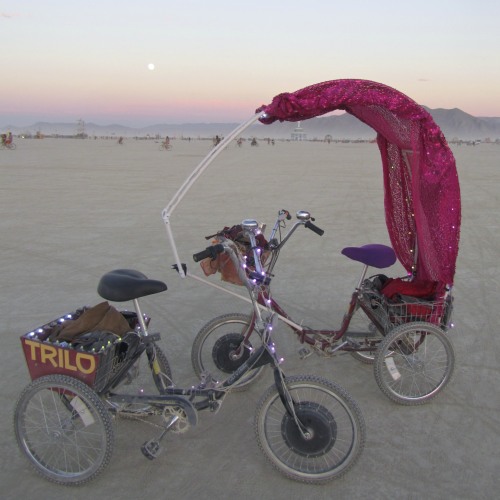
I've got plenty of storage room in the bike basket, as well as space to attach to the bike frame if that proved to be more practical. The current SLA battery came in a canvas bag which is secured to the sides of the bike basket via velcro. I'd like to make my own enclosure that could possibly attach on the outside of the basket, be a bit more firmly connected, and have some foam or some sort of cushion to dampen the shaking and vibration of the playa.
I've got plenty of storage room in the bike basket, as well as space to attach to the bike frame if that proved to be more practical. The current SLA battery came in a canvas bag which is secured to the sides of the bike basket via velcro. I'd like to make my own enclosure that could possibly attach on the outside of the basket, be a bit more firmly connected, and have some foam or some sort of cushion to dampen the shaking and vibration of the playa.
-
GreyCoyote
- Posts: 2176
- Joined: Mon Feb 18, 2013 8:24 am
- Burning Since: 2000
Re: 36v Battery/Charger DIY?
Two instant suggestions.
1). Grab a triplet of 12v SLA batteries (Panasonic, Yesua, etc) and put them in series. You can adapt the AH capacity to fit space and budget. I like these better than most lithiums for stuff like this. Very durable, if you have the space.
2). Look for a scrapped Worx or B&D electric lawnmower. The 19 inch versions are 36 volt and you can repurpose the batts when the crappy motor burns out. Might be as close as your nearest dumpster.
1). Grab a triplet of 12v SLA batteries (Panasonic, Yesua, etc) and put them in series. You can adapt the AH capacity to fit space and budget. I like these better than most lithiums for stuff like this. Very durable, if you have the space.
2). Look for a scrapped Worx or B&D electric lawnmower. The 19 inch versions are 36 volt and you can repurpose the batts when the crappy motor burns out.
Might be as close as your nearest dumpster."To sum up my compassion level, I think we should feed the unwanted animals to the homeless. Or visa versa. Too much attention and money is spent on both."
(A Beautiful Mind)
(A Beautiful Mind)

Re: 36v Battery/Charger DIY?
First things first!
Find out what the load limit of the trike is.
Calculate in your weight plus whatever you usually carry.
That will give you an idea of how much battery pack you can add.
Then subtract 10% as a safty factor.
Before I moved my battery to the front of my trike, it was over weight and I had to have someone hold the front down while I got in it when I had 6 bags of ice or it would wheely.
But the big concern was taco wheel from too much weight.
Since my front wheel is now a heavy duty dollie wheel (300 pound capacity) and the 80 pound battery rides in front of that, there are no more worries.
Find out what the load limit of the trike is.
Calculate in your weight plus whatever you usually carry.
That will give you an idea of how much battery pack you can add.
Then subtract 10% as a safty factor.
Before I moved my battery to the front of my trike, it was over weight and I had to have someone hold the front down while I got in it when I had 6 bags of ice or it would wheely.
But the big concern was taco wheel from too much weight.
Since my front wheel is now a heavy duty dollie wheel (300 pound capacity) and the 80 pound battery rides in front of that, there are no more worries.
"Don't buy ur Burn...........Build ur Burn!"
"If I can't find an answer, I'll create one!!!"
Fuck Im Good Just Ask Me
"If I can't find an answer, I'll create one!!!"
Fuck Im Good Just Ask Me
-
trilobyte
- Site Admin
- Posts: 17261
- Joined: Tue Mar 02, 2004 10:54 pm
- Burning Since: 2004
- Camp Name: Atomic Octopus
- Location: Las Vegas
- Contact:
Re: 36v Battery/Charger DIY?
The trike's rated capacity is 225lbs, which seems ridiculously light considering the solid construction Worksman puts on their gear. Perhaps that's a carry capacity beyond the passenger? I can't imagine it getting taco wheel, since it's a port-o-trike they're smaller 20 inch wheels. Load-wise, I'm not usually carrying a lot. When exploring the playa I bring along a water jug and maybe a bottle or three of something to enjoy and share, and random extra stuff such as a coat. In Defaultia, it might be a couple bags full of groceries or goodies from the Farmer's Market.
The current battery pack weighs just under 20lbs in the canvas bag, and there's never been any kind of issue with weight or load balance with the read basket loaded down with ice. I don't think the picture shows it too clearly, but the battery is currently attached to the front of that basket, so the weight is just in front of where that rear axle sits. Ideally I'd keep it in the same spot, or maybe design an enclosure that would attach to the outside of the basket in the front... that way it doesn't take up any basket space, and it still keeps the weight centered.
I've had bad experiences with sealed lead acid batteries not living up to expectations in a few different applications (that could have been entirely due to user error). Weight is also a consideration - ideally I'd like to have something that weighed less than what I've got. My guess is that going from a 9ah to 15 or 20 amp hour SLA would probably mean a significant increase to the battery weight (though I don't know enough about the tech to know if that's true).
The current battery pack weighs just under 20lbs in the canvas bag, and there's never been any kind of issue with weight or load balance with the read basket loaded down with ice. I don't think the picture shows it too clearly, but the battery is currently attached to the front of that basket, so the weight is just in front of where that rear axle sits. Ideally I'd keep it in the same spot, or maybe design an enclosure that would attach to the outside of the basket in the front... that way it doesn't take up any basket space, and it still keeps the weight centered.
I've had bad experiences with sealed lead acid batteries not living up to expectations in a few different applications (that could have been entirely due to user error). Weight is also a consideration - ideally I'd like to have something that weighed less than what I've got. My guess is that going from a 9ah to 15 or 20 amp hour SLA would probably mean a significant increase to the battery weight (though I don't know enough about the tech to know if that's true).
Re: 36v Battery/Charger DIY?
Here's a good example of what's possible.
They're 12 pounds apiece, and although you'll need 3 connected in series, it gets you 20AHs.
I didn't check the dimensions, but they shouldn't take up much space even if they have to go in the basket.
The AGMs can't spill even with a corner knocked off, that's why they're pricier.
http://www.batteriesplus.com/product_se ... -20NB.aspx
They're 12 pounds apiece, and although you'll need 3 connected in series, it gets you 20AHs.
I didn't check the dimensions, but they shouldn't take up much space even if they have to go in the basket.
The AGMs can't spill even with a corner knocked off, that's why they're pricier.
http://www.batteriesplus.com/product_se ... -20NB.aspx
"Don't buy ur Burn...........Build ur Burn!"
"If I can't find an answer, I'll create one!!!"
Fuck Im Good Just Ask Me
"If I can't find an answer, I'll create one!!!"
Fuck Im Good Just Ask Me
-
unjonharley
- Posts: 10434
- Joined: Tue Sep 09, 2003 11:05 am
- Burning Since: 2001
- Camp Name: Elliot's naked bycycel repair
- Location: Salem Or.
Re: 36v Battery/Charger DIY?
My Zappy is a 36v hub motor.. It runs off of 6 10ah gel batteries arranged in two 3 packs..They charge in about 6 hours from 50%.. The scooter weight is about 80 pounds.. I was at 220 lb. 9 miles used 50% of batteries.. I burned the controler climbing a hill to many.. $75 buck for that listen.. All parts are on the net..
-
trilobyte
- Site Admin
- Posts: 17261
- Joined: Tue Mar 02, 2004 10:54 pm
- Burning Since: 2004
- Camp Name: Atomic Octopus
- Location: Las Vegas
- Contact:
Re: 36v Battery/Charger DIY?
Looks like those are 7.1x6.5x3 apiece. The size isn't terrible, but it does double the weight. I'm trying to recall from a conversation we had on the playa, you said something about needing to get some kind of device for a new SLA battery to keep the thing from getting screwed up when storing for a few months at a time?
From my research, it appears LifePO4 is another potential solution. It's a kind of li-ion battery geared towards high power applications - tools and EV cars and stuff. Looking at that option, I see listings like this one, which is basically 36v and 20 amp hours at $400 with shipping from overseas. And it weighs a couple pounds less than the current battery.
From my research, it appears LifePO4 is another potential solution. It's a kind of li-ion battery geared towards high power applications - tools and EV cars and stuff. Looking at that option, I see listings like this one, which is basically 36v and 20 amp hours at $400 with shipping from overseas. And it weighs a couple pounds less than the current battery.
-
BBadger

- Posts: 6074
- Joined: Wed Jan 19, 2011 10:37 am
- Burning Since: 2010
- Location: (near) Portland, OR, USA
Re: 36v Battery/Charger DIY?
You might get dinged with those hazmat transportation fees for larger Lithium batteries. It's really killed those battery shippers out of Hong Kong.
"The essence of tyranny is not iron law. It is capricious law." -- Christopher Hitchens
Hate reading my replies? Click here to add me to your plonk (foe) list.
Hate reading my replies? Click here to add me to your plonk (foe) list.
Re: 36v Battery/Charger DIY?
The "device" would just be a smart charger to keep your batteries maintained.
My batts only get used on the playa so they're on a smart charger the rest of the year, but if you use your trikes regularly, it isn't as much of an issue.
My batts only get used on the playa so they're on a smart charger the rest of the year, but if you use your trikes regularly, it isn't as much of an issue.
"Don't buy ur Burn...........Build ur Burn!"
"If I can't find an answer, I'll create one!!!"
Fuck Im Good Just Ask Me
"If I can't find an answer, I'll create one!!!"
Fuck Im Good Just Ask Me
Re: 36v Battery/Charger DIY?
A 36V lithium pack isn't very common, you'd definitely benefit by learning to build your own pack. Yes...balancing the cells will be pretty aggravating.
This is the best 37V pack I could find: http://www.all-battery.com/Tenergy37V10 ... 31442.aspx
It's only 10AH, but it's also only 5 pounds.
It looks like for lithium batteries, you get about 2AH per pound. For NiMH, you get about 1AH per pound. For SLA, you get about 0.5AH per pound.
This is the best 37V pack I could find: http://www.all-battery.com/Tenergy37V10 ... 31442.aspx
It's only 10AH, but it's also only 5 pounds.
It looks like for lithium batteries, you get about 2AH per pound. For NiMH, you get about 1AH per pound. For SLA, you get about 0.5AH per pound.
-
trilobyte
- Site Admin
- Posts: 17261
- Joined: Tue Mar 02, 2004 10:54 pm
- Burning Since: 2004
- Camp Name: Atomic Octopus
- Location: Las Vegas
- Contact:
Re: 36v Battery/Charger DIY?
Thanks, Figjam, that's good to know. The charger I have seems extremely simplistic, and if I remember correctly the manual cautioned to unplug once things were charged. For us, throughout the year is still sporadically, I'll go weeks or even months between uses. I've been charging to full and then disconnecting the battery from anything before the trike goes into storage. That wasn't a problem in the past, but maybe I'd pulled it out and used it often enough that it wasn't a problem then. The gap before this past burn was longer, and could have been the problem. Perhaps a more deluxe charger, and then just keeping the batteries/charger in the loft and charging when the trike is in storage...
Can the lithium-ion/lithium phosphate batteries connect in sequence like the SLA's then? 12v+12v+12v=36v, or some other combination... If so, do they need some kind of special controller or linkup, or do they just sequence positive to negative like so many AA batteries in a radio?
Can the lithium-ion/lithium phosphate batteries connect in sequence like the SLA's then? 12v+12v+12v=36v, or some other combination... If so, do they need some kind of special controller or linkup, or do they just sequence positive to negative like so many AA batteries in a radio?
-
trilobyte
- Site Admin
- Posts: 17261
- Joined: Tue Mar 02, 2004 10:54 pm
- Burning Since: 2004
- Camp Name: Atomic Octopus
- Location: Las Vegas
- Contact:
Re: 36v Battery/Charger DIY?
Forgive another silly question, but when it comes to chargers, does more amps translates into a shorter charging time? For example, will a 6a charger get the job done 3 times faster than a 2a charger (assuming it's the same voltage, of course)?

Re: 36v Battery/Charger DIY?
My understanding is limited, but based on a lot of shopping years ago for an electric bike solution. The "V is for voltage" forum was a great resource for me. Lithium battery chemistry needs a special charger, and I think the battery packs include some kind of circuitry beyond just the individual cells. Early lithium batteries were prone to self igniting while charging, and I know you shouldn't use a regular lead acid charger to charge lithium batteries. Your 36 Volt motor with a small 20" wheel probably gives you a lot of torque, and power, lots of power.
More amps charging does make it charge faster, but it also might cause heat and damage with the rapid charging, and effect the total number of charges you get out of the battery.
More amps charging does make it charge faster, but it also might cause heat and damage with the rapid charging, and effect the total number of charges you get out of the battery.
”On second thought, Let’s not go to Camelot. It’s a silly place.”
Roll on through, Tumbleweed.
Roll on through, Tumbleweed.
Re: 36v Battery/Charger DIY?
The simple answer is yes, but there is more to it then that.
http://www.batterystuff.com/kb/articles ... asics.html
Here's the "smart charger" that I have, but on playa it would be nice to have a higher AMP charger.
http://batteryminders.com/details.php?prod=12248
http://www.batterystuff.com/kb/articles ... asics.html
Here's the "smart charger" that I have, but on playa it would be nice to have a higher AMP charger.
http://batteryminders.com/details.php?prod=12248
"Don't buy ur Burn...........Build ur Burn!"
"If I can't find an answer, I'll create one!!!"
Fuck Im Good Just Ask Me
"If I can't find an answer, I'll create one!!!"
Fuck Im Good Just Ask Me

Re: 36v Battery/Charger DIY?
I knew when I did a drive-by of the site and saw this post I'd get sucked in.
I haven't got much time to explain it all out, but there's pieces mentioned in the other post that should get considered.
The SLA will give you the most range for the $, but the size & weight can become an issue.
LiFePO4 are great, lightweight for the AH, but expensive. Also, they have definite charge & discharge requirements. Discharge them too far, you've got a paper weight. After charging a pack, the charge between the cells needs to be equalized, taking time, wasting power, and the resulting pack doesn't have full capacity. The safe & easy way to build a pack is to have a Battery Management System build into the pack. It protects against over charging and over discharging, and some will charge balance after you've charged. Some will regulate the charge to each cell while charging, so the cells are already balanced when the pack is done charging. E-bike packs used to be readily available in 24VDC, 36 VDC and 48 VDC. AH ranges from 10 ah through 20 ah, and above, but it can quickly get expensive. Assembling a DIY pack can be difficult or easy, depending on the cells you choose.
The cells and the BMS I choose appeared to be the best available at that time. I haven't checked recently to see what has changed.
48 VDC & 10 AH, BMS & case & pack monitor came in around $800 DIY.
In 2010 I built a 48 VDC LiFePO4 using Headway cells.
If I trust the old spreadsheet I dug out, the Max/Min voltage of the pack is 43.8/24 VDC. I really like that the cell is fully enclosed, and built into one end of each cell, is a space to allow the cell to expand so there is less likely to be a leak due to expansion failure. No soldering, small screw-head bolts do the connections. Robust connects with no solder joints to fail.
You can use various bus-bars bolted between the cells for series/parallel configurations. They also have plastic brackets that connect to each other for easily building arrays of cells to pack.
No issue getting the cells, as I bought from a North American supplier, who had brought them in from Hong Kong in bulk.
For BMS (battery management system), you can try to do that manually, or use a simple one that monitors the pack voltage or one that monitors each cell in the pack. The per-cell ones are safer, and can be smaller, cheaper, even while having more features.
I used a 5-to-13 cell BMS in my pack that monitors each cell. I specified the max & min cell voltage, max charge current and maximum discharge current, the number of cells, and the board was custom populated to those requirements (oddly the board is configured internally with a positive ground, but interfaces with the world on negative ground...). It's small, compact, and with a harness connected to the board that puts a lead to the junction between each cell: it monitors the voltages and allows for fully charging each cell without over-charging & without requiring a post-charge rebalancing, and stops discharging if a single cells reaches the cell limit, and limits the pack output current. This BMS also has a temperature sensor that gets taped to one of the cells to protect against over-heating while charging or discharging. You need a specific type of charger that matches the voltage curve to what LiFePO4 works well with.
My knowledge is dated. I would strongly suggest that you NOT rush out to duplicate what I did in a 36 VDC pack, but it does give you an idea of what to consider when looking at what's currently available/recommended.
I'd suggest starting here: http://www.endless-sphere.com/forums/viewforum.php?f=14
I haven't got much time to explain it all out, but there's pieces mentioned in the other post that should get considered.
The SLA will give you the most range for the $, but the size & weight can become an issue.
LiFePO4 are great, lightweight for the AH, but expensive. Also, they have definite charge & discharge requirements. Discharge them too far, you've got a paper weight. After charging a pack, the charge between the cells needs to be equalized, taking time, wasting power, and the resulting pack doesn't have full capacity. The safe & easy way to build a pack is to have a Battery Management System build into the pack. It protects against over charging and over discharging, and some will charge balance after you've charged. Some will regulate the charge to each cell while charging, so the cells are already balanced when the pack is done charging. E-bike packs used to be readily available in 24VDC, 36 VDC and 48 VDC. AH ranges from 10 ah through 20 ah, and above, but it can quickly get expensive. Assembling a DIY pack can be difficult or easy, depending on the cells you choose.
The cells and the BMS I choose appeared to be the best available at that time. I haven't checked recently to see what has changed.
48 VDC & 10 AH, BMS & case & pack monitor came in around $800 DIY.
In 2010 I built a 48 VDC LiFePO4 using Headway cells.
If I trust the old spreadsheet I dug out, the Max/Min voltage of the pack is 43.8/24 VDC. I really like that the cell is fully enclosed, and built into one end of each cell, is a space to allow the cell to expand so there is less likely to be a leak due to expansion failure. No soldering, small screw-head bolts do the connections. Robust connects with no solder joints to fail.
You can use various bus-bars bolted between the cells for series/parallel configurations. They also have plastic brackets that connect to each other for easily building arrays of cells to pack.
No issue getting the cells, as I bought from a North American supplier, who had brought them in from Hong Kong in bulk.
For BMS (battery management system), you can try to do that manually, or use a simple one that monitors the pack voltage or one that monitors each cell in the pack. The per-cell ones are safer, and can be smaller, cheaper, even while having more features.
I used a 5-to-13 cell BMS in my pack that monitors each cell. I specified the max & min cell voltage, max charge current and maximum discharge current, the number of cells, and the board was custom populated to those requirements (oddly the board is configured internally with a positive ground, but interfaces with the world on negative ground...). It's small, compact, and with a harness connected to the board that puts a lead to the junction between each cell: it monitors the voltages and allows for fully charging each cell without over-charging & without requiring a post-charge rebalancing, and stops discharging if a single cells reaches the cell limit, and limits the pack output current. This BMS also has a temperature sensor that gets taped to one of the cells to protect against over-heating while charging or discharging. You need a specific type of charger that matches the voltage curve to what LiFePO4 works well with.
My knowledge is dated. I would strongly suggest that you NOT rush out to duplicate what I did in a 36 VDC pack, but it does give you an idea of what to consider when looking at what's currently available/recommended.
I'd suggest starting here: http://www.endless-sphere.com/forums/viewforum.php?f=14
You do not have the required permissions to view the files attached to this post.
Last edited by Canoe on Wed Nov 20, 2013 9:10 pm, edited 3 times in total.
4.669
.
That's one word I regret googling during breakfast.
.
Video games are giving kids unrealistic expectations on how many swords they can carry.
.
, but don't harm the red dragon that frequents the area from time to time. He and I have an agreement.
.
That's one word I regret googling during breakfast.
.
Video games are giving kids unrealistic expectations on how many swords they can carry.
.
, but don't harm the red dragon that frequents the area from time to time. He and I have an agreement.
Re: 36v Battery/Charger DIY?
In addition, a LiFePO4 pack needs a pack voltage monitor so you know how much life you have left before you need to recharge. I used a small monitor that has both LEDS and an audible alarm. I had to use two precision resistors in series to half the pack voltage into the range of the monitor (think you can get these with a higher voltage limit now, so you wouldn't need the resistors). You set the alarm voltage. I choose a voltage above the minimum voltage, so I'd know when it was getting close.
MUST be a charger for LiFEPO4 so it follows an appropriate charge curve.
Chargers can vary from under 2A to 60A. Cost varies, higher amps for faster rates can get expensive. Make sure you're not exceeding the cell charge rate.
Chargers can vary from under 2A to 60A. Cost varies, higher amps for faster rates can get expensive. Make sure you're not exceeding the cell charge rate.
You do not have the required permissions to view the files attached to this post.
Last edited by Canoe on Wed Nov 20, 2013 9:28 pm, edited 3 times in total.
4.669
.
That's one word I regret googling during breakfast.
.
Video games are giving kids unrealistic expectations on how many swords they can carry.
.
, but don't harm the red dragon that frequents the area from time to time. He and I have an agreement.
.
That's one word I regret googling during breakfast.
.
Video games are giving kids unrealistic expectations on how many swords they can carry.
.
, but don't harm the red dragon that frequents the area from time to time. He and I have an agreement.
Re: 36v Battery/Charger DIY?
packs can be small, large, or nuts
White PVC tubes can be an easy way to make a robust water-proof pack.
White PVC tubes can be an easy way to make a robust water-proof pack.
You do not have the required permissions to view the files attached to this post.
Last edited by Canoe on Wed Nov 20, 2013 9:15 pm, edited 1 time in total.
4.669
.
That's one word I regret googling during breakfast.
.
Video games are giving kids unrealistic expectations on how many swords they can carry.
.
, but don't harm the red dragon that frequents the area from time to time. He and I have an agreement.
.
That's one word I regret googling during breakfast.
.
Video games are giving kids unrealistic expectations on how many swords they can carry.
.
, but don't harm the red dragon that frequents the area from time to time. He and I have an agreement.
Re: 36v Battery/Charger DIY?
Playa vibration can cause failure in anything too complex.
I would keep it simple.
I would keep it simple.
"Don't buy ur Burn...........Build ur Burn!"
"If I can't find an answer, I'll create one!!!"
Fuck Im Good Just Ask Me
"If I can't find an answer, I'll create one!!!"
Fuck Im Good Just Ask Me
Re: 36v Battery/Charger DIY?
As simple as possible, but no simpler.
If you're going LiFePO4, you should keep it safe to charge and safe to use, so you don't trash the expensive cells, nor your time invested. That means a quality BMS. Saves you time too.
Slide the plastic clips together in the configuration you want, slide your cells into place, connect the bus bars, including the voltage monitoring wires to the BMS board. Attach the BMS board with the ground, charge and discharge wires, plugging in the harness and taping the temp sensor to a cell. Put it into a case.
The only "trick" is to make sure you use a volt meter to confirm the voltage at the pins on the monitoring harness (lowest to highest in order), to confirm you've got the wires at the right point in the series stack of cells - before you plug the harness into the BMS board. And the soldering of the charge/discharge/ground wires to the BMS board must be done with the usual appropriate soldering technique so you don't toast the components on the board.
Sample showing a nominal 36 VDC pack, 2x6 (max voltage 12 x 3.65). Or do a 2x5 for a max voltage of 36.5. Check what the target max voltage is for a 36 VDC pack charger.
In my pack, I used shrinkwrap on the connectors to have less metal exposed, just because. Note the standoff tabs on the plastic holders. Mine's in an aluminum case.
If you're going LiFePO4, you should keep it safe to charge and safe to use, so you don't trash the expensive cells, nor your time invested. That means a quality BMS. Saves you time too.
Slide the plastic clips together in the configuration you want, slide your cells into place, connect the bus bars, including the voltage monitoring wires to the BMS board. Attach the BMS board with the ground, charge and discharge wires, plugging in the harness and taping the temp sensor to a cell. Put it into a case.
The only "trick" is to make sure you use a volt meter to confirm the voltage at the pins on the monitoring harness (lowest to highest in order), to confirm you've got the wires at the right point in the series stack of cells - before you plug the harness into the BMS board. And the soldering of the charge/discharge/ground wires to the BMS board must be done with the usual appropriate soldering technique so you don't toast the components on the board.
Sample showing a nominal 36 VDC pack, 2x6 (max voltage 12 x 3.65). Or do a 2x5 for a max voltage of 36.5. Check what the target max voltage is for a 36 VDC pack charger.
In my pack, I used shrinkwrap on the connectors to have less metal exposed, just because. Note the standoff tabs on the plastic holders. Mine's in an aluminum case.
You do not have the required permissions to view the files attached to this post.
Last edited by Canoe on Wed Nov 20, 2013 9:59 pm, edited 1 time in total.
4.669
.
That's one word I regret googling during breakfast.
.
Video games are giving kids unrealistic expectations on how many swords they can carry.
.
, but don't harm the red dragon that frequents the area from time to time. He and I have an agreement.
.
That's one word I regret googling during breakfast.
.
Video games are giving kids unrealistic expectations on how many swords they can carry.
.
, but don't harm the red dragon that frequents the area from time to time. He and I have an agreement.
Re: 36v Battery/Charger DIY?
But as your speed is limited on the playa, the voltage your controller will apply to the motor for it to draw current that keeps the e-bike to 5 mph or less will be a lot less than 36 VDC. If your controller will handle it, a 12 VDC at 105 AH or 120 AH deep cycle battery from costco is heavy, but it will take you far at 5 mph....
For playa use at 5 mph, perhaps a different controller (nominal 12 VDC) along with such a battery is better bang for your buck?
You'd go a lot further before you need a recharge.
For playa use at 5 mph, perhaps a different controller (nominal 12 VDC) along with such a battery is better bang for your buck?
You'd go a lot further before you need a recharge.
4.669
.
That's one word I regret googling during breakfast.
.
Video games are giving kids unrealistic expectations on how many swords they can carry.
.
, but don't harm the red dragon that frequents the area from time to time. He and I have an agreement.
.
That's one word I regret googling during breakfast.
.
Video games are giving kids unrealistic expectations on how many swords they can carry.
.
, but don't harm the red dragon that frequents the area from time to time. He and I have an agreement.
Re: 36v Battery/Charger DIY?
You can always order a LiFePO4 back at a good price, then put your own BMS into it.
The place in Hong Kong where I got the custom populated & configured BMS sold it for around $21, if I remember correctly.
They'd also assemble packs with the cells and BMS you wanted.
A 12 cell could be 2x6, 3x4 or 4x3 (for tubes). More AH by using a larger capacity cell or double the AH by doubling the number of cells 4x6, 3x8, etc..
When buying a pack, know which LiFePO4 cell they'll use, and check out its specs to find out what:
- useful voltage range the pack will have,
- calculate the max pack voltage from the max cell voltage to ensure the charger's voltage matches, so the charger will fully charge the pack (and match the charge curve), and
- how many charge/discharge cycles you can expect from the cell/pack.
LiFePO4 have a good AH to weight, but high price and limited life.
If choosing values for a BMS:
- Remember that LiFePO4 can delivery very high current - a short can weld, or blow apart the metal where it sparks. Do limit the output.
- Consider both your present and future drive current needs when limiting output current.
- Charge Current Limit - you may be buying a 2A charger for now, but if you may splurge on a higher current (faster) charger in the future, make sure you choose a charge limit that will accommodate it.
The place in Hong Kong where I got the custom populated & configured BMS sold it for around $21, if I remember correctly.
They'd also assemble packs with the cells and BMS you wanted.
A 12 cell could be 2x6, 3x4 or 4x3 (for tubes). More AH by using a larger capacity cell or double the AH by doubling the number of cells 4x6, 3x8, etc..
When buying a pack, know which LiFePO4 cell they'll use, and check out its specs to find out what:
- useful voltage range the pack will have,
- calculate the max pack voltage from the max cell voltage to ensure the charger's voltage matches, so the charger will fully charge the pack (and match the charge curve), and
- how many charge/discharge cycles you can expect from the cell/pack.
LiFePO4 have a good AH to weight, but high price and limited life.
If choosing values for a BMS:
- Remember that LiFePO4 can delivery very high current - a short can weld, or blow apart the metal where it sparks. Do limit the output.
- Consider both your present and future drive current needs when limiting output current.
- Charge Current Limit - you may be buying a 2A charger for now, but if you may splurge on a higher current (faster) charger in the future, make sure you choose a charge limit that will accommodate it.
4.669
.
That's one word I regret googling during breakfast.
.
Video games are giving kids unrealistic expectations on how many swords they can carry.
.
, but don't harm the red dragon that frequents the area from time to time. He and I have an agreement.
.
That's one word I regret googling during breakfast.
.
Video games are giving kids unrealistic expectations on how many swords they can carry.
.
, but don't harm the red dragon that frequents the area from time to time. He and I have an agreement.
-
GreyCoyote
- Posts: 2176
- Joined: Mon Feb 18, 2013 8:24 am
- Burning Since: 2000
Re: 36v Battery/Charger DIY?
Hot DAMN, Canoe! Great stuff!
Printed for file!
Printed for file!
"To sum up my compassion level, I think we should feed the unwanted animals to the homeless. Or visa versa. Too much attention and money is spent on both."
(A Beautiful Mind)
(A Beautiful Mind)
-
EspressoDude

- Posts: 4920
- Joined: Tue Jan 24, 2006 7:30 pm
- Location: the first Vancouver
- Contact:
Re: 36v Battery/Charger DIY?
Canoe wrote:But as your speed is limited on the playa, the voltage your controller will apply to the motor for it to draw current that keeps the e-bike to 5 mph or less will be a lot less than 36 VDC. If your controller will handle it, a 12 VDC at 105 AH or 120 AH deep cycle battery from costco is heavy, but it will take you far at 5 mph....
For playa use at 5 mph, perhaps a different controller (nominal 12 VDC) along with such a battery is better bang for your buck?
You'd go a lot further before you need a recharge.
good point. How fast does Trilo's trike go at full speed (36volts). Speed is directly proportional to voltage
Example: If it is 15mph, then 12volts will make it go 5 or so. A 24volt system will get to 9 or 10 mph. If it takes 6 volts to go 5mph and the system is 36volts, then 36 - 6 or 30 volts is being wasted or limited by the controller.
Is 4 shots enuff? no foo-foo drinks; just naked Espresso
Tactical Espresso Service http://home.comcast.net/~espressocamp/
Field Artillery Tractor
FOGBANK, GOD OF HELLFIRE
BLACK ROCK f/x Trojan Horse,Anubis,2014Temple
burn shit and blow shit up
Tactical Espresso Service http://home.comcast.net/~espressocamp/
Field Artillery Tractor
FOGBANK, GOD OF HELLFIRE
BLACK ROCK f/x Trojan Horse,Anubis,2014Temple
burn shit and blow shit up
Re: 36v Battery/Charger DIY?
OR...or...the controller is doing the sensible thing and just chopping the motor current to regulate speed. I think this is evident due to the fact that Trilo's trike isn't molten by now. A solution that was just a giant rheostat would be crappy indeed, and severely limit range.
I do like the $90 Costco deep cycle battery solution, though. If the motor can run on 12V, I'd say go for it. Even better if the controller can also handle it, but one of those batteries plus a new controller would still be far cheaper than a lithium pack with the same range as what he has now, plus a special battery charger.
I do like the $90 Costco deep cycle battery solution, though. If the motor can run on 12V, I'd say go for it. Even better if the controller can also handle it, but one of those batteries plus a new controller would still be far cheaper than a lithium pack with the same range as what he has now, plus a special battery charger.
-
unjonharley
- Posts: 10434
- Joined: Tue Sep 09, 2003 11:05 am
- Burning Since: 2001
- Camp Name: Elliot's naked bycycel repair
- Location: Salem Or.
Re: 36v Battery/Charger DIY?
I do enjoy watching you guy pole vault over mouse turds...
If your worried about charge time.. Just get two sets of batteries..
My 36 volt hub motor runs twice as long at half speed.. About 6.5 mph.
This is not taking into account the friction of the playa surface..
The dust ate the old style controller.. The newer sealed controller worked fine.. I will be moving it out of the direct sun this year.. Going with a 24 volt motor driving a 8 inch pneumatic caster wheel to push the trike/bike. Charge one rig while riding the other..
If your worried about charge time.. Just get two sets of batteries..
My 36 volt hub motor runs twice as long at half speed.. About 6.5 mph.
This is not taking into account the friction of the playa surface..
The dust ate the old style controller.. The newer sealed controller worked fine.. I will be moving it out of the direct sun this year.. Going with a 24 volt motor driving a 8 inch pneumatic caster wheel to push the trike/bike. Charge one rig while riding the other..
-
melodiousdirge

- Posts: 688
- Joined: Wed Mar 16, 2011 11:29 pm
- Burning Since: 2011
- Location: Central Coast, CA
Re: 36v Battery/Charger DIY?
I must apologise - I didn't read all the replies, but I thought I could contribute.
Trilo - i am building a couple of Lithium packs for my own use this year, based on the popular "18650" lithium cell. There are large lots available on ebay of used cells, which means you'd have to go through and make sure they are all good, but the discounts compared to buying new cells make it worthwhile (as low as $1 per cell compared to $8 for new ones).
It's tricky that you need 36v, as the lithium cells are 3.7v nominal (2.7-4.2 depending on the charge level) but there are SO MANY people who are playing with these cells that there is plenty of information and parts available. If I were you I'd build two 18.5v nominal packs and run them in series. The reason for this is that most popular chargers will only handle up to around 21v as a charging voltage. you could charge the packs in parralel though if you were a bit clever about how you wire it all up.
18650 cells are 2.6Amp hours (most of them). Used cells will be a bit less. If you spring for new, kick-ass cells, some panasonic cells are advertising 3.4AH. In your application I'd run 5 in parralel, so you get around 10AH, and 5 in series for each pack (10 in series total when the packs are wired together). This gives you 2 packs of 25 cells that will weigh a little over 2.5lbs each, and be about 5x5x3" per pack.
I have put together quite a few links, articles, and spreadsheets trying to figure out how best to do this and I've got it about 99% figured out. Feel free to PM me if you want me to send any of it to you. I'm looking at building a 30 cell pack, with voltage indicators, protection circuitry, individual cell holders so I can swap out cells as I want, and including the charger it looks like it will come out to about $300.
Trilo - i am building a couple of Lithium packs for my own use this year, based on the popular "18650" lithium cell. There are large lots available on ebay of used cells, which means you'd have to go through and make sure they are all good, but the discounts compared to buying new cells make it worthwhile (as low as $1 per cell compared to $8 for new ones).
It's tricky that you need 36v, as the lithium cells are 3.7v nominal (2.7-4.2 depending on the charge level) but there are SO MANY people who are playing with these cells that there is plenty of information and parts available. If I were you I'd build two 18.5v nominal packs and run them in series. The reason for this is that most popular chargers will only handle up to around 21v as a charging voltage. you could charge the packs in parralel though if you were a bit clever about how you wire it all up.
18650 cells are 2.6Amp hours (most of them). Used cells will be a bit less. If you spring for new, kick-ass cells, some panasonic cells are advertising 3.4AH. In your application I'd run 5 in parralel, so you get around 10AH, and 5 in series for each pack (10 in series total when the packs are wired together). This gives you 2 packs of 25 cells that will weigh a little over 2.5lbs each, and be about 5x5x3" per pack.
I have put together quite a few links, articles, and spreadsheets trying to figure out how best to do this and I've got it about 99% figured out. Feel free to PM me if you want me to send any of it to you. I'm looking at building a 30 cell pack, with voltage indicators, protection circuitry, individual cell holders so I can swap out cells as I want, and including the charger it looks like it will come out to about $300.
Beware teh snarkasm
-
nixiebunny
- Posts: 90
- Joined: Mon Jul 23, 2007 10:27 pm
- Location: Tucson
- Contact:
Re: 36v Battery/Charger DIY?
Here's a plan to make your life easier. There is a thing called FIRST Robotics, which is high school program. They use 12V, 18AH SLA batteries to run 100 lb robots in competitions. They have a supplier called AndyMark that sells all sorts of useful stuff.
They sell a charger that will charge three of these batteries at once, in a couple hours. That should be fast enough to get the job done, if you have two sets of three batteries on hand. Each battery weighs 14 lbs, so it's not too hard to change them out. It would take about 5 minutes to do all three.
If you can hook up with a local robotics team, they would probably be willing for you to use their batteries and charger on the playa, to cycle their batteries and keep them freshened up.
They sell a charger that will charge three of these batteries at once, in a couple hours. That should be fast enough to get the job done, if you have two sets of three batteries on hand. Each battery weighs 14 lbs, so it's not too hard to change them out. It would take about 5 minutes to do all three.
If you can hook up with a local robotics team, they would probably be willing for you to use their batteries and charger on the playa, to cycle their batteries and keep them freshened up.
--David Forbes